
Steampunk shelves work best when they look engineered, not just decorated. Start with the practical checks first: where the shelf will go, what it needs to hold, and whether the wall can support it. Once those are clear, the dark wood, aged metal, brass details, and mechanical accents are much easier to choose without making the room feel overdone.
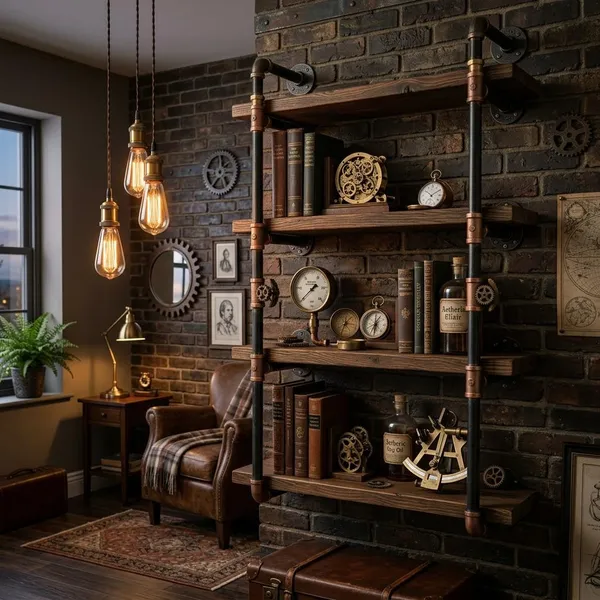
What makes shelves look steampunk
Steampunk shelving usually sits between an old study and a machine workshop. The shelf should feel sturdy enough to be useful, but detailed enough to suggest invention, history, and hand-built character.
Dark wood and aged metal
Dark wood gives the shelf warmth, while aged metal gives it weight. Walnut, stained pine, oak, or reclaimed boards can all work if the grain is visible and the finish does not look too flat. Black iron, gunmetal, antique bronze, and weathered steel usually fit better than shiny chrome.
For a long-term shelf, choose finishes that can handle real use. A sealed wood board is easier to dust and protect than raw timber, and coated metal is usually more forgiving in kitchens, bathrooms, or humid rooms.
Pipe brackets and exposed hardware
Pipe brackets are the quickest visual shortcut to the style, but they still need to look intentional. Use flanges, elbows, bolts, and screws as part of the design rather than hiding them. Before buying, check three things:
- Spacing: supports should not be so far apart that the board may bow.
- Scale: thick pipe can overwhelm a small hallway or desk nook.
- Anchoring: the wall fixing matters as much as the pipe itself.
Brass valves gears and rivets
Brass valves, gears, and rivets add the fantasy-mechanical layer that separates steampunk from plain industrial shelving. They work best as accents, not as decoration scattered everywhere.
Victorian details with industrial structure
Victorian touches soften the harder frame. Curved brackets, shaped board edges, antique-style labels, darker stains, or a slightly ornate side panel can make the shelf feel more collected. If the trim is already decorative, keep the metal frame simpler; if the shelf feels too bare, one refined detail can make it read more clearly as steampunk.
How to choose steampunk shelves
Choose the shelf in this order: wall fit, expected load, mounting method, finish, then decorative details. That priority prevents the most common mistake, which is buying a dramatic shelf that looks good in photos but is too deep, too heavy-looking, or too weak for daily use.
Measure the available wall space
Measure the width, height, and depth of the space before choosing a design. Then check doors, switches, radiators, desks, sofas, and walking paths. A deep pipe shelf may look perfect above a sideboard but feel annoying in a narrow hallway.
Painter's tape is useful here. Mark the shelf outline on the wall and live with it for a day before drilling. In a small apartment or reading corner, a shorter two-tier shelf may look better than a tall unit that visually crowds the wall.
Match the shelf to its intended load
The shelf should be chosen for what it will actually hold, not for the lightest version of the display you imagine on day one.
- For books or kitchenware: prioritize solid boards, close support spacing, and clear load information.
- For light display: slimmer boards and more decorative brackets may be enough.
- For changing use: choose stronger hardware now, because display shelves often become storage shelves later.
Pipe shelves can be strong, but the limit depends on the whole system: board thickness, bracket spacing, anchors, and wall material. Heavy books on weak drywall anchors are not a safe trade-off, even if the pipe looks sturdy.
Choose finishes that suit the room
The finish should connect with the room rather than fight it. In a dark home office, deep wood and black iron can feel rich and deliberate. In a lighter living room, medium wood with antique brass may keep the character without making the wall look too heavy.
Check mounting hardware and capacity
Look closely at how the shelf mounts. Some capacity ratings assume installation into studs or masonry, while lighter anchors may only be suitable for small decor. If the listing does not explain the mounting method, treat that as a reason to be cautious.
For rentals, plaster walls, older homes, or shelves within reach of children, be more conservative. Find the wall structure, use the right anchors for that material, and consider professional installation if the shelf will carry heavy items.
Compare ready-made custom and DIY costs
Ready-made shelves are usually best when you want a quick, predictable option. Custom work makes sense for an awkward wall, a specific pipe layout, or a finish that needs to match existing furniture. DIY is worth considering if you already have basic tools and enjoy sanding, staining, sealing, and careful measuring.
| Option | Best fit | Watch out for |
|---|---|---|
| Ready-made | Standard walls and simple display use | Thin boards, vague capacity claims, weak anchors |
| Custom | Exact size, unusual layout, polished finish | Higher price and longer lead time |
| DIY | Budget control and hands-on styling | Tool costs, uneven finishes, unsafe mounting shortcuts |
Price the full project, not just the board. Include pipe fittings, brackets, screws, anchors, stain, sealer, sandpaper, delivery, and any tools you would need to buy.
How to style steampunk shelves
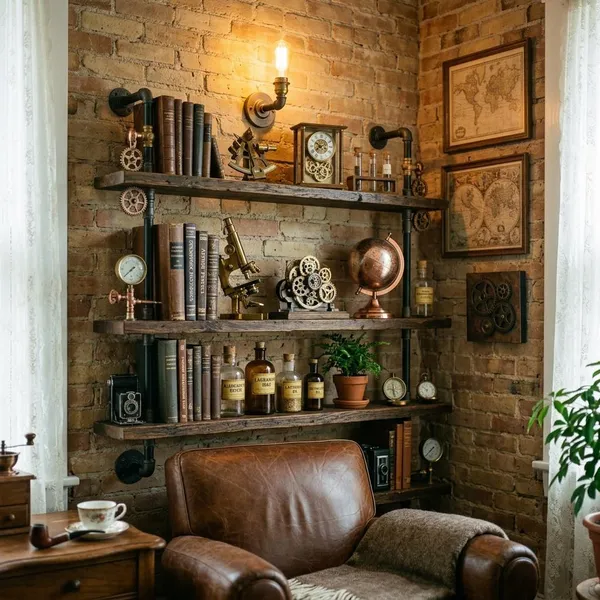
Styling should make the shelf feel collected, not packed. Start with useful objects, add one or two pieces with character, then stop before every surface is filled. The restraint matters because dark wood, iron, and brass already carry a lot of visual weight.
Mix books with vintage objects
Books are a natural base because they add height, texture, and a practical reason for the shelf to exist. Mix them with vintage-style objects such as clocks, globes, old cameras, binoculars, boxes, framed sketches, or small sculptural pieces. Reproduction items and flea-market finds can work just as well as antiques if the colors and materials feel believable.
Add warm industrial lighting
Warm light makes steampunk shelves look more intentional, especially in a dark corner or home office. A small metal lamp, wall sconce, clip light, or discreet picture light can bring out the grain in the wood and the warmer tones in brass.
- For a reading corner: use a directional lamp that also serves the chair or desk.
- For display only: use soft accent lighting rather than a bright task light.
- For a small room: avoid cool blue lighting, which can make the metal feel harsh.
Repeat matching wood and metal finishes
Repeat the shelf finishes elsewhere in the room so the piece does not look stranded. A black metal lamp, a dark frame, or a brass drawer pull nearby can be enough. In a mixed modern room, repeating just one or two materials is usually better than turning every object into a steampunk accessory.
Leave space around statement pieces
Give one object on each shelf visual priority. A large clock, valve sculpture, framed print, or antique camera needs empty space around it so it can actually be seen. This is especially important on deep, dark shelves, where clutter can quickly make the whole wall feel heavy.
Use mechanical accents sparingly
Mechanical accents should act like punctuation. A gauge beside a book stack, a gear-shaped bookend, or a small valve detail can reinforce the theme without shouting it.
If the shelf already has pipe brackets, exposed flanges, and visible bolts, you may not need much more. The strongest displays usually read as steampunk at a glance but still feel like part of a real home.
Conclusion
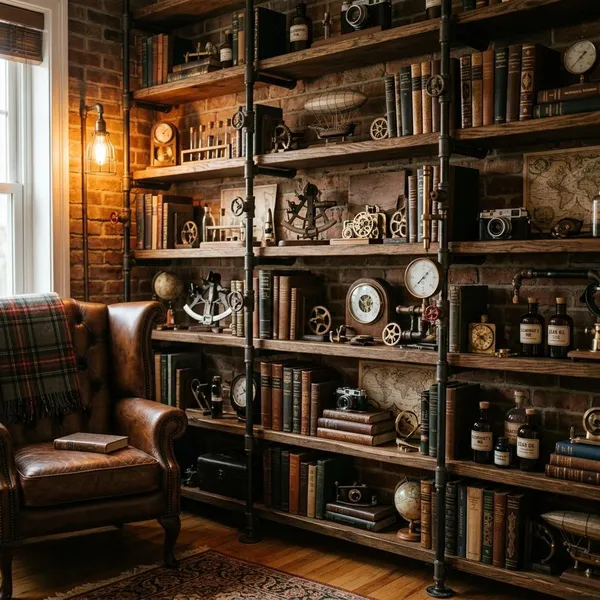
The best choice is the shelf that fits the wall, carries the real load, and uses steampunk details with restraint. Build the practical base first, then add character through dark wood, aged metal, warm lighting, and a few well-chosen accents. That approach creates a shelf that feels distinctive without becoming cluttered, flimsy, or overly theatrical.
FAQ
What makes a shelf look steampunk?
A shelf looks steampunk when sturdy industrial structure is combined with older, more decorative details. Dark wood, black pipe, aged metal, brass accents, exposed hardware, and Victorian-style touches are the usual signals.
Are pipe shelves strong enough for books?
They can be, but only if the boards, brackets, anchors, and wall type are suitable for the weight. For heavy books, do not rely on appearance; check the mounting method and use proper support points.
How are steampunk and industrial shelves different?
Industrial shelves are usually simpler and more utility-focused. Steampunk shelves add a more historical, inventive feel through brass, darker finishes, ornate edges, valves, gears, or other mechanical details.
What makes a shelf look steampunk?
A shelf looks steampunk when sturdy industrial structure is combined with older, more decorative details. Dark wood, black pipe, aged metal, brass accents, exposed hardware, and Victorian-style touches are the usual signals.
Are pipe shelves strong enough for books?
They can be, but only if the boards, brackets, anchors, and wall type are suitable for the weight. For heavy books, do not rely on appearance; check the mounting method and use proper support points.
How are steampunk and industrial shelves different?
Industrial shelves are usually simpler and more utility-focused. Steampunk shelves add a more historical, inventive feel through brass, darker finishes, ornate edges, valves, gears, or other mechanical details.