
If you want a steampunk quilt that looks intentional, start with one strong idea instead of collecting every gear, clock, and brass print you can find. The easiest path is to choose a clear project type, limit the palette, and save the most detailed techniques for the parts people will actually notice.
What makes a quilt steampunk
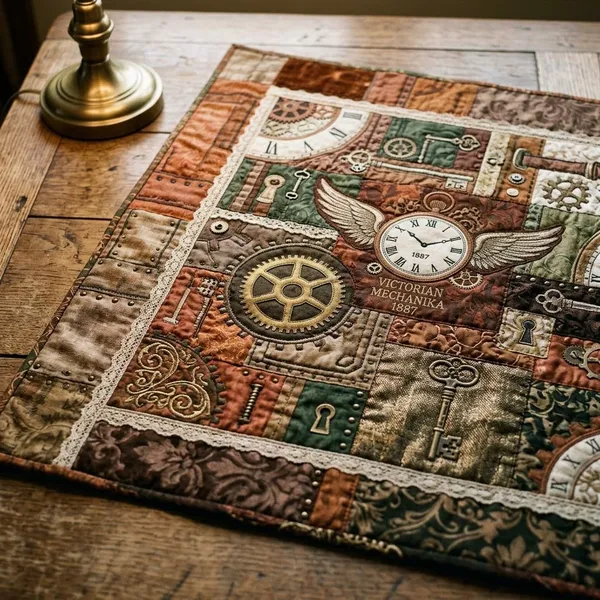
A quilt starts to feel steampunk when Victorian style and mechanical detail work together. The priority is not "more decoration"; it is a readable mix of old-world elegance, machine imagery, dark metal-inspired color, and texture that suggests age or invention.
Before choosing a pattern, make three decisions: the mood, the main motif, and the use of the quilt. A dramatic wall piece can handle dense detail and metallic accents. A washable throw or bed quilt needs a cleaner surface, stronger stitching, and fewer hard embellishments.
Victorian-inspired motifs
Victorian-inspired motifs give the quilt its historical side. Cameos, keys, top hats, lace prints, ornate frames, corset shapes, old script, and dark florals all work well because they soften the industrial look.
Use them as supporting details rather than letting them compete with the main image. For example, a clock medallion with burgundy florals and striped shirting usually reads more clearly than a layout filled with unrelated vintage symbols.
Gears, clocks, and machines
Mechanical motifs are the fastest way to make the theme recognizable. Gears, pocket watches, compasses, sewing machines, cameras, airships, locomotives, and typewriter parts all fit, but scale matters more than quantity.
- Beginner-friendly: one large appliquéd gear, key, or clock face.
- More detailed: a paper-pieced sewing machine, camera, or airship block.
- Best for large quilts: repeated simple cog or compass blocks instead of tiny detailed images.
Brass, copper, and dark tones
Color does much of the work. Good steampunk palettes often include charcoal, black, rust, brown, burgundy, olive, navy, brass, copper, cream, or tea-stained ivory.
Layered textures and aged details
Texture can come from fabric choice as much as embellishment. Distressed cottons, batiks, woven-look prints, faux leather effects, tone-on-tone backgrounds, and subtle metallic prints can create depth without making the quilt bulky.
If the quilt includes detailed motifs, keep the background texture quieter so the shapes remain clear. Save the strongest distressed or metallic effects for borders, accent strips, or areas that do not fight the focal image.
Steampunk quilt ideas by project type
The best design depends on how the quilt will be used. A small wall hanging can be decorative and theatrical. A throw should stay soft and washable. A bed quilt needs larger shapes that still look good when viewed from across the room.
| Project type | Best design choice | What to avoid |
|---|---|---|
| Wall hanging | One bold focal motif with extra stitching or texture | Too many small symbols fighting for attention |
| Throw | Repeating mechanical blocks and durable fabrics | Hard charms or trims where the quilt will be handled |
| Bed quilt | Simple center with themed borders | Tiny novelty details that disappear at bed size |
| Art quilt | Mixed media used around one clear centerpiece | Heavy pieces that distort the hanging surface |
Wall hangings with one bold motif
A wall hanging is the safest place to try a dramatic steampunk idea. Choose one strong image, such as a clock, airship, sewing machine, camera, or oversized gear, and keep the surrounding piecing simple.
This format is especially good if you want metallic thread, layered appliqué, or decorative trims, because the quilt will be viewed more than washed or folded. It is also a good test project before committing to a larger quilt.
Throws with repeating mechanical blocks
Throws work well with repetition. A small set of gear, compass, clock, or key blocks gives the quilt rhythm without making the construction feel endless.
For a throw that will actually be used on a sofa, let fabric, piecing, and quilting carry most of the theme. Metallic-look cottons and dark sashing are safer than real metal charms, especially in areas that will be folded, leaned on, or washed.
Bed quilts with themed borders
A bed quilt usually looks better when the center is calmer and the steampunk detail is pushed into borders, cornerstones, or a medallion area. Large quilts can swallow tiny gears and novelty prints, so bigger shapes and stronger contrast are easier to read.
Art quilts with mixed-media details
Art quilts give you the most freedom: embroidery, appliqué, image transfers, beads, ribbons, paint, faux metal trim, and layered fabrics can all work. The important limit is weight. If an embellishment pulls the surface forward or makes the quilt hard to hang flat, it is probably too heavy.
Best techniques for steampunk quilt patterns
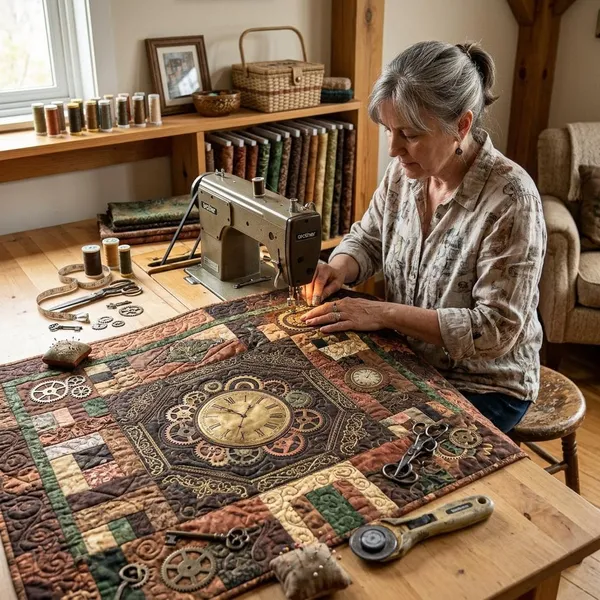
Most steampunk quilt patterns work best when techniques are mixed instead of forced into one method. Use precision where the image needs it, quick methods where the shape is simple, and traditional piecing where the quilt needs structure.
Paper piecing for detailed shapes
Paper piecing is worth using when the motif needs crisp angles or narrow parts. Cameras, sewing machines, robots, letters, clock faces, and small machine components usually look cleaner with this method than with standard piecing.
It does take more time, so it is best saved for one or two feature blocks unless you enjoy detailed foundation work. For a beginner, a single paper-pieced pocket watch in the center can be more satisfying than trying to paper-piece every block in a throw.
Appliqué for bold focal motifs
Appliqué is often the easiest way to add strong steampunk shapes. Gears, keys, top hats, silhouettes, airships, and clock rings can be cut large enough to read clearly and placed exactly where the design needs them.
- Raw-edge appliqué: good for a worn, textured look.
- Turned-edge appliqué: cleaner and more formal.
- Fused appliqué: approachable for bold shapes and beginner projects.
Traditional piecing for structured backgrounds
Traditional piecing gives the quilt breathing room. Nine-patches, strips, checkerboards, medallion settings, and simple borders can hold the design together while the themed motifs do the storytelling.
This is the best choice for larger quilts that need to be finished, washed, and used. A bed quilt does not need every block to be shaped like a gear; the right palette and a few themed focal areas are usually enough.
Embroidery for fine details
Embroidery is useful when a motif needs definition but not more fabric layers. Clock hands, rivets, screw marks, outlines, cracks, labels, and decorative flourishes can all be added with thread.
For a washable quilt, keep embroidery sturdy and moderate. A few stitched highlights will usually survive use better than fragile metallic thread spread across large areas.
How to finish a steampunk quilt
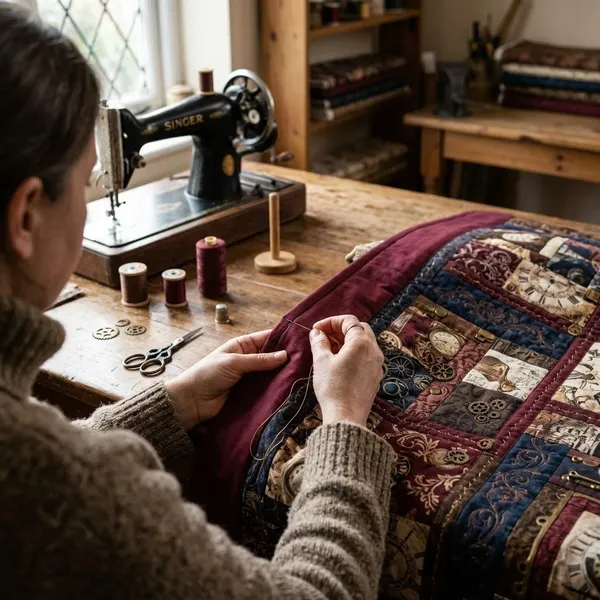
Finishing choices decide whether the quilt feels polished or overworked. Check the intended use first: display quilts can handle more texture and decoration, while everyday quilts need smooth surfaces, secure stitching, washable materials, and comfortable backing.
Before binding, look at the quilt from the distance where it will usually be seen. If the focal shapes are already strong, the finish can be quieter. If the design feels flat, quilting lines or binding color may be the better place to add one last steampunk touch.
Echo the motifs with quilting lines
Quilting lines can reinforce the theme without adding more fabric. Circles can echo gears and clocks, straight channels can feel mechanical, and soft curves can suggest smoke, movement, or airship trails.
Keep dense quilting away from areas where it would flatten appliqué or blur a detailed motif. A small sample sandwich is useful here because metallic-looking thread, dark fabric, and dense stitching can behave differently once layered.
Secure decorative pieces firmly
Charms, trims, buttons, and layered pieces need stronger attachment than ordinary decoration. Stitch them in more than one place when possible, and keep bulky pieces away from areas that will be folded, sat on, or pressed against the body.
For a display quilt, decorative pieces can sit near the lower edge or around a focal motif. For a sofa throw, the same pieces may snag or feel uncomfortable, so stitched fabric versions are usually the better choice.
Choose washable embellishments
If the quilt will be washed, test embellishments before using them. Some metallic trims, novelty buttons, and findings can rust, peel, loosen, or catch on other fabrics.
When durability matters, imitate metal with fabric and thread instead. Metallic-look prints, embroidered rivets, couched cord, and stitched outlines give a similar impression without making the quilt difficult to care for.
Match the binding to the palette
Binding frames the whole quilt, so it should look deliberate. Charcoal, rust, bronze-inspired prints, burgundy, dark brown, or narrow stripes usually fit better than a bright modern fabric that has no connection to the quilt top.
Test binding strips against all four sides before sewing. A stripe can sharpen the edge of a wall hanging, while a quieter tonal binding may be better for a bed quilt with a busy center.
Use a simple backing fabric
A simple backing is often the smartest choice, especially when the front already has strong motifs or specialty fabrics. For throws and bed quilts, choose a soft cotton solid, tonal print, or low-contrast fabric that feels good in use.
Wall quilts can handle a more decorative backing, but it still should not compete with the front. If you are unsure, choose the backing that supports comfort and stability first.
Conclusion
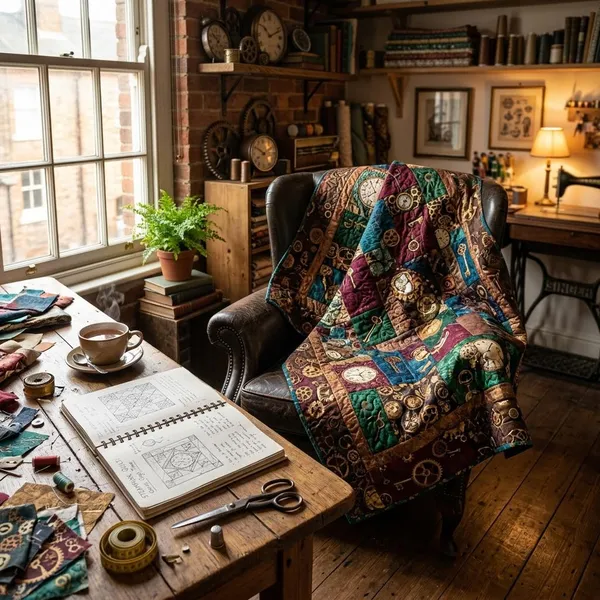
A strong steampunk quilt usually comes from restraint: one clear mood, a controlled palette, and techniques chosen for the project's real use. Start with the item you actually want to make, then decide where detail will have the most impact and where the quilt needs to stay simple, soft, or durable.
FAQ
Can you make a steampunk quilt without paper piecing?
Yes. Use appliqué for gears, keys, and silhouettes, then support the theme with dark fabrics, Victorian prints, embroidery, and simple patchwork.
Are metallic fabrics suitable for everyday quilts?
They can be, but test them first. Wash a scrap, check whether the finish cracks or fades, and avoid scratchy metallic areas on the side that touches the body.
Which steampunk motifs are easiest for beginners?
Large gears, keys, clock faces, top hats, and simple airship silhouettes are the easiest because they stay recognizable without tiny seams or advanced piecing.
Can you add gears and charms to a washable quilt?
Only if they are washable, smooth, and attached securely. For quilts that will be laundered often, fabric appliqué or embroidery is usually the safer version of the same idea.