
If you want steampunk bookends that actually hold books upright, choose for the books first and the decoration second. Weight, base grip, height, and shelf depth matter more than the number of gears on the outside. A good pair should look Victorian-industrial, but it should also stay put when you pull one book from the row.
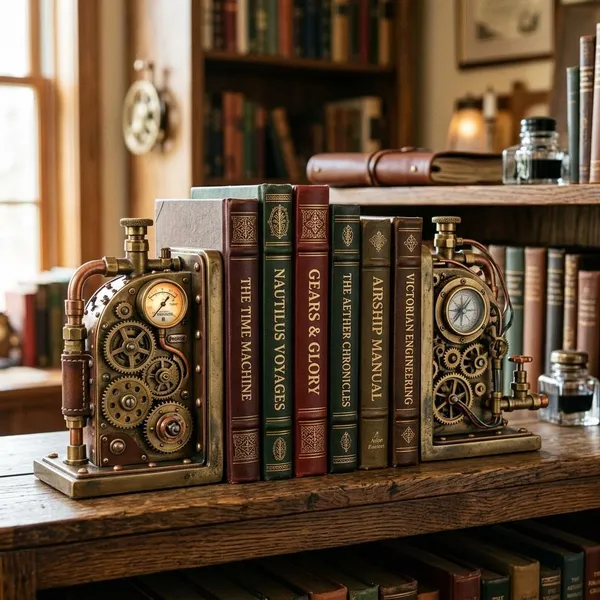
What makes bookends steampunk
Steampunk bookends usually combine old-world elegance with imaginary machinery. The style works well on bookshelves because it already belongs near stories, maps, notebooks, and objects that feel a little collected over time.
Victorian shapes and ornament
Victorian ornament gives steampunk its refined side. Look for arched outlines, scrollwork, filigree, old-library shapes, decorative trim, or carved-looking panels. These details keep the piece from looking like ordinary industrial hardware.
This style is especially easy to use in rooms with dark wood, leather, framed prints, or classic furniture. If your shelf already feels warm and traditional, Victorian shaping usually blends better than sharp, minimal metal forms.
Gears, pipes, and clockwork details
Gears, pipes, valves, bolts, and clock faces are the clearest visual cues, but more detail is not always better. A few well-placed mechanical elements usually look stronger than a crowded surface covered with random parts.
- Good sign: the gears or pipes support the overall shape.
- Warning sign: the decoration sticks into the books or makes the piece wobble.
- Cleaning issue: deep gear clusters collect dust faster on open shelves.
Brass, copper, and aged finishes
Warm aged finishes are often what make steampunk bookends feel convincing. Brass leans classic and library-like, copper feels richer, and dark bronze or blackened metal gives a more industrial look.
Aged finishes are also forgiving. Small scratches, fingerprints, and dust show less on weathered brass or bronze than on shiny chrome. For a shelf you use daily, that matters more than it seems.
Industrial design with a fantasy twist
The fantasy side can show up as airships, mechanical animals, fictional lab equipment, robot figures, or strange clockwork devices. These are the pieces that turn a shelf into more of a display.
Just check the support face before falling for the theme. A mechanical raven or miniature airship can look great, but the book-facing side still needs to be flat enough and tall enough to keep the row from leaning.
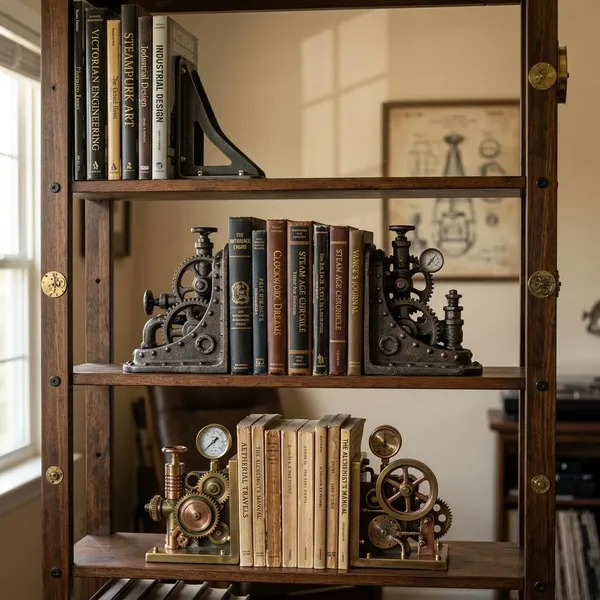
Steampunk bookend styles for different shelves
The right style depends on where the bookends will sit. A deep bookcase with hardcovers can handle heavier, more sculptural pieces. A desk shelf, cubby, or floating shelf usually needs something slimmer and safer.
Cast-iron designs for heavy books
Cast iron is the strongest everyday choice for large hardcovers, cookbooks, reference books, and tightly packed shelves. Its weight helps resist sideways pressure when books are pulled out and pushed back often.
The trade-off is shelf load. On a thin floating shelf or delicate painted surface, cast iron may be too heavy or may scratch if it has rough feet. Felt or rubber pads are worth adding if they are not already attached.
Resin sculptures for detailed displays
Resin is useful when you want dramatic detail: figures, gears, clock faces, creatures, or fantasy scenes. It is often less expensive than solid metal and can look very decorative from a distance.
The weak point is weight. Some resin bookends are hollow, so check whether they have a weighted base or dense construction. For a few novels or display books, weighted resin can be fine; for oversized hardcovers, it is usually not the safest pick.
Metal bookends for compact shelves
Slim metal bookends work well for short shelves, desks, dorm rooms, and apartments where space is limited. L-shaped designs are especially practical because the books sit on the base and help hold it down.
For a steampunk look, choose cutout gears, riveted panels, pipe-like lines, or aged metal finishes rather than bulky sculptures. The result is easier to fit on a narrow shelf while still giving a clear style cue.
Wood designs for warmer interiors
Wood softens the harder mechanical look of steampunk. It works nicely in bedrooms, living rooms, and reading corners where full metal pieces might feel too cold.
Choose solid construction over light decorative blocks. A wooden pair with brass hardware and a low weighted base is more useful than a pretty hollow piece that slides as soon as the books lean.
Mixed-media pieces for collectors
Mixed-media bookends combine wood, metal, resin, glass, faux leather, or found-object details. They often feel more personal and collected than single-material designs.
Inspect how the parts are attached. A layered piece can be excellent if the weight stays low and the decoration is secure. If most of the mass sits high in a sculpture, it may tip more easily than it looks.
How to match bookends to your books
Start with the books that create the most pressure, not the ones that look nicest in photos. A short row of paperbacks needs very different support from a stack of art books or heavy reference volumes.
| Book situation | Best bookend direction | What to check first |
|---|---|---|
| Small paperback row | Light metal, wood, or weighted resin | Non-slip base on the shelf surface |
| Tall hardcovers | Taller support face | Whether the top of the row still leans |
| Art or reference books | Heavy cast iron or weighted metal | Base width and low weight |
| Short shelf or cubby | Compact L-shaped design | Depth before buying |
| Small display collection | Decorative sculptural pair | Flat inner face and stable footing |
Lightweight pairs for paperbacks
Lightweight pairs are usually enough for paperbacks, especially if the row is short and the shelf is not slick. This is a low-risk setup: the books are not heavy, and the goal is mostly to stop slow leaning.
A hidden-base metal design or a small weighted resin pair often works well here. Avoid very tall, top-heavy decorative pieces beside short paperbacks because they can look out of scale.
Taller pairs for large hardcovers
Large hardcovers need height more than decoration. If the bookend only supports the bottom edge, the top half of the books can still fan outward.
As a practical check, look for a support face that reaches a meaningful portion of the book height. Around half the height is often a useful minimum for ordinary hardcovers, while taller books feel steadier with more vertical contact.
Heavy pairs for art and reference books
Art books, atlases, large cookbooks, and reference books deserve the heaviest and most stable option you can reasonably use on that shelf. This is where lightweight decorative pieces often disappoint.
- Choose low weight: mass near the base resists tipping better than a tall sculpture.
- Check the base: a broad bottom spreads pressure more effectively.
- Add grip: rubber pads help on polished wood, glass, or laminate.
Compact pairs for short shelves
Short shelves need bookends that support without stealing usable space. Measure depth before ordering, especially if the design has pipes, gears, or a sculptural front that projects outward.
For a desk or bedside shelf used every day, slim metal is often better than a large decorative pair. It is less dramatic, but it makes grabbing and replacing books easier.
Decorative pairs for small collections
Small collections give you more freedom. If you only want to frame a few favorite novels, journals, or special editions, a sculptural steampunk pair can be chosen partly for mood.
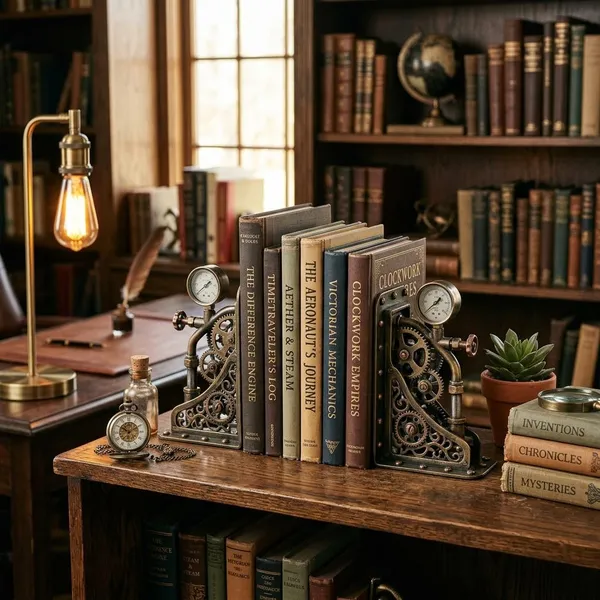
How to style steampunk bookends
Styling steampunk bookends is mostly about restraint. These pieces already have visual weight, so the surrounding shelf should make them easier to notice, not bury them in more objects.
You do not need a fully themed room. A modern apartment, a home office, or a classic reading corner can all handle steampunk if the finishes and nearby materials feel connected.
Match the metal finish to nearby decor
Use the finish as the bridge between the bookends and the room. Aged brass works well with warm lamps and wood shelves, while blackened metal or dark bronze suits industrial shelving and modern darker accents.
If the room has cool chrome or silver hardware, avoid bright copper unless you want contrast on purpose. Mixed metals can work, but they look better when one finish clearly leads.
Pair them with vintage books and clocks
Vintage-style books, a small clock, a weathered journal, or a magnifying glass can support the steampunk mood without turning the shelf into a stage set.
Add wood, leather, or glass accents
Wood, leather, and glass keep steampunk from becoming too heavy. Wood adds warmth, leather adds depth, and glass gives a little reflection against dark metal.
- Wood: good with brass, copper, and old-library styling.
- Leather: useful for journals, boxes, or classic book spines.
- Glass: best as one small accent, not a crowded cluster.
Leave open space around detailed designs
Detailed bookends need breathing room. If gears and pipes are pressed tightly between books, plants, candles, and picture frames, the design becomes visual noise.
A few inches of open space near the outside edge can make the whole shelf look more deliberate. On a small shelf, remove extra decor before sacrificing the space around the bookends.
Use one strong theme across the shelf
Pick one clear direction: old library, industrial workshop, Victorian laboratory, airship fantasy, or dark academic. Mixing too many themes on one shelf usually makes the bookends look like random novelty items.
How to make DIY steampunk bookends
DIY steampunk bookends can look great, but build them like bookends before treating them like art. The base, weight, grip, and flat support face decide whether they work.
This matters most for long-term use. A pair made for a photo or a light display can be more decorative; a pair used on a real reading shelf needs to survive books being moved every week.
Start with a weighted bookend base
Begin with a plain metal L-shaped bookend, a solid wood block, or a simple cast base. Test it with real books before adding decoration.
If it slides, add rubber or silicone pads. If it tips, add low weight such as a steel plate or hidden metal bar. Fixing the structure after painting is much more frustrating.
Plan the mechanical details
Decide on the look before gluing anything down. A clean gear-and-pipe layout usually looks more believable than scattered parts covering every empty space.
- Keep the inner face flat so it presses evenly against books.
- Keep heavy details low to reduce tipping.
- Use medium-size parts because tiny pieces disappear on a shelf.
Attach gears, pipes, and hardware
Use screws, strong adhesive, or both, depending on the materials. Washers, faux gears, pipe fittings, small bolts, and old hardware can all work if they are attached securely.
Try grouping parts into one clear feature, such as a gear cluster around a dial or a short pipe with a valve. Purposeful grouping looks more finished than decoration spread evenly everywhere.
Add paint and an aged finish
Paint helps mismatched parts look like one object. A dark base coat with dry-brushed brass, bronze, or copper on the raised edges gives an aged-machine effect without needing perfect materials.
Do not make every surface shiny. A matte or satin finish usually feels more convincing for steampunk, while bright metallic paint can look toy-like if used heavily.
Seal the surface and add grip pads
Seal the finished surface after the paint is fully dry, then add grip pads underneath. The pads are not a small detail; on smooth shelves, they may be the difference between bookends that hold and bookends that slowly slide.
- Test the plain base with the heaviest books first.
- Add decoration without blocking the flat support face.
- Paint, seal, add grip pads, and test the finished pair again.
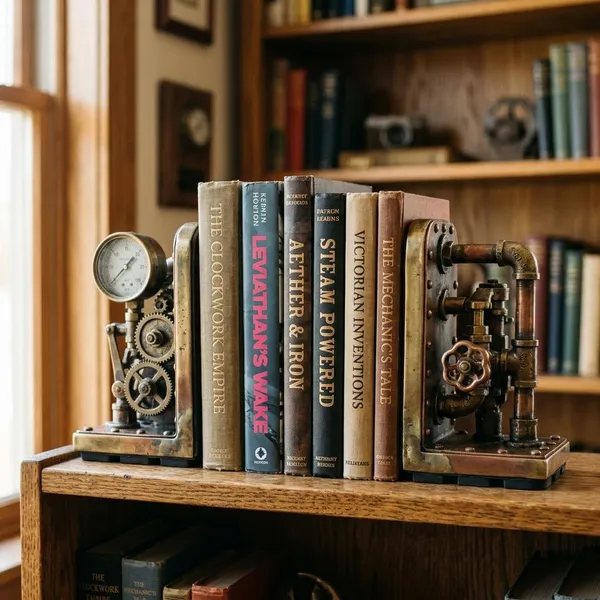
Conclusion
The best choice is the pair that fits your heaviest realistic books, your shelf depth, and the room's finish before it impresses you with decoration. For paperbacks, you can be more flexible; for tall hardcovers or reference books, choose height, low weight, and grip first. Once the support is right, the gears, brass, wood, and fantasy details can do what they should: add character without creating a shelf problem.
FAQ
What is the best material for durable bookends?
Cast iron is usually the safest durable choice for heavy books because it adds real weight and resists bending. Steel can also work well, especially in compact L-shaped designs.
Can steampunk bookends work with modern decor?
Yes, especially if you choose a cleaner shape and a restrained finish such as matte black, dark bronze, or aged brass. Keep nearby decor simple so the bookends feel like an accent, not a costume theme.
Are handmade steampunk bookends worth the price?
They can be worth it when the construction is solid, the base is stable, and the details are securely attached. If the piece is expensive only because it has many decorative parts, check function carefully before buying.
Do bookends need to be heavy to work?
Not always. Light bookends can hold paperbacks or a small display row if the base grips well, but heavy books need more mass, height, and stability to stay upright reliably.