
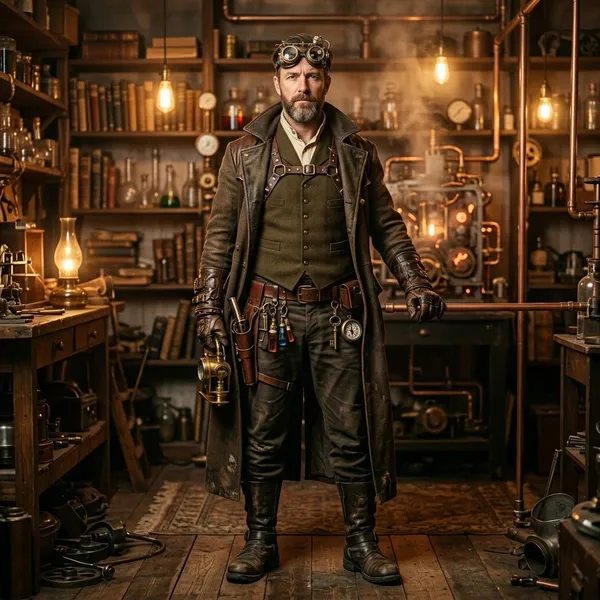
A strong steampunk scientist look should tell people three things quickly: what your character studies, where they work, and what invention or discovery has changed their life. Start with a Victorian-inspired base, add scientific gear that looks useful, then choose one standout prop instead of covering everything in gears.
What makes a character a steampunk scientist?
A steampunk scientist is more than a Victorian outfit with brass accessories. The character should look as if they observe, test, repair, measure, preserve, or experiment in a world powered by steam, clockwork, chemistry, pressure, or strange alternative science.
Victorian scientific clothing
The clothing should give the character a 19th-century shape before the fantasy details appear. Waistcoats, high-collar shirts, fitted jackets, frock coats, aprons, long skirts, corset dresses, tailored trousers, and sturdy boots all work because they create the right silhouette.
For a polished academic, keep the fabrics crisp and the layers neat. For a field scientist, choose tougher textures such as cotton, canvas, wool, leather, or weathered linen. You do not need strict historical accuracy, but you do need to hide anything that looks too modern, such as bright zippers, athletic fabric, or plastic-looking trim.
Experimental tools and props
Tools are what move the costume from "steampunk" to "scientist." Pick props that explain the character's daily work: sample jars for a naturalist, marked bottles for a chemist, calipers for a mechanical researcher, or maps and tags for an expedition scientist.
- Best first choices: notebook, goggles, gloves, flask, measuring tool, small satchel.
- Good field details: labels, specimen bottles, rolled maps, weathered tags.
- Common mistake: carrying too many unrelated props just because they look vintage.
Mechanical inventions
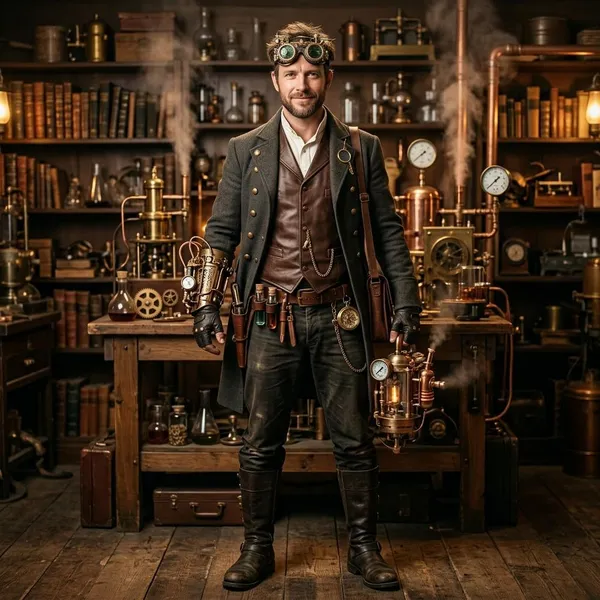
A mechanical invention gives the character a memorable focal point. It might be a brass respirator, a pressure gauge device, a clockwork scanner, a mechanical gauntlet, a diagnostic monocle, or a compact backpack engine.
The invention should solve a problem in the character's world. A scientist exploring toxic ruins might need a filtration rig. A weather researcher could carry a storm meter. A medical specialist may use a clockwork pulse reader. When the device has a purpose, it feels like part of the story instead of decoration.
An inventor-focused backstory
A short backstory helps you decide what belongs on the costume and what does not. You only need a few practical answers: what does the scientist study, where do they work, and what are they trying to prove or fix?
Essential steampunk scientist accessories
Accessories should explain the work, not just fill empty space. Before adding another belt pouch or gear charm, ask whether the item shows protection, measurement, storage, repair, observation, or experimentation. If it does not, it may weaken the look instead of improving it.
For long events, comfort matters as much as style. Lightweight props, secure straps, and safe materials are usually better than heavy metal pieces that pull on the costume all day.
Goggles and protective eyewear
Goggles are not required, but they are one of the fastest ways to signal risk, steam, sparks, fumes, or close-up mechanical work. Wear them over the eyes, on the forehead, around the neck, or fixed to a hat, depending on how practical you want the character to look.
Flasks and specimen bottles
Flasks and specimen bottles are small, readable, and easy to customize. They can suggest medicine, poison, fuel, botanical samples, alchemical compounds, or unstable reagents.
- For crowded venues: use plastic or sealed lightweight bottles instead of fragile glass.
- For better storytelling: add handwritten labels, dates, locations, wax seals, or coded marks.
- For a cleaner character: keep bottles organized in a case rather than hanging everywhere.
Notebooks and rolled blueprints
A notebook is one of the easiest high-value props because it instantly suggests observation and research. A few sketched formulas, field notes, diagrams, or pressed-paper labels can make it feel personal without much cost.
Rolled blueprints work especially well when your character has a larger invention that cannot be carried. If the costume is for photos, let the paper show a diagram or map instead of leaving it as a blank roll.
Mechanical backpacks and tools
A mechanical backpack can define the whole outfit from across the room, but it needs to be wearable. Foam, hollow plastic, faux leather, and painted lightweight parts are often more sensible than real metal, especially for a convention or party where you will be walking for hours.
Add tools only where your hands could actually reach them. Pliers, small wrenches, screwdrivers, shears, and measuring devices look more convincing when they sit in a belt, holster, apron loop, or satchel instead of hanging randomly from every strap.
Pocket watches and measuring devices
Pocket watches, compasses, calipers, rulers, magnifiers, pressure dials, and analog gauges add quiet authority. They are good choices if you want the scientist to feel precise rather than explosive.
Steampunk scientist character ideas
Choosing a character type keeps the outfit from becoming a random collection of vintage-looking things. Once you know the role, you can judge every piece by one simple question: would this scientist actually use it?
Elegant academic researcher
This version is polished, controlled, and best suited to observatories, museums, universities, or private studies. Use a fitted waistcoat, crisp shirt or blouse, structured coat, gloves, dark skirt or trousers, and refined details such as a pocket watch, monocle, star chart, or leather notebook.
Keep the palette composed: navy, burgundy, cream, dark green, antique gold, or brown. Damage should be minimal unless the character has just returned from a failed experiment.
Rugged field scientist
A rugged field scientist should look ready for travel. Think sturdy boots, practical layers, maps, sample jars, gloves, a satchel, faded fabric, patched knees, and dust on the hems. This is a good choice if you want comfort and movement rather than a delicate costume.
Eccentric laboratory inventor
This character can be messy, animated, and slightly unsafe-looking, but the chaos still needs a theme. A stained apron, rolled sleeves, gloves, mismatched tools, scribbled notes, and one half-finished device are usually enough.
- Chemistry angle: colored bottles, stained cuffs, formula pages.
- Clockwork angle: tiny tools, gears, magnifying lens, mechanical assistant prop.
- Energy research angle: coil, gauge, insulated gloves, warning labels.
Mysterious alchemist
A mysterious alchemist sits between science, secrecy, and forbidden experimentation. Deep colors, high collars, layered coats, smoked glass, sealed bottles, coded notebooks, unusual keys, and dark leather work well here.
This style is strongest when it is selective. A few carefully chosen objects can feel more unsettling than a costume overloaded with symbols. If a prop looks too magical, give it a scientific label or measuring device to keep it within the steampunk scientist world.
Clockwork medical specialist
A clockwork medical specialist blends care with machinery. Use structured layers, gloves, instrument cases, clean straps, diagnostic lenses, syringes or safe prop tools, and one medical-looking invention such as a surgical monocle, prosthetic brace, or portable pulse device.
How to create a steampunk scientist outfit
Build the outfit in a practical order: base clothing first, scientific gear second, one signature invention third, then colors, wear, and story. That order prevents the usual problem of buying accessories before knowing what character they belong to.
Choose a Victorian base outfit
Start with the silhouette. A shirt and waistcoat, long coat, apron, tailored trousers, layered skirt, corset-inspired dress, or high-collar blouse will do more for the look than a handful of loose gears.
Add practical scientific gear
Choose gear by imagining one normal workday for the character. What do they need to protect, carry, measure, collect, repair, or record?
| Character situation | Gear that makes sense | What to avoid |
|---|---|---|
| One-night party or Halloween outfit | Goggles, notebook, gloves, one bottle, pocket watch | Heavy backpacks or fragile glass |
| Full convention day | Secure satchel, lightweight tools, comfortable boots | Props that swing, snag, or block movement |
| Photo shoot or stage look | Larger invention, dramatic coat, visible labels and gauges | Tiny details that cannot be seen from a distance |
Pick one signature invention
Choose one centerpiece and let it do the storytelling. A backpack engine, brass respirator, analytical monocle, clockwork arm brace, belt-mounted reactor, or field scanner can make the character memorable without cluttering the whole outfit.
Match the colors and materials
Limit the palette so the outfit looks designed instead of assembled from every steampunk item available. Brass, copper, brown, cream, charcoal, navy, burgundy, forest green, and oxblood are reliable choices.
- Repeat one metal: use brass or copper across goggles, buckles, chains, and tools.
- Repeat one leather tone: match straps, gloves, boots, or satchel where possible.
- Use contrast carefully: one bright liquid or glowing prop stands out more than five competing accents.
Add wear and experiment marks
Wear marks should match the job. A field scientist may have dusty boots, frayed cuffs, and scratched cases. A laboratory chemist might show ink, soot, or stained apron edges. A medical specialist may stay mostly clean but have worn gloves and creased tool straps.
Keep the marks where real handling would happen: sleeve cuffs, pockets, glove fingers, boot toes, belts, bag corners, and tool loops. Random smears can look fake, while careful aging makes even inexpensive pieces feel used.
Build a clear character story
Finish with a short story you can remember easily. Choose the specialty, workplace, goal, and one complication. A two-sentence version is enough for a costume: "Dr. Vale studies storm pressure aboard damaged airships. Her backpack gauge keeps failing, but it is the only device that can predict lightning before it strikes."
This is also the best final check for the outfit. If an accessory does not fit the story, remove it or give it a purpose. A clean, focused character almost always looks stronger than a crowded one.
Conclusion
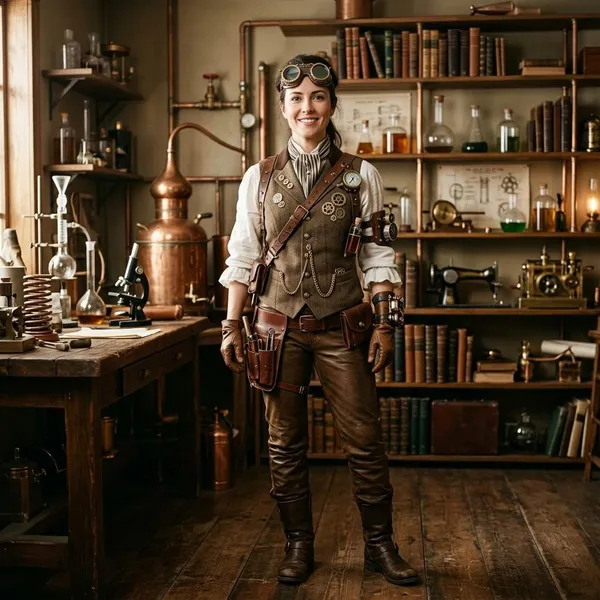
The best steampunk scientist costumes feel purposeful before they feel decorative. If the clothing sets the era, the accessories show the work, and one invention explains the character's obsession, the whole look becomes easier to read and more enjoyable to wear. When in doubt, remove the extra trinkets and make the main idea sharper.
FAQ
Do steampunk scientists always wear goggles?
No. Goggles are useful because they quickly suggest risk and experimentation, but spectacles, a monocle, a face shield, or no eyewear can work if the rest of the outfit clearly shows the scientist's role.
What is the best prop for a steampunk scientist?
The best prop is the one that explains the specialty fastest. For a simple outfit, choose a notebook or flask set; for a stronger cosplay centerpiece, choose one custom invention with a clear purpose.
Can a steampunk scientist outfit be gender-neutral?
Yes. Waistcoats, long coats, trousers, boots, gloves, utility belts, goggles, satchels, and scientific props all work without relying on gendered styling. Focus on silhouette, function, and character role instead.
Do steampunk scientists always wear goggles?
No. Goggles are useful because they quickly suggest risk and experimentation, but spectacles, a monocle, a face shield, or no eyewear can work if the rest of the outfit clearly shows the scientist's role.
What is the best prop for a steampunk scientist?
The best prop is the one that explains the specialty fastest. For a simple outfit, choose a notebook or flask set; for a stronger cosplay centerpiece, choose one custom invention with a clear purpose.
Can a steampunk scientist outfit be gender-neutral?
Yes. Waistcoats, long coats, trousers, boots, gloves, utility belts, goggles, satchels, and scientific props all work without relying on gendered styling. Focus on silhouette, function, and character role instead.