
Post apocalyptic steampunk works best when the steam-age machinery is not just decoration, but the thing keeping people alive after collapse. The fastest way to recognize it is to look for scarcity: patched boilers, salvaged parts, fuel rationing, ruined cities, and factions fighting over the few machines that still work.
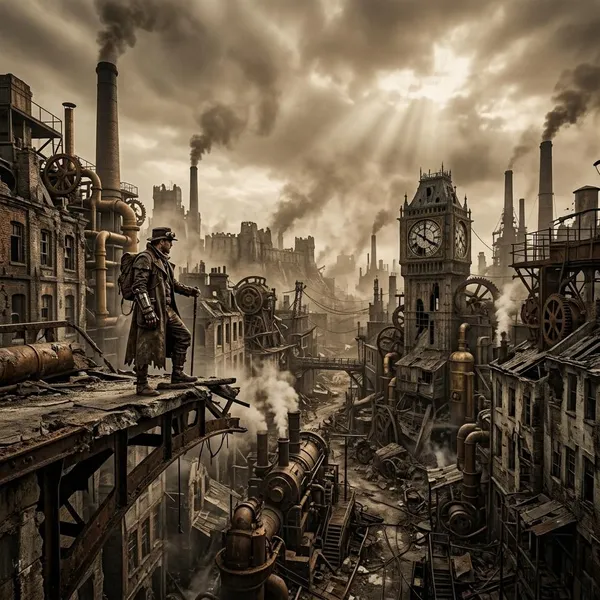
What defines a post-apocalyptic steampunk world
A post-apocalyptic steampunk world is built around one simple tension: civilization has broken, but older industrial technology still matters. Steam engines, pressure systems, rail machinery, furnaces, workshops, and hand-built mechanical devices become practical survival tools rather than elegant inventions.
Steam power keeps society running
Steam power should feel necessary. A city may depend on one central generator for heat, a wasteland town may survive because its pump still draws water, or a convoy may exist only because its patched engines can still pull weight across dead roads.
Salvage replaces mass production
After collapse, people rarely have clean factories and reliable supply chains. They strip dead locomotives, abandoned mills, crashed airships, and ruined workshops for valves, gauges, copper, gears, plates, and usable tools.
- Good sign: machines look assembled from different sources.
- Weak sign: everything looks newly built despite the world being ruined.
- Useful detail: a small part, like a pressure seal or pump valve, can be more valuable than money.
Fuel and resources shape daily life
Fuel is often the real ruler of the setting. Coal, wood, peat, oil substitutes, scrap timber, or whatever else feeds the boilers determines who travels, who stays warm, and which settlements matter.
For a frozen city, heat rationing may shape class and law. For a desert rail outpost, water and condenser maintenance may matter more than coal. The resource pressure should change behavior in visible ways: shorter trips, guarded fuel stores, strict workshop access, or trade routes built around refueling points.
Rust and decay dominate the aesthetic
Rust, soot, cracked lenses, patched coats, blackened chimneys, and mismatched metal all fit the look, but they should point to use rather than costume. A repaired engine tells a better story than a spotless brass machine with random gears attached.
Clothing follows the same rule. Masks, gloves, heavy boots, layered coats, and tool belts make sense when people live around smoke, cold, grit, hot pipes, and unstable machinery. The aesthetic works when every object looks like it has survived weather, labor, and repair.
Factions compete for working technology
When manufacturing is weak, existing technology becomes power. A faction that controls the rail line, generator hall, water pumps, or only trained boiler crew can control food, travel, heat, and safety.
Post-apocalyptic steampunk vs regular steampunk
Regular steampunk often treats technology as progress, spectacle, invention, or social change inside a functioning world. Post-apocalyptic steampunk starts after that confidence has failed. The machines are still impressive, but now they are old, dangerous, and tied to survival.
| Question to ask | Regular steampunk | Post-apocalyptic steampunk |
|---|---|---|
| What does technology represent? | Ambition, invention, expansion | Survival, repair, dependency |
| What is scarce? | Status, opportunity, political power | Fuel, parts, heat, water, safe transport |
| What does a machine failure cause? | Delay or embarrassment | Death, unrest, evacuation, collapse |
Survival vs technological progress
In regular steampunk, a new engine or airship often suggests possibility. In a post-apocalyptic version, the same kind of machine is judged by whether it keeps people alive. A generator matters less because it is clever and more because the settlement freezes without it.
Repair vs invention
Repair is the heartbeat of the post-collapse version. Characters patch pipes, rebuild pistons, straighten damaged rails, and adapt old components because starting from scratch is usually impossible.
Invention can still exist, but it should come from constraint. A mechanic might build a water purifier from boiler scrap and cracked pressure gauges, not from a perfect laboratory with unlimited materials. That difference keeps the setting from sliding back into ordinary steampunk.
Scarcity vs industrial abundance
Traditional steampunk can have poverty and class conflict, but it usually assumes that factories, foundries, investors, rail networks, and workshops still operate. Post-apocalyptic steampunk removes or damages that base.
Broken cities vs thriving metropolises
Regular steampunk loves grand capitals, ports, stations, laboratories, and crowded industrial streets. Post-apocalyptic steampunk turns those spaces into evidence of failure: frozen avenues, collapsed bridges, dead factories, sealed districts, and stations used as shelters.
Fragile societies vs established institutions
Governments, guilds, newspapers, armies, and universities may still exist in regular steampunk because society has enough stability to support them. After an apocalypse, institutions survive only if they control something practical.
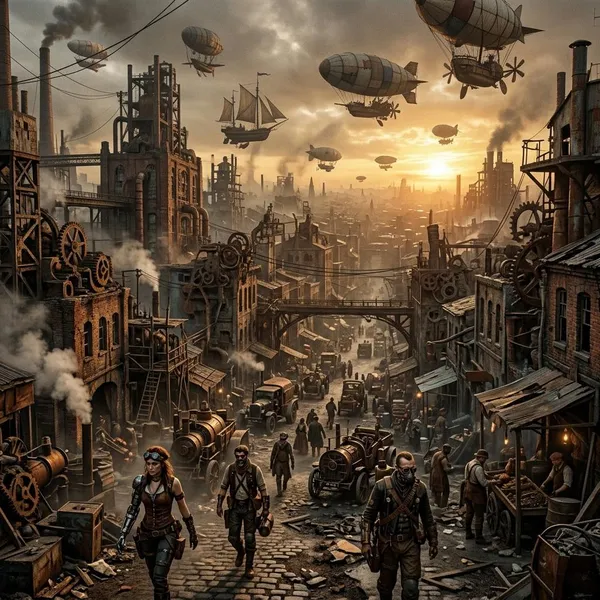
Common post-apocalyptic steampunk settings
The setting should create pressure, not just atmosphere. A frozen city makes heat political. A wasteland settlement makes fuel and water urgent. A moving fortress turns maintenance into survival. Pick the environment first, then make the machines answer a real problem inside it.
Frozen industrial cities
Frozen industrial cities are especially effective because heat becomes the main survival question. The best-known example is Frostpunk, where the generator is not background scenery; it shapes labor, law, housing, medicine, and moral compromise.
This setting works well for stories about class and governance. People closer to heat, food, and maintenance crews will usually have more security than those pushed to the edge of the city. If you want a harsh, civic, pressure-cooker version of the genre, this is one of the clearest choices.
Steam-powered wasteland settlements
A wasteland settlement shifts the focus from cold to distance, dust, corrosion, and exposure. These communities often grow around a pump station, rail spur, water tower, coal store, or machine depot that still functions well enough to support trade.
- Best for: travel stories, traders, scavengers, frontier politics.
- Main pressure: fuel, water, spare parts, safe routes.
- Common mistake: making travel easy when every journey should cost resources.
Mobile towns and moving fortresses
Mobile towns and moving fortresses make the whole settlement dependent on engines. Mortal Engines takes this to an extreme with cities that move across a ruined world, but the basic idea also works on a smaller scale: a crawler town, armored train, steam convoy, or floating industrial platform.
This is a good scenario when you want social hierarchy built into the machine itself. Upper decks may get cleaner air and better views, while engine levels deal with heat, noise, smoke, and danger. The layout can show class without needing long explanations.
Ruined factory districts
Ruined factory districts are ideal for tighter stories. Foundries, rail yards, warehouses, machine halls, and collapsed workshops offer shelter and salvage, but also unstable floors, toxic residue, old security systems, and rival claimants.
Fortified survivor colonies
Fortified colonies focus on walls, rationing, maintenance, and social order under pressure. They usually form around one key asset: a generator, mine, greenhouse, repair yard, rail hub, or water system.
The useful question is not only "what are they keeping out?" but "what are they trying to keep running?" A colony can look secure from the outside while being one broken furnace, failed crop, or missing pressure part away from panic.
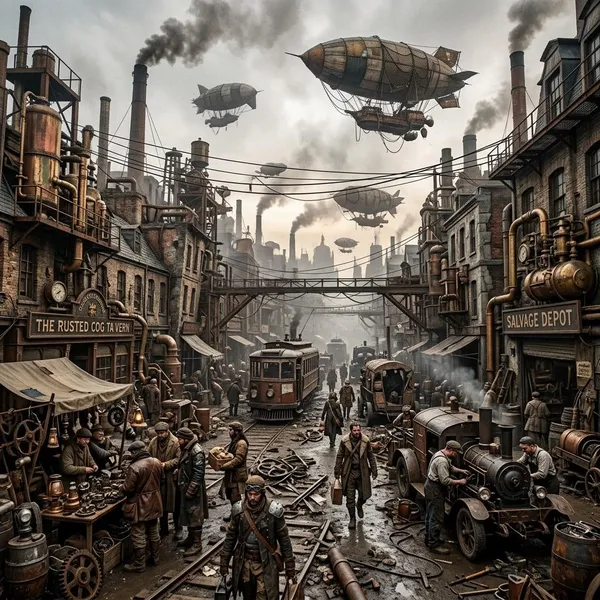
How to build a post-apocalyptic steampunk world
Start with the survival system before adding the visual style. Brass, goggles, rivets, and smokestacks help the mood, but the world becomes believable when the reader understands what collapsed, what still works, and what people must protect first.
Decide what caused the collapse
The cause of collapse should leave daily consequences. A volcanic winter creates cold, ash, crop failure, and dependence on heat. A war leaves wrecked rail lines, damaged factories, distrust, and unexploded danger. A plague may empty districts while leaving machines intact but understaffed.
You do not need pages of history. You do need a clear link between disaster and routine life: where people live, what they fear, what they ration, and which old places they avoid.
Define what technology survived
Choose limits on purpose. If airships still work, trade and politics may remain regional. If only rail survives, routes become predictable and contested. If stationary boilers work but vehicles do not, settlements become more isolated and defensive.
- Still works: the systems society depends on now.
- Can be repaired: the source of quests, jobs, and conflict.
- Permanently lost: the boundary that keeps the world post-apocalyptic.
Make fuel and resources matter
Do not leave resources as background flavor. Show the consequences: ration cards, guarded coal sheds, refueling queues, scavenging permits, workshop arguments, or a journey delayed because the boiler crew cannot spare parts.
For a game world, resource pressure can guide player choices. For a novel, it can shape moral choices. A town with only a few days of fuel left creates a stronger decision than a vague statement that "supplies are low."
Build factions around survival
Functional factions feel more convincing than costume-based factions. A salvage union, heat ministry, rail guard, water-tender order, boiler cult, or convoy syndicate immediately tells the reader what that group controls and why others need them.
Give each faction a practical argument for its power. A severe rail militia may protect trade routes. A secretive engineer guild may prevent dangerous repairs by untrained workers. A rebel group may be right about fairness but wrong about how fragile the machines are.
Let repaired machines show their history
The best machines look as if they have been used, damaged, claimed, repaired, and argued over. A locomotive with mismatched plates, handwritten pressure warnings, replacement gauges, and a patched boiler casing says more than a perfect decorative engine.
This also keeps the aesthetic from becoming generic. Repair marks show scarcity. Good maintenance can signal wealth or discipline. Dangerous improvisation can reveal desperation. Let important objects carry visible history.
- Pick one collapse cause. Tie it to climate, transport, food, or trust.
- Choose one key survival machine. Make people depend on it.
- Name the bottleneck. Fuel, water, parts, labor, or knowledge should be limited.
- Give control to someone. That person or faction becomes politically important.
- Show repair history. Let machines look patched, claimed, and imperfect.
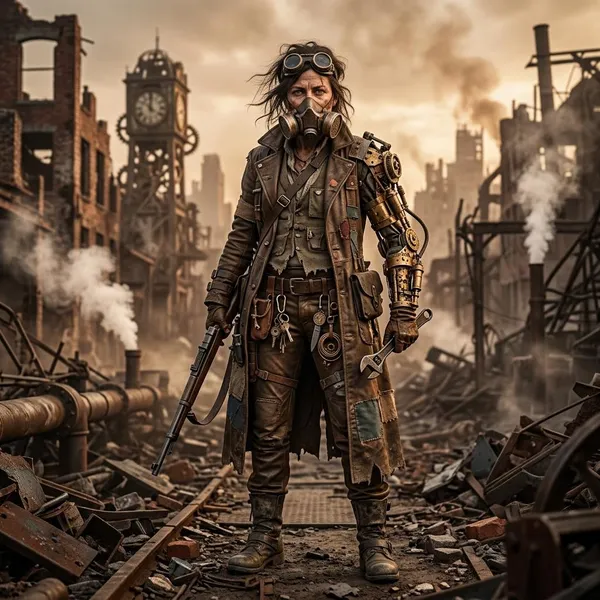
Characters that fit post-apocalyptic steampunk
Characters fit this subgenre best when their role connects to survival systems. In a world built on fragile machines and scarce resources, the most interesting people are often the ones who can find parts, keep engines alive, move goods, or decide who gets access to heat and transport.
Salvage engineers
Salvage engineers make strong protagonists because they turn wreckage into usable systems. They can identify valuable parts, stabilize damaged machinery, and improvise repairs when the correct tools are gone.
Steam mechanics
Steam mechanics live close to danger: pressure, heat, leaks, worn seals, and machines that can kill people when neglected. They know the real condition of a settlement better than most leaders because they see what is about to fail.
- Good viewpoint for: hidden risks and class boundaries.
- Useful access: engine rooms, elite compounds, public workshops, military depots.
- Natural tension: they may know a machine is failing before anyone wants to admit it.
Wasteland traders
Wasteland traders bring movement into an otherwise isolated world. They carry fuel, medicine, maps, rumors, pressure parts, and news between settlements that may not fully trust each other.
Machine hunters
Machine hunters search dead cities, wreck fields, factory belts, and sealed depots for usable technology. They work well when the old world is still dangerous: unstable floors, toxic dust, trapped pressure systems, rival claims, or laws against entering certain ruins.
They are useful for revealing history without long exposition. A recovered gauge, half-working engine, or sealed workshop can show what the world used to value and why the present society is desperate to reclaim it.
Faction leaders
Faction leaders should control something concrete. Heat, rail access, water, food production, repair training, salvage rights, or fuel distribution gives them real authority after collapse.
The most interesting leaders are not simply villains or heroes. One may enforce brutal rationing because the numbers are genuinely bad. Another may promise freedom while ignoring maintenance reality. Their power works best when it exposes the central question of the genre: who should control the technology everyone needs?
Conclusion
Post-apocalyptic steampunk is strongest when every stylish detail has a survival reason behind it. If steam power keeps people warm, salvage changes the economy, fuel shapes politics, and repaired machines carry visible history, the world feels more than decorative; it feels like a society holding itself together one dangerous fix at a time.
FAQ
Is post-apocalyptic steampunk a real subgenre?
Yes. It is a recognized hybrid that combines steampunk machinery and industrial-era style with post-apocalyptic collapse, scarcity, salvage, and survival stakes.
Is Frostpunk post-apocalyptic steampunk?
Yes. Frostpunk is one of the clearest examples because steam-powered heat, fuel, labor, and social control are central to survival after a climate disaster.
How is post-apocalyptic steampunk different from dieselpunk?
Post-apocalyptic steampunk leans on boilers, steam pressure, coal, pistons, and Victorian-industrial imagery. Dieselpunk usually draws from oil, combustion engines, military machinery, and early 20th-century design.
Can steampunk also be dystopian?
Yes. Steampunk can be dystopian through authoritarian rule, class exploitation, pollution, or oppressive industry even without an apocalypse. The post-apocalyptic version adds a major collapse on top of those tensions.