
A good steampunk fantasy race should feel as if the age of steam changed how its people live, work, dress, suffer, and gain power. Start with the pressure point first: are they shaped by factories, airships, empire, alchemy, class, or machine-made bodies? If the race would work almost unchanged in a medieval forest kingdom, it probably needs a stronger reason to exist in a steampunk world.
What makes a fantasy race feel steampunk?
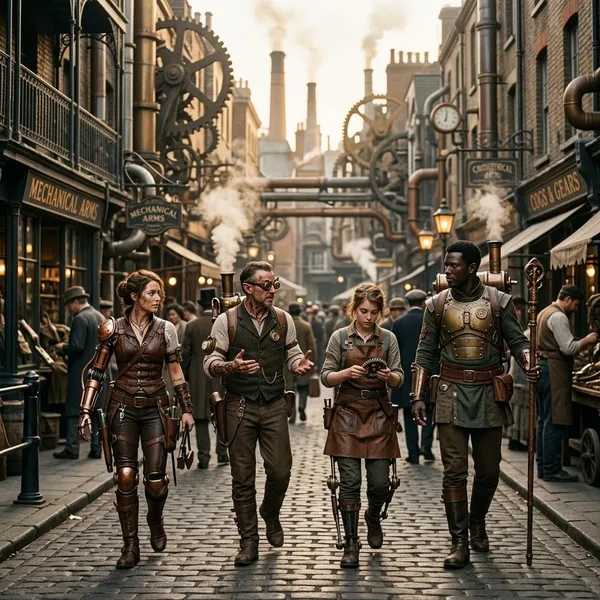
A fantasy race feels steampunk when its identity grows from industrial life instead of wearing brass decoration on top of standard fantasy traits. The first thing to check is not whether the race has goggles or gears. Check whether steam-age technology changes its homes, jobs, social rank, body, education, and conflicts.
Industry shapes daily life
Industry should affect the boring parts of life as much as the dramatic ones. A foundry-born people might measure adulthood by surviving a first furnace shift, while a canal-dwelling race may build homes around locks, pumps, and foghorn schedules. These details make the race feel lived in rather than painted onto the setting.
Technology changes the body
Steampunk technology becomes more interesting when it touches the body. Mechanical lungs, pressure goggles, brass fingers, boiler-cooled skin plates, or clockwork prosthetics can show how the race survives its environment. The important question is: did they choose these changes, need them, inherit them, or have them forced on them?
Magic interacts with machines
Magic does not have to replace engineering. It can make engineering stranger, more expensive, more dangerous, or more political. A race might stabilize aether engines through song, bind ancestor-spirits into locomotives, or refine spell residue into fuel.
Give that magic a practical limit. Maybe only trained ritual mechanics can use it safely. Maybe poor districts rely on black-market charms because official aether lines serve rich neighborhoods first. A clear limit keeps the race useful without turning it into a solution for every problem.
Class and empire shape society
Steampunk usually feels stronger when it admits that progress has winners and losers. Decide where the race sits in that system: owners, workers, colonized subjects, military recruits, smugglers, scholars, migrants, or rebels. Their place in society should affect how others speak to them and what choices are open to them.
Victorian design supports the setting
Victorian-inspired design works best when it has a job to do. Brass, leather, velvet, lace, glass, iron, engraved tools, and tailored coats can all fit, but they should reveal occupation and rank. A boiler mechanic does not dress like an aether diplomat unless that contrast is part of the story.
Classic fantasy races in steampunk settings
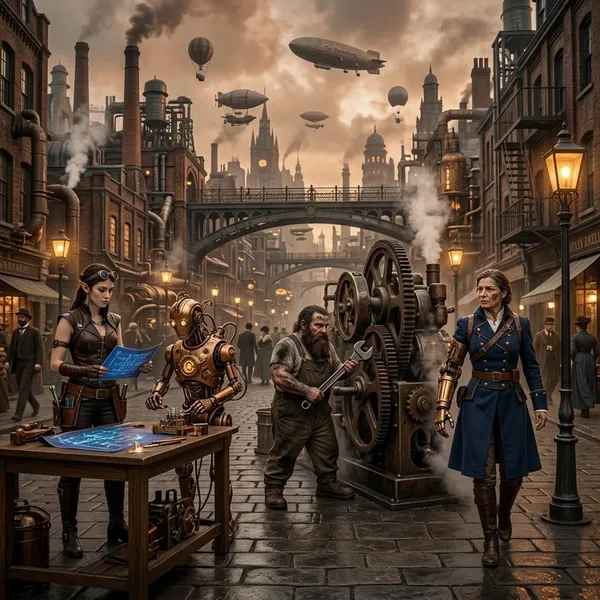
Classic fantasy races can work in steampunk, but they need to be rebuilt around modernizing pressure. Keep the recognizable core, then ask what factories, patent law, mass transport, imperial expansion, and machine magic would do to that culture over generations.
This is useful when you want readers or players to understand the race quickly. Dwarves can still value craft, elves can still carry old knowledge, and goblins can still be clever survivors. The twist is that their familiar traits now have industrial consequences.
Dwarves as engineers and foundry clans
Dwarves are one of the easiest races to move into steampunk because metal, stone, heat, and craft already belong to their usual identity. The scale changes. Instead of one master smith making a legendary axe, a dwarf clan might control rail forges, armored train factories, bridge works, or furnace temples that supply an empire.
Elves as aether scholars and elites
Elves often need a sharper adjustment because forest mysticism can clash with soot and iron. One strong option is to make them experts in aether theory, star navigation, old magical engines, or long-term imperial planning. Their long lives give them institutional memory, which can be a gift or a tool of control.
Use elegance carefully. Polished manners, observatories, silver instruments, and old universities can look beautiful while hiding class barriers. An elven elite may argue that dangerous knowledge must be "managed responsibly," while workers hear that as another way to keep power locked behind academy doors.
Gnomes as inventors and mechanics
Gnomes fit the workshop side of steampunk naturally, especially if their culture values repair, miniaturization, clever failures, and practical invention. Give them useful everyday work: lift mechanisms, medical devices, locks, pumps, clock regulators, prosthetic joints, and portable heaters.
Goblins as salvagers and saboteurs
Goblins work well in the spaces polite society ignores: boiler rooms, scrap markets, storm drains, rail cuts, abandoned stations, and collapsed factory wards. As salvagers, they know the hidden value of broken things. As saboteurs, they know exactly which bolt stops a machine without destroying the whole city.
- Low-risk use: make them clever recyclers, tunnel guides, repair crews, and black-market traders.
- Darker use: connect sabotage to labor abuse, forced evictions, monopolies, or military occupation.
- Common mistake: do not make "goblin chaos" their whole culture. Give them rules, trade customs, debts, and loyalties.
Orcs as workers, soldiers, or rebels
Orcs become more compelling when strength is treated as something society exploits. They may be dock workers, furnace haulers, colonial soldiers, railway guards, strikebreakers, union organizers, or rebels who understand the machinery of empire because they helped build it.
Internal variety matters here. Some orcs might be decorated officers or factory managers. Others may be trapped in dangerous contract labor. That split lets you write orcs as people under pressure, not a single block of angry muscle.
Original steampunk fantasy race ideas
Original races give you more freedom because you are not repairing old fantasy assumptions. The risk is that a new race can become one striking image with no life behind it. Start with a strong concept, then connect it to labor, survival, power, and conflict.
Brass-bodied people powered by memories
These people could live in artificial brass bodies animated by preserved memories, emotional residue, or ancestral recollection. Their culture would naturally care about archives, testimony, funerary recordings, stolen memories, and the craft of keeping identity intact.
The conflict is immediate: who owns memory? A rich family might buy elegant, stable bodies filled with curated ancestry, while poorer citizens rent damaged shells powered by fragments they do not fully understand. That gives the idea both a visual hook and a social wound.
Skyborn clans bonded to aether creatures
Skyborn clans might live in tethered cities, storm towers, or airship caravans, surviving through bonds with aether creatures that sense pressure shifts and invisible currents. Their value is obvious in an air-travel world, which also makes them vulnerable to contracts, kidnapping, military recruitment, or marriage politics.
Underground workers with mechanical limbs
This race could come from tunnel cities where mining, geothermal rail work, or deep-furnace labor made mechanical limb replacement common. Over time, prosthetics become more than medical devices: drilling arms, wire-finger hands, pressure-jointed legs, and heatproof shoulder mounts show trade, age, and family craft.
- If workers own the limbs: the race can build pride, artistry, and guild power around modification.
- If employers lease the limbs: the body becomes part of the debt system.
- If limbs are inherited: repairs, upgrades, and funeral customs become deeply emotional.
Alchemical beings created for dangerous labor
An alchemical race created for toxic refineries, plague disposal, acid handling, or unstable fuel work gives you a strong ethical center. Their bodies may resist poison or heat, but that does not mean they should be treated as disposable.
The most useful question is whether they are still being made. If new individuals are manufactured under guild license, the story leans toward legal personhood and industrial abuse. If they now reproduce or form families independently, the conflict may shift toward citizenship, inheritance, housing, and fear from the people they protect.
Chimeras escaping imperial laboratories
Chimeras suit a darker steampunk world where science, magic, and empire have crossed a moral line. They may carry engineered traits from animals, humans, spirits, or machines, but their real identity should not be "mixed body parts." It should be survival after being designed as property.
How to create a steampunk fantasy race
To create a strong race, begin with function before appearance. Decide where the people come from, what industrial role they fill, how much power they can actually use, and what conflict makes their place in the world unstable. The brass, masks, coats, and machinery should come after those choices.
Choose its origin and environment
Pick an origin that leaves marks. A race from polluted capitals will not behave like one from desert rail towns, storm platforms, fungus-lit tunnels, or alchemical vats under a university. Environment should shape lungs, posture, clothing, food, architecture, taboos, and fears.
Define its role in industry
Give the race a practical place in the economy. What do they mine, build, repair, refine, transport, guard, invent, or regulate? A race becomes easier to write when you know what other groups need from them.
- Essential labor: they keep engines, railways, refineries, ships, or power grids running.
- Special knowledge: they control maps, formulas, rituals, patents, or repair traditions.
- Exploited skill: society praises their usefulness while limiting ownership or rights.
- Hidden work: they do the dangerous jobs behind a glamorous public industry.
Set its access to power
Power is not only magic strength. It can mean patents, votes, land, guild membership, military rank, fuel access, school admission, repair licenses, or the right to own a workshop. Decide what your race can reach and what is blocked.
Build its beliefs and social rules
Beliefs should grow from life under pressure. A mining people may value silence because loose rock speaks before it falls. A skyfaring race may treat unsecured clothing as rude because it can kill someone on a rigging line. A memory-powered people may consider careless storytelling almost obscene.
Small rules often do more than grand mythology. Decide how they greet workers returning from dangerous shifts, what they refuse to sell, what counts as a good marriage, which tools are inherited, and how they treat broken machines. Those choices make the race feel like a culture rather than a concept sketch.
Create a clear visual identity
Build the look from purpose. Heat workers might wear vented coats, ceramic glove plates, and burn charms. Aether scholars may carry glass instruments and ink-stained cuffs. Brass-bodied people may display memory cores, engraved family plates, or repair seams they choose not to hide.
Add a setting-specific conflict
Give the race a problem that could only happen in your world. A fuel shortage, patent ban, imperial draft, factory lockout, stolen spirit engine, housing law, or broken treaty will feel stronger than a vague "they are misunderstood" conflict.
- Write the plain version first. Name what the race is, where it came from, and what problem defines it.
- Check five categories. Body, work, belief, style, and social position should all connect.
- Test ordinary scenes. Travel, meals, clothing, illness, funerals, and arguments reveal weak spots fast.
- Give them two relationships. Add one useful alliance and one serious tension with another group.
Conclusion
The best steampunk race is not the one with the most gears; it is the one that would fall apart if you removed the engines, factories, air routes, class rules, or strange science from the setting. Build from pressure first, then let the appearance follow. When a people has work to do, power to fight over, habits shaped by daily danger, and a conflict tied to the world's machinery, the design starts to feel real instead of decorative.
FAQ
Does a steampunk fantasy race need magic?
No. Magic is optional. A race can feel fully steampunk through engineering, labor, fuel, patents, urban life, empire, and body modification, as long as those forces shape its identity.
Should a setting use fantasy races or species?
Use the term that fits your audience and tone. "Race" is common in older fantasy language, while "species," "people," "folk," or a setting-specific word may feel more precise or less loaded.
How many races should a steampunk world include?
Use as many as you can develop with purpose, but fewer usually works better. Two to five well-connected groups often create more tension, history, and reader memory than ten shallow ones with only costumes and names.
Does a steampunk fantasy race need magic?
No. Magic is optional. A race can feel fully steampunk through engineering, labor, fuel, patents, urban life, empire, and body modification, as long as those forces shape its identity.
Should a setting use fantasy races or species?
Use the term that fits your audience and tone. "Race" is common in older fantasy language, while "species," "people," "folk," or a setting-specific word may feel more precise or less loaded.
How many races should a steampunk world include?
Use as many as you can develop with purpose, but fewer usually works better. Two to five well-connected groups often create more tension, history, and reader memory than ten shallow ones with only costumes and names.