
The right steampunk pen should look mechanical and distinctive, but it still has to fit the way you write. If you want something for daily notes, start with comfort, refill type, and mechanism before choosing the most dramatic design. If it is mainly a gift, display piece, or maker project, you can give more weight to materials, finish, and visual character.
What makes a pen steampunk?
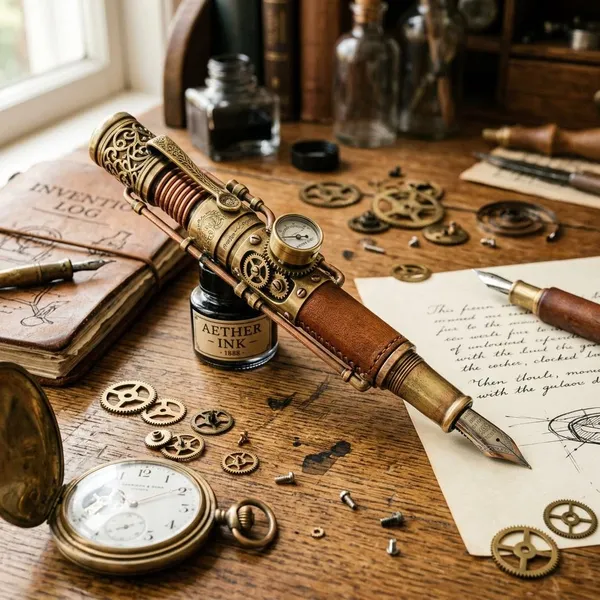
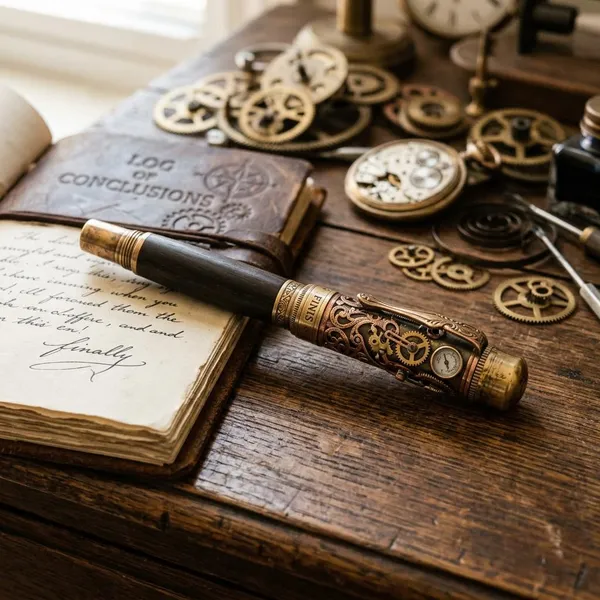
A pen feels steampunk when it mixes a usable writing tool with retro-industrial details: aged metal, visible mechanics, workshop-like hardware, and a hint of Victorian ornament. The best designs do not just glue gears onto a barrel. They make the pen look as if it belongs on an inventor's desk while still feeling comfortable in the hand.
Industrial metal details
Rivets, screw heads, pipe-like bands, chunky clips, and machined textures give the pen its industrial character. These details should look intentional rather than randomly attached. A good check is simple: if a raised part sits where your fingers rest, or if the clip looks like it would catch on fabric, the design may be better for display than regular writing.
Brass and copper finishes
Brass, copper, gunmetal, pewter, and antique plating are common because they create an aged machine-shop look. For a pen you plan to carry often, muted antique finishes are usually easier to live with than bright polished metal because small marks and fingerprints show less.
Look closely at the edges in product photos. Even an "aged" finish should feel smooth and deliberate, not rough, flaky, or patchy around the grip and cap area.
Gears and watch parts
Gears and watch components are the quickest visual shortcut to steampunk, especially when they are embedded under resin or built into the barrel. Embedded parts are usually safer for frequent use because they do not snag in a pocket or loosen as easily. Exposed gears can look striking, but they make more sense for a desk pen, collector piece, or gift that will be handled carefully.
Mechanical actions
The mechanism is part of the fun. Bolt-action pens, twist pens, and pump-style clicks all suit the theme because they make the pen feel like a small machine rather than a plain writing tool.
- Daily use: choose a smooth bolt or twist action that locks securely.
- Pocket carry: avoid loose mechanisms that might open in a bag.
- Display or occasional use: a more theatrical action can be worth it, even if it is less practical.
Victorian-inspired styling
Victorian styling softens the industrial side with scrollwork, ornate clips, feather shapes, engraved trim, or antique desk-accessory details. This is what keeps the pen from looking like a hardware-store novelty. For gifts, that balance matters: a pen with both machinery and elegance usually feels more thoughtful than one overloaded with gears.
Popular types of steampunk pens
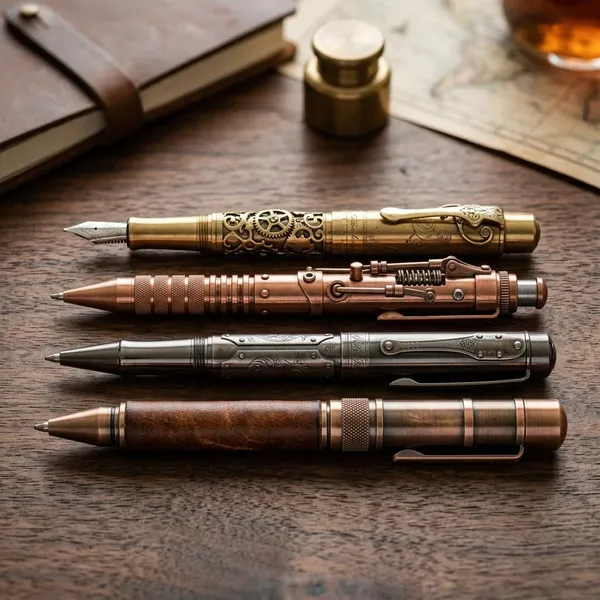
The main types differ more than they first appear. Some are ordinary writers with steampunk styling, while others are closer to desk art, calligraphy tools, or craft projects. Before comparing prices, decide whether you want convenience, uniqueness, display value, or the satisfaction of making the pen yourself.
| Type | Best fit | Watch out for |
|---|---|---|
| Bolt-action pen | Everyday writing with a mechanical feel | Too much weight near the top |
| Gear or watch-part pen | Gifts, collectors, visual detail | Loose exposed parts or rough resin |
| Circuit board pen | Retro-futuristic style, tech-themed gifts | Cheap printed patterns sold as handmade work |
| Feather dip pen | Decorative writing and display | Not convenient for quick notes |
| Custom turned pen | Personalized gifts or unique daily writers | Unclear refill compatibility |
How to choose a steampunk pen
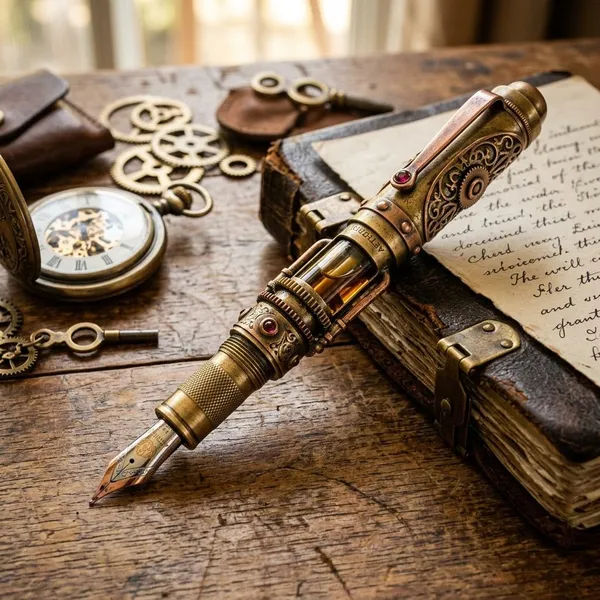
Choose in this order: use first, comfort second, refill third, decoration last. That order prevents the most common mistake: buying the pen that looks best in photos and then discovering it is too heavy, awkward, or difficult to refill.
Decide how you will use it
If the pen will live on your desk and come out for signatures, you can choose a heavier, more decorative model. If it will travel in a pocket or notebook loop, a slimmer refill-based pen is usually better. For a gift, think about the recipient's habits: a writer may appreciate comfort and refills, while a collector may care more about unusual materials and display presence.
Check the weight and balance
Steampunk pens often use metal hardware, so they can feel heavier than ordinary pens. A little weight can feel premium for signatures and short notes, but top-heavy pens become tiring during longer writing sessions.
When buying online, check reviews for words like "heavy," "balanced," "chunky," or "comfortable." For a gift where you cannot test the pen, medium weight is the safer choice than an oversized showpiece.
Choose a comfortable grip
The grip area matters more than the most decorative part of the barrel. Smooth metal can feel slippery, deep grooves can press into your fingers, and raised decoration near the grip can become annoying quickly. If you write with firm pressure or for long periods, choose a thicker, cleaner grip section rather than a narrow barrel covered in texture.
Confirm the refill type
Refill compatibility decides whether the pen stays useful after the first ink runs out. Many steampunk ballpoints use common ballpoint or Parker-style refills, but not all sellers state this clearly. If the listing does not name the refill type, ask before buying, especially for a gift or a higher-priced custom pen.
For dip pens, the equivalent check is nib and ink availability. A beautiful quill set is less enjoyable if the nibs are unusual or the included ink is the only easy option.
Inspect the mechanism and finish
A bolt should slide cleanly and lock without wobble. A twist mechanism should feel firm, not gritty or loose. For the finish, look for even plating, tidy seams, and smooth edges around the grip and clip.
- Avoid: visible glue around decorative parts.
- Avoid: rough metal where fingers rest.
- Avoid: vague listings with no close-up photos.
- Prefer: clear refill information and detailed images of the mechanism.
Match the quality to your budget
Budget pens can be fun if you mainly want the look, but expect simpler hardware and less refined finishing. Mid-range refill-based pens are usually the best value for regular use. Higher-priced custom pens make sense when the materials, turning work, embedded parts, or personalization are the reason you are buying.
For a maker kit, remember that the kit price is not the full cost if you still need blanks, tools, finishing supplies, or practice time. The value is in the project as much as the finished pen.
Best steampunk pens for different uses
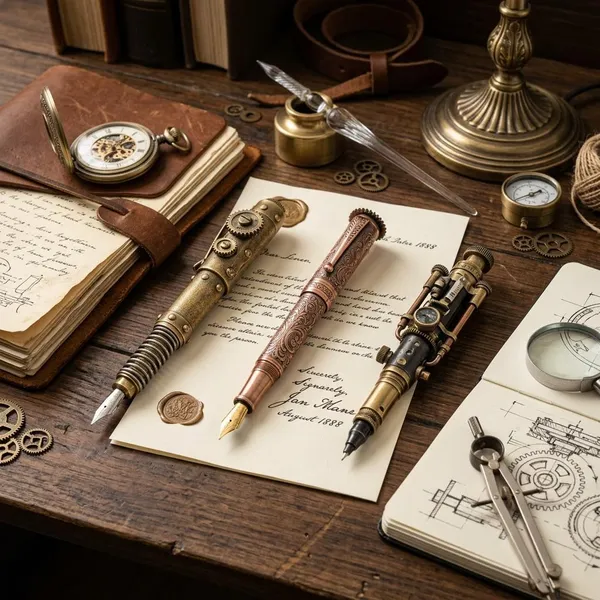
The "best" option changes with the job. A daily pen should be comfortable and easy to refill. A gift should feel distinctive without becoming awkward to use. A collector piece can lean harder into artistry, while a dip pen can trade convenience for atmosphere.
Ballpoint pens for daily writing
For daily writing, choose a ballpoint, hybrid ballpoint, or rollerball-style pen with a standard refill and a reliable bolt or twist mechanism. The best everyday version is not always the most dramatic one. A cleaner grip, secure clip, and balanced barrel will matter more after a week of actual use than extra gears on the outside.
Custom pens for gifts
A custom pen works well as a gift because it feels chosen rather than grabbed from a shelf. Engraving, a selected wood or resin color, antique hardware, or a simple display box can make it feel personal without making it impractical.
Handmade pens for collecting
Collectors usually look for details that show human work: clean turning, well-set watch parts, unusual material combinations, limited runs, or a maker with a recognizable style. A collectible does not have to be the easiest writer, but it should still be well finished. Rough resin, uneven plating, or loose decoration weaken the appeal no matter how interesting the theme is.
Dip pens for decorative writing
Dip pens are the right choice for decorative writing, themed photos, journals, invitations, and display desks. They require bottled ink and a slower writing rhythm, so they are better for occasional moments than everyday tasks. A complete set with several nibs, a stand, and usable ink is usually more satisfying than a single decorative handle.
Pen kits for maker projects
Pen kits are for people who want the making process as much as the finished object. They make sense if you already enjoy turning, sanding, finishing, and fitting hardware. For a first project, choose a kit with clear instructions and a common refill so the finished pen is not only attractive but easy to maintain.
Conclusion
A good choice is the one that matches the pen's style to its real job. For everyday writing, stay practical: comfortable grip, balanced weight, reliable action, and easy refills. For gifts, collecting, decorative writing, or maker projects, let the design become more expressive, but do not ignore the small details that decide whether the pen feels enjoyable after the first impression.
FAQ
Do steampunk pens use standard ink refills?
Many do, especially ballpoint and bolt-action models, but it is not guaranteed. Look for a named refill type in the listing; if none is given, ask before buying.
Are bolt-action pens practical for daily writing?
Yes, if the pen is not too heavy and the bolt locks smoothly. They are often one of the most practical steampunk styles because they keep a normal refill-based writing system.
Do feather dip pens require bottled ink?
Yes. A feather dip pen uses a nib dipped into ink, so it is better for decorative writing than quick everyday notes.
Can a steampunk pen be personalized?
Yes, especially custom turned pens and DIY kits. Common options include engraving, chosen barrel materials, antique hardware finishes, and gift boxes.
Do steampunk pens use standard ink refills?
Many do, especially ballpoint and bolt-action models, but it is not guaranteed. Look for a named refill type in the listing; if none is given, ask before buying.
Are bolt-action pens practical for daily writing?
Yes, if the pen is not too heavy and the bolt locks smoothly. They are often one of the most practical steampunk styles because they keep a normal refill-based writing system.
Do feather dip pens require bottled ink?
Yes. A feather dip pen uses a nib dipped into ink, so it is better for decorative writing than quick everyday notes.
Can a steampunk pen be personalized?
Yes, especially custom turned pens and DIY kits. Common options include engraving, chosen barrel materials, antique hardware finishes, and gift boxes.