
You do not need an official LEGO steampunk theme to build something that looks convincingly steampunk. The best route is to start with steam-era shapes, Victorian details, muted colors, and mechanical parts, then decide whether you want an official set to modify or a custom MOC from scratch. For most builders, steampunk LEGO sets work best when the model has one clear idea instead of random gears placed everywhere.
Official LEGO options with steampunk appeal
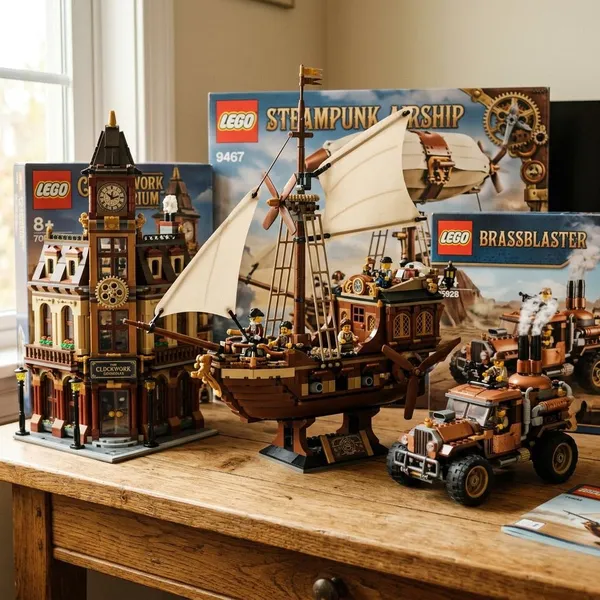
LEGO rarely labels a set as steampunk, so it is better to search by visual features: steam transport, old-world buildings, brass-like accents, dark colors, exposed machinery, and adventurous minifigures. An official set can work as a finished display, a starting point for modification, or simply a useful parts source.
Steam trains and riverboats
Steam trains are the easiest official-style match because the boiler, wheels, smokestack, and side rods already do half the work. If you want a shelf build that reads as steampunk immediately, a locomotive is safer than trying to convert a modern car or spaceship.
Riverboats work well when you want a gentler Victorian travel scene. A paddle wheel, railings, lanterns, and dark red or brown accents can turn a boat into a believable canal or dockside centerpiece without needing a huge layout.
Victorian-style buildings
Victorian-style buildings give your machines somewhere to belong. Look for ornate windows, balconies, lamps, roof details, arches, and muted colors such as tan, dark green, reddish brown, black, and dark red.
- Good for display: a townhouse, hotel, station, or shop facade.
- Easy upgrades: rooftop tanks, wall pipes, vents, clocks, and old signs.
- Common mistake: adding machinery before the building has a strong period look.
Mechanical fantasy vehicles
Adventure and fantasy vehicles can become steampunk quickly if they already have propellers, armor plates, rugged wheels, engines, or exposed frames. This is a forgiving choice for beginners because the vehicle does not need to copy real history; it only needs to look like it could run on steam, gears, pressure, or experimental engineering.
Steampunk-inspired minifigures
A single minifigure can set the tone for a whole build. Goggles, top hats, waistcoats, printed belts, tool straps, maps, satchels, compasses, and mechanical arms are more useful than they might seem because they tell the viewer who uses the machine.
Detailed display sets
Detailed display sets are worth considering even when the subject is not steampunk. They often include windows, lanterns, curved slopes, printed tiles, foliage, furniture, and trim pieces that are hard to gather from basic brick boxes.
They are also useful for learning. If a set shows you how to make a facade feel deep, a roofline feel old, or a small interior feel lived in, those techniques can transfer directly into workshops, stations, submarines, and street scenes.
Popular steampunk LEGO MOC ideas
Custom builds are where the steampunk style really opens up. You can build a whole city if you want, but a small, focused model is usually a better starting point: one airship, one workshop corner, one locomotive, or one strange machine with a clear purpose.
Flying airships
Airships are the classic steampunk MOC because the shape is instantly readable: balloon above, hull below, engines or propellers at the sides, and a small deck or cabin for the crew. A compact airship on a stand is often easier to live with than a large hanging model, especially if your display space is a desk or bookcase.
Inventor workshops
An inventor workshop is one of the best first MOCs because it can be small and still feel complete. A desk, boiler, tool rack, blueprint tile, lamp, and half-finished machine can tell a clear story without needing hundreds of specialty parts.
Victorian city streets
A Victorian street scene works when you want a longer-term project. Start with one facade and a short pavement rather than a full block. Later, you can add a second building, a steam cart, overhead pipes, street lamps, or a docking mast.
This kind of build is ideal if you enjoy minifigures and world-building. It shows daily life: people repairing machines, shopping, loading cargo, or waiting for strange steam-powered transport.
Steam-powered mechs
Steam-powered mechs suit builders who like chunky mechanical shapes. Instead of making the robot sleek, make it look heavy: pressure tanks on the back, pistons near the joints, wide feet, visible frames, and tools or cargo hooks that explain its job.
- Low-risk idea: a small dockside cargo loader.
- Harder idea: a tall walking mech with stable legs and moving joints.
- Best detail check: every tank, pipe, or gear should look connected to a function.
Submarines and locomotives
Submarines and locomotives are strong standalone choices because both already fit a world of exploration and heavy machinery. A submarine needs a rounded hull, portholes, fins, propellers, and pipes; a locomotive needs large wheels, a layered boiler, side rods, and a strong front profile.
Choose one of these if you want a finished display rather than an expanding city. They photograph well, fit neatly on shelves, and reward careful surface detail.
How to choose a steampunk LEGO build
The right project is the one you are likely to finish, display, and enjoy improving. Before buying parts or instructions, check four things in this order: available space, build size, missing parts, and your current skill level.
| Situation | Best starting choice | Why it works |
|---|---|---|
| Small desk or shelf | Workshop, mini locomotive, small submarine | Compact, detailed, and easier to finish |
| Beginner MOC builder | One-room scene or modified official set | Less structural pressure and fewer rare parts |
| Long-term display plan | Victorian street or modular-style scene | Can grow section by section |
| Mechanical build fan | Mech, airship, or moving vehicle | Gives room for joints, gears, and functions |
Choose between sets and MOCs
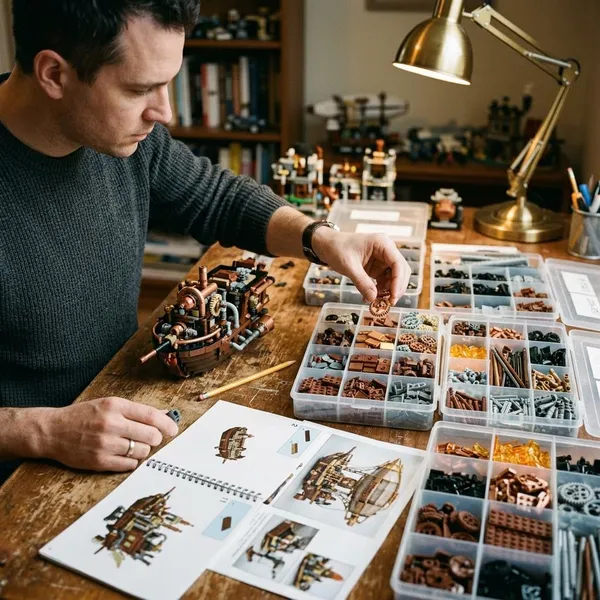
Choose an official set if you want instructions, predictable building, and a model you can enjoy quickly. Choose a MOC if the main appeal is designing your own world, vehicle, or character story.
Pick the right build size
Small builds are not a compromise; they are often the smartest first step. A compact workshop, airship, or facade gives you enough room for shape and detail without becoming expensive, fragile, or impossible to display.
Go larger only when you know where the model will live. A huge airship may look impressive online, but if it needs to hang from the ceiling and you cannot safely mount it, a smaller stand-based version is the better choice.
Check the required parts
Before you commit, gather the parts that create the style: bars, clips, grilles, gears, lanterns, curved slopes, tiles, pipes, wheels, reddish brown pieces, dark neutrals, and metallic accents. If those are missing, the build may look like a normal model with a few random gold pieces added.
- Sort by function: machinery, structure, decoration, and minifigure accessories.
- Replace rare colors early: use a practical palette instead of chasing every metallic part.
- Check fan instructions first: review the inventory before buying a file or starting a large order.
Match the build to your skill
If you are new to custom building, avoid starting with a large articulated mech or full city block. A one-room workshop or small vehicle teaches color control, detail placement, and storytelling without demanding advanced engineering.
Intermediate builders can try airships, locomotives, and building facades. Experienced builders will get more from moving parts, large modular streets, or tall models that need stronger internal support.
Set a realistic budget
Steampunk builds can get expensive when you chase rare printed parts, unusual metallic colors, or large quantities of matching pieces. Set a budget before you decide whether the money is going toward a complete set, loose parts, minifigures, display stands, or instructions.
How to build a steampunk LEGO MOC
A good steampunk MOC usually starts simple: one concept, one strong shape, one believable mechanical idea. The details come later. If you start by covering a weak frame with gears, the model may look busy but not convincing.
Choose a clear concept
Write the idea in one sentence before building: a courier airship for a crowded city, a repair shop for steam robots, a mining walker for underground tunnels, or a private locomotive owned by an eccentric inventor. That sentence becomes your filter for every detail you add.
Plan the shape and scale
Block out the largest forms first. For an airship, that means balloon, hull, engine placement, and cabin. For a building, it means footprint, height, entrance, roofline, and street edge.
Decide early whether the model is minifigure scale or display-only. A minifigure-scale workshop needs usable doors, chairs, tools, and work surfaces; a display submarine can focus almost entirely on the outer shell.
Build a strong base
The base is where many custom builds succeed or fail. Vehicles need a central spine, buildings need floors and wall support, and tall models need weight in the right places. Test the frame before adding delicate trim, pipes, or hanging sections.
Add working machinery
Add machinery where it appears to have a job. Engines should sit near propulsion, tanks should connect to pipes, gears should support motion or control, and levers should be reachable by a minifigure if the model uses one.
- Easy movement: spinning propeller, rolling wheels, hinged hatch.
- More advanced movement: linked pistons, rotating gears, articulated limbs.
- Static option: fixed machinery is fine if the system still looks connected.
Layer in Victorian details
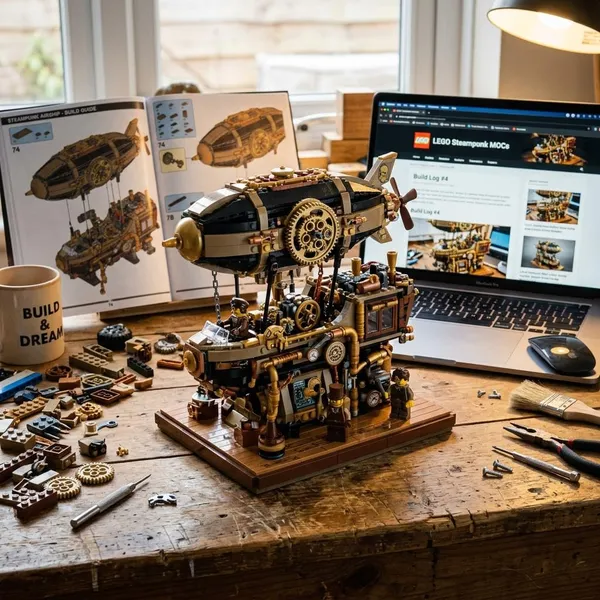
Once the mechanical side is readable, add the elegant side: lamps, railings, clocks, framed windows, patterned floors, luggage, signs, top hats, and decorative trim. This is what separates steampunk from plain industrial machinery.
Finish with characters and props
Characters and props make the model feel used. A wrench on a bench, a map on a wall, a coal bin beside a boiler, or a captain at the controls explains the scene faster than another layer of decoration.
Keep the final details selective. Empty space can help the important parts stand out, especially on a small build where too many props quickly turn into clutter.
Conclusion
The most satisfying steampunk LEGO project is usually not the biggest one; it is the one with a clear purpose, a strong silhouette, and enough Victorian-mechanical detail to feel intentional. Start with a train, building, minifigure, or compact MOC that fits your space and budget, then build up only when the idea still feels fun rather than forced.
FAQ
Can you build steampunk models with common LEGO parts?
Yes. Common bars, clips, slopes, grilles, wheels, lanterns, and brown or dark gray bricks can do a lot. Rare metallic parts help, but they are not required for a convincing small build.
Which LEGO colors work best for steampunk builds?
Brown, reddish brown, tan, dark tan, black, dark gray, dark red, pearl gold, and silver usually work best. Pick three or four main colors first so the model does not become visually noisy.
Can steampunk LEGO builds include moving parts?
Yes. Propellers, wheels, hinges, pistons, and simple gear motion fit the style well. Just make the structure stable first, because a moving feature that breaks the model is rarely worth the frustration.
Can you build steampunk models with common LEGO parts?
Yes. Common bars, clips, slopes, grilles, wheels, lanterns, and brown or dark gray bricks can do a lot. Rare metallic parts help, but they are not required for a convincing small build.
Which LEGO colors work best for steampunk builds?
Brown, reddish brown, tan, dark tan, black, dark gray, dark red, pearl gold, and silver usually work best. Pick three or four main colors first so the model does not become visually noisy.
Can steampunk LEGO builds include moving parts?
Yes. Propellers, wheels, hinges, pistons, and simple gear motion fit the style well. Just make the structure stable first, because a moving feature that breaks the model is rarely worth the frustration.