
Start by deciding whether the fan needs to cool the room every day or mainly add character, because that choice changes everything. A steampunk ceiling fan is worth choosing when its vintage-mechanical look fits the room, but size, ceiling clearance, airflow, and usable light should come before the most dramatic cage or brass finish.
What makes a ceiling fan steampunk
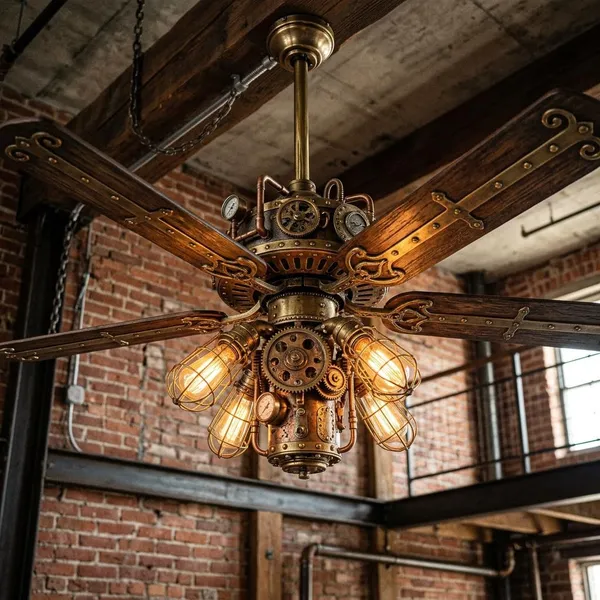
A ceiling fan starts to feel steampunk when it looks inspired by old machinery, Victorian fixtures, workshop hardware, and early electrical design. The style is not just "dark metal." It usually needs a mix of aged finishes, visible construction, vintage lighting, and shapes that feel engineered rather than sleek.
Victorian-inspired details
Look for decorative motor housings, curved brackets, rivet-like trim, scrollwork, or small ornamental details that soften the industrial side. These touches matter most in rooms with bookshelves, leather seating, warm wood, framed prints, or antique-style accessories, where a plain warehouse fan can look too blunt.
Aged metal finishes
Finish sets the mood quickly. Antique brass and bronze feel warmer and more decorative, while distressed black, iron, and oil-rubbed finishes feel heavier and more industrial.
- Warm rooms: bronze or brass usually works better with wood, leather, cream walls, and vintage décor.
- Cooler rooms: blackened metal often suits brick, concrete, gray walls, and darker shelving.
- Mixed-metal rooms: repeat the fan's finish at least once nearby, such as in lamps, handles, frames, or furniture legs.
Exposed bulbs and hardware
Exposed bulbs, visible screws, cage-covered lights, and jointed frames give the fan that built-by-hand character. They are great for atmosphere, but check the real lighting need before buying. A few warm Edison-style bulbs may look beautiful over a bed or dining nook, yet feel too dim for a home office or family room.
Cages and mechanical shapes
Caged designs, drum frames, rounded guards, and gear-like forms are easy steampunk signals. They work especially well when you want a compact fixture with a strong visual identity.
The trade-off is airflow. A caged fan can be fine for a small bedroom, office, or reading corner, but it is rarely the best choice for a hot living room that needs steady circulation throughout summer.
Industrial blades and fittings
Blades and fittings decide whether the fan feels sturdy or theatrical. Wood blades, metal blade irons, distressed surfaces, and visible supports can all fit the look, but keep the room in mind: broad dark blades add weight, while simpler wood or metal blades make the style easier to live with long term.
Main steampunk ceiling fan styles
The main styles are caged fans, dual fans, open-blade fans, fandeliers, and more subtle industrial designs. The best choice depends less on which one looks most "steampunk" and more on what the room needs from the fixture.
Caged fans for compact spaces
Caged fans are a good fit when the room is small and the fan is partly decorative. They can add personality over a desk, in a guest room, or in a small studio without using the wide blade span of a traditional fan.
Dual fans for a bold focal point
Dual fans use two smaller fan heads on one shared fixture, so they naturally look mechanical and dramatic. They make the most sense in long rooms, loft-style spaces, or open living-dining areas where a single compact fixture would look undersized.
Open-blade fans for stronger airflow
Open-blade fans are usually the safer pick when comfort comes first. With less obstruction around the blades, they tend to move air more effectively than compact caged or hidden-blade designs.
- Best for: living rooms, family rooms, warmer bedrooms, and spaces used daily.
- Watch for: blade span, motor quality, speed settings, and whether the light kit hangs too low.
- Good compromise: aged metal hardware with simpler blades instead of a heavy cage.
Fandelier designs for decorative lighting
A fandelier is closer to a decorative light fixture with fan function added. In a steampunk version, that often means exposed bulbs, metal frames, cages, and compact or hidden blades.
This style works well when lighting and mood matter more than strong airflow, such as in a dining room, bedroom, entry area, or sitting space. For a room that gets hot every day, treat it as comfort support rather than the main cooling solution.
Subtle industrial fans for easier styling
A restrained industrial fan is often the easiest long-term choice. It may use aged metal, simple hardware, and warm bulbs without looking like a movie prop. If your home mixes modern furniture with wood, brick, or black metal accents, this style gives you the steampunk influence without locking the whole room into a theme.
Which style works best in each room
Room use should narrow the choice before appearance does. A fan over a bed has different priorities from one in a loft or home office, even if both can share the same aged-brass or black-metal finish.
Open designs for living rooms
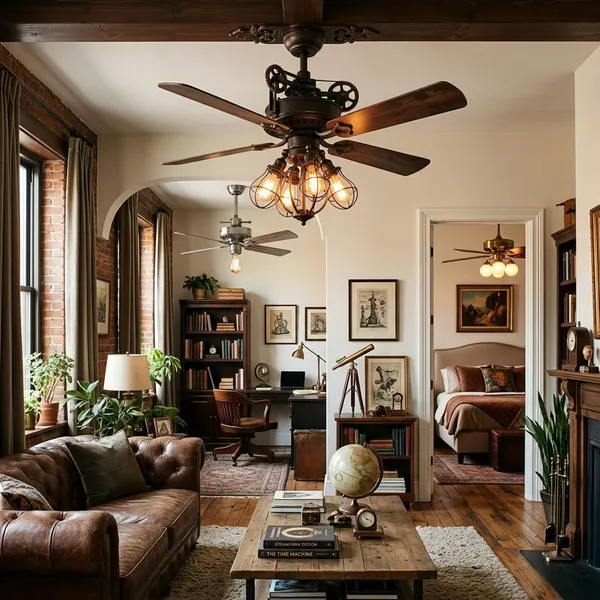
Living rooms usually benefit from open-blade designs because they cover more area and feel proportionate in a larger space. If people gather there often or the room gets warm in summer, prioritize airflow data, blade span, and speed control before decorative extras.
Quiet compact fans for bedrooms
Bedrooms need calm more than drama. A compact caged fan, low-profile design, or simpler industrial model usually works better than a large dual fixture, especially if the fan will run at night.
- Choose quieter operation over an aggressive mechanical look.
- Use warm, dimmable lighting if the fixture is near the bed.
- Avoid heavy overhead forms in small rooms, where they can feel visually tiring.
Caged fans for offices and studios
Caged fans suit offices and studios because they bring character without requiring a wide sweep of blades over a desk or worktable. They pair naturally with shelving, tools, books, black metal furniture, and vintage-style task lamps.
Dual fans for long open spaces
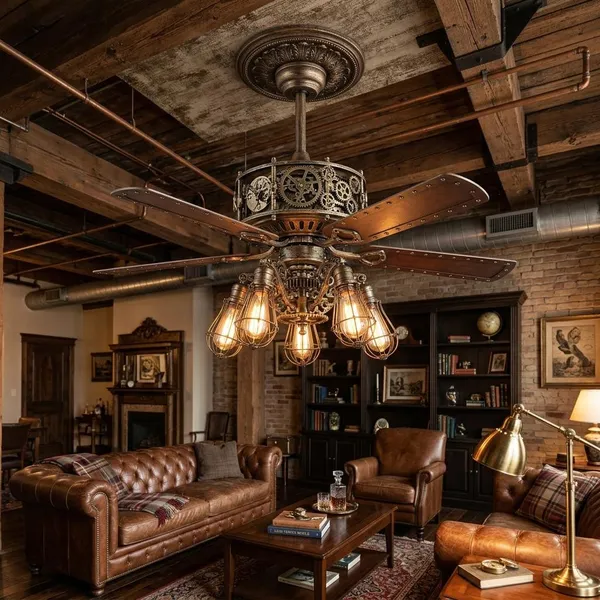
Dual fans are best for rooms with length, height, and visual confidence: lofts, great rooms, converted studios, or open-plan spaces with beams, brick, or exposed materials. In that setting, the shape feels intentional rather than oversized.
They are not automatically better for every large room. If the space is square rather than long, a larger open-blade fan may look cleaner and move air more evenly.
Low-profile models for lower ceilings
You can use a steampunk-style fan on a lower ceiling, but only if the model is made for low-profile or flush-mount installation and still leaves comfortable clearance. Compact cages and simpler hugger-style fans are usually the easiest options.
How to balance style and function
The best order is simple: fit first, performance second, style details third. That prevents the common mistake of choosing a dramatic fixture and only later realizing it is too low, too dim, too weak, or too hard to clean.
Match the finish to the room
Pick a finish that connects to something already in the space. The fan does not have to match every metal exactly, but it should not be the only antique brass, black iron, or bronze element in the room.
| Room detail you already have | Fan finish that usually feels natural |
|---|---|
| Warm wood, tan leather, cream walls | Antique brass, bronze, oil-rubbed bronze |
| Brick, concrete, black shelving | Distressed black, iron, darker bronze |
| Modern furniture with a few vintage accents | Subtle aged metal rather than a heavily distressed finish |
Keep the fan size in proportion
For a small office or guest room, a compact caged fan may look intentional. For a broad living room, the same fan can look decorative but underpowered. For a low ceiling, even a beautiful fixture becomes the wrong choice if it hangs too far into the room.
Prioritize airflow over decoration
If the fan will run daily, airflow should beat ornament. Check the manufacturer's airflow information, blade span, speed options, and comments about noise or wobble. If those details are unclear, be cautious with very decorative models.
- Main cooling fan: lean toward open blades and a reliable motor.
- Occasional comfort fan: a caged or fandelier style may be enough.
- Mostly decorative fixture: lighting quality and finish can lead the decision.
Choose lighting for actual use
Think about what the room needs at night, not just how the bulbs look in photos. Exposed warm bulbs can be perfect for atmosphere, but they may not be enough for reading, cleaning, working, or a busy family space.
Avoid designs that feel too heavy
The most common style mistake is choosing too many bold features at once: dark finish, dense cage, large body, exposed bulbs, and heavy ornament all in one fixture. Pick one or two strong elements and let the rest stay quieter.
- Measure first: room size, ceiling height, and the space below the fixture.
- Choose the style category: open blade, caged, dual, fandelier, or subtle industrial.
- Check daily needs: airflow, noise, light level, controls, and cleaning access.
- Match the finish: repeat the metal tone somewhere else in the room.
- Compare two or three realistic options: avoid buying the most dramatic model by impulse.
Conclusion
A good steampunk ceiling fan should look distinctive without making the room harder to live in. Start with room size, ceiling height, airflow, and lighting, then choose the finish and mechanical details that support the space. If the fan fits the way you actually use the room, the style will feel intentional instead of just decorative.
FAQ
Are steampunk and industrial ceiling fans the same?
No. Industrial fans are usually simpler and more utility-focused, while steampunk fans add stronger vintage character through aged finishes, exposed bulbs, ornate details, or mechanical-looking shapes.
Are caged ceiling fans harder to clean?
Usually, yes. The cage and exposed bulb areas collect dust in more small spots, so choose a simpler cage if the fan will be installed high or in a room you do not want to clean often.
Can you install one on a low ceiling?
Yes, if it is a flush-mount or low-profile model and the installation leaves proper clearance. Avoid long downrods, deep cages, and hanging light kits when headroom is already limited.
Are steampunk and industrial ceiling fans the same?
No. Industrial fans are usually simpler and more utility-focused, while steampunk fans add stronger vintage character through aged finishes, exposed bulbs, ornate details, or mechanical-looking shapes.
Are caged ceiling fans harder to clean?
Usually, yes. The cage and exposed bulb areas collect dust in more small spots, so choose a simpler cage if the fan will be installed high or in a room you do not want to clean often.
Can you install one on a low ceiling?
Yes, if it is a flush-mount or low-profile model and the installation leaves proper clearance. Avoid long downrods, deep cages, and hanging light kits when headroom is already limited.