
The Steampunk Bible is still worth reading if you want a broad, image-rich introduction to steampunk rather than a narrow academic study. Its best use is as a starting point: it helps you understand where the style came from, why the visuals matter, and which parts of the culture you may want to explore next. If you mainly want the newest steampunk creators or a deep literary analysis, it will feel more dated and less complete.
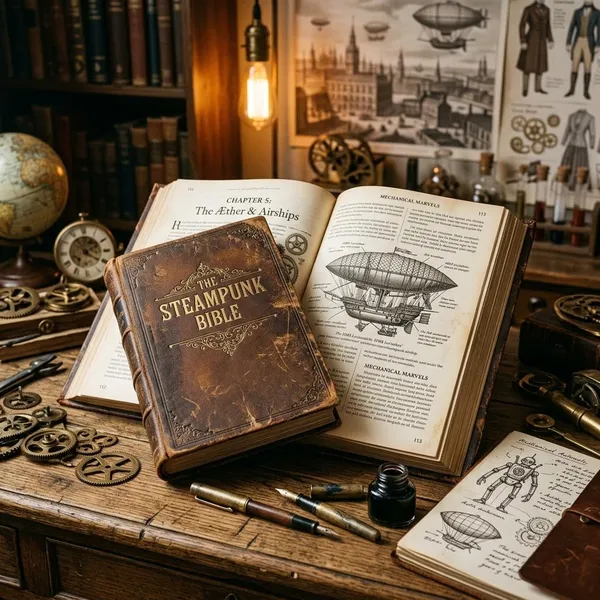
What does The Steampunk Bible cover
The book covers steampunk as a cultural movement, not just as a fiction label. It moves between literature, Victorian influence, retro-futurist design, clothing, handmade objects, film, music, and fan culture, which is why it still works well for someone trying to get oriented.
Steampunk origins and literary influences
The literary background is one of the book's most useful entry points. It connects steampunk to Victorian adventure, industrial imagination, scientific wonder, and classic influences such as Jules Verne and H. G. Wells, while also touching on later genre conversations around the word "steampunk."
That context matters because it keeps the style from becoming just goggles, gears, and brown leather. For a reader or writer, the stronger takeaway is that steampunk works best when the old world and the imagined technology are in tension: invention, class, empire, exploration, anxiety, and fantasy all sit close together.
Art and mechanical invention
The art and invention material shows why steampunk is so easy to recognize visually. Airships, altered instruments, automatons, rayguns, laboratory devices, and ornate machinery are treated as storytelling objects, not just decoration.
- For casual browsing: the images make the mood clear quickly.
- For creators: the useful lesson is how materials and shapes suggest a world.
- For collectors: this section adds much of the book's display value.
Fashion and personal style
Fashion is treated as identity and performance, not only as costume. Corsets, coats, goggles, boots, gloves, hats, watches, and customized accessories appear as ways people enter the world of steampunk and make it visible in public spaces.
This is especially helpful for someone who first encountered steampunk through cosplay or convention photos. The book shows that a good outfit is usually not "Victorian clothing plus random gears"; it has a role, a silhouette, and a story behind it, whether that role is engineer, explorer, aristocrat, aviator, scientist, or outlaw.
Makers and DIY culture
The maker side is one of the reasons the book still has practical value. It gives attention to altered gadgets, handmade props, modified objects, and the appeal of visible craftsmanship.
If you use the book for a project, start with three checks:
- Pick a role first: explorer, mechanic, inventor, performer, or collector.
- Choose a material logic: brass, wood, leather, glass, copper, paper, or worn metal.
- Add only details that support the object: decoration should feel intentional, not pasted on.
For a small project, that may mean one convincing prop or accessory. For a longer-term creative setup, such as a costume series or illustrated world, the book is more useful as a mood board than as a technical manual.
Film, music, and popular culture
The book also looks at steampunk in film, music, comics, performance, and fan spaces. This matters because many people do not enter steampunk through novels; they enter through a movie design, a band, an event, a game, or an image that feels instantly atmospheric.
The useful distinction is depth versus surface. Some media examples use steampunk to explore alternate history or technology; others mainly borrow the look. The book helps readers notice that difference without turning the subject into a lecture.
What makes The Steampunk Bible stand out
The Steampunk Bible stands out because it balances explanation with visual pleasure. It is informative enough to explain the movement, but image-heavy enough to browse like an illustrated reference book.

Strong visual presentation
The visuals are not just filler. Steampunk is easier to understand when you can see the difference between historical influence, fantasy machinery, handmade modification, and theatrical style.
That makes the book useful even after the first read. Artists can return to it for texture and mood, while a beginner can use the images to understand why certain choices feel steampunk and others feel like generic vintage decoration.
Broad coverage of steampunk culture
The broad coverage is a strength if you are still deciding what part of steampunk interests you. The book opens several doors at once: fiction, fashion, props, art, events, performance, and media.
| If you come for... | The book is strongest at... |
|---|---|
| Literary background | Giving a clear starting context |
| Visual inspiration | Showing motifs, materials, and atmosphere |
| DIY or costume ideas | Suggesting design logic rather than step-by-step instructions |
| Current scene updates | Less strong; you will need newer sources too |
Accessible historical context
The historical context is readable without feeling thin. The book gives enough background on industry, Victorian imagination, empire, invention, adventure fiction, and alternate history to make the aesthetic feel grounded.
For a casual fan, that context adds meaning. For a writer, it is a reminder that a convincing steampunk setting needs more than attractive machines; it needs social pressure, technology that changes behavior, and a reason the world looks the way it does.
Creative work from across the movement
The book's range of creative examples keeps steampunk from feeling like a single fixed formula. Some work leans elegant and neo-Victorian, some looks grimier and industrial, and some is playful, theatrical, or pulp-adventure driven.
That variety is useful if you are trying to define your own taste. You may not care about ornate fashion but love prop design, or you may skip the machinery and respond more to illustration, worldbuilding, or performance culture.
Who should read The Steampunk Bible
The best reader for The Steampunk Bible is someone who wants orientation plus inspiration. It is not the book to choose if you need the most current survey of online communities or a specialist study of one narrow subject.
Beginners exploring steampunk
Beginners are probably the easiest audience to recommend it to. If you have seen steampunk outfits, props, or artwork but do not yet understand how the pieces connect, the book gives you a readable starting framework.
It is especially good for a first pass because it does not force you to choose one doorway. You can arrive through books, costumes, games, art, or general curiosity and still find a path into the subject.
Fans interested in its history
Existing fans may get the most from the historical framing rather than the basic definitions. The book connects familiar images and motifs to older fiction, industrial culture, and the rise of steampunk as a recognizable subculture.
If your interest has mostly been visual, this can fill in missing context. If you already know the literary history well, the value shifts more toward the illustrations and cultural snapshot.
Artists and visual creators
Artists, photographers, costume designers, prop makers, and set designers can use the book as a visual reference. Its strength is not a set of instructions but a sense of recurring design choices: silhouette, texture, materials, tools, machines, and atmosphere.
For a one-off artwork, it can help you avoid random "old-timey" details. For a larger body of work, it can help you keep the visual language consistent from clothing to objects to environment.
Writers and worldbuilders
Writers should treat it as inspiration and context, not as a fiction-writing manual. It is useful for seeing how steampunk worlds draw from technology, social history, invention, spectacle, and nostalgia.
- Use it for: atmosphere, motifs, setting ideas, cultural background.
- Do not rely on it for: plot structure, character craft, or detailed historical accuracy.
Collectors of illustrated reference books
Collectors of image-heavy genre books are a natural audience. The book has the kind of visual density that makes it pleasant to revisit, even when the main ideas are already familiar.
Condition may matter if you are buying a used copy, because the appeal depends partly on the images and layout. For a reading copy, light wear may not matter much; for a display shelf or gift, the physical state is worth checking before purchase.
Strengths and limitations of The Steampunk Bible
The book's strengths are clear: breadth, visual appeal, accessible context, and a strong sense of steampunk as a cultural movement. Its limitations come from the same place. Because it tries to cover so much, it cannot go deeply into every branch.
Its publication era also matters. Some references reflect the steampunk conversation around the early 2010s, so readers looking for the newest creators, online spaces, or adjacent aesthetics should pair it with more current sources.

Wide-ranging rather than highly specialized
The book is a survey, and that should shape your expectations. It is helpful when you want the whole landscape, less satisfying when you want a deep dive into one topic.
Visual material supports the explanations
The visual material does real work. It helps explain how steampunk ideas appear across clothing, tools, machines, artwork, and performance.
Cultural history is a major strength
The cultural history gives the book more staying power than a simple style gallery. It presents steampunk as a conversation between the past and the imagined future, with technology, craft, nostalgia, critique, and identity all involved.
Some references reflect an earlier era of steampunk
Some names, examples, and cultural touchpoints naturally reflect the period when the book was published. That does not make it useless, but it does mean it should not be your only source if you want a current picture of the scene.
Read it partly as a snapshot of steampunk at a major moment of visibility. That framing actually helps: instead of expecting it to be fully up to date, you can use it to understand how the movement was being presented, celebrated, and defined at that time.

Conclusion
The Steampunk Bible still deserves attention if you want an accessible, visually generous overview of steampunk's roots, style, and cultural reach. It is strongest as a first serious orientation or an inspiration source for creative work, and weakest as a current or highly specialized study. Go in expecting a broad illustrated map rather than the last word on the subject, and the book holds up well.
FAQ
Is The Steampunk Bible mostly pictures or text?
It is a mix, but the visual side is a major part of the appeal. The text gives context, while the images make the style, objects, and atmosphere much easier to grasp.
Who wrote The Steampunk Bible?
The Steampunk Bible was written by Jeff VanderMeer and S. J. Chambers. Their backgrounds help the book balance speculative fiction context with broader cultural and visual material.
Does The Steampunk Bible include steampunk history?
Yes. It covers literary roots, Victorian and industrial influence, and the way steampunk expanded into art, fashion, making, media, and fan culture.
Is The Steampunk Bible a reference book or a fiction book?
It is a nonfiction reference book, not a novel. It discusses fiction and creators, but its purpose is to explain and document steampunk culture rather than tell an original story.