
If you are comparing biopunk vs steampunk, start with the technology: biopunk is driven by engineered life, while steampunk is driven by steam-era machines. That one difference usually tells you what kind of setting, conflict, visual style, and mood you are dealing with.
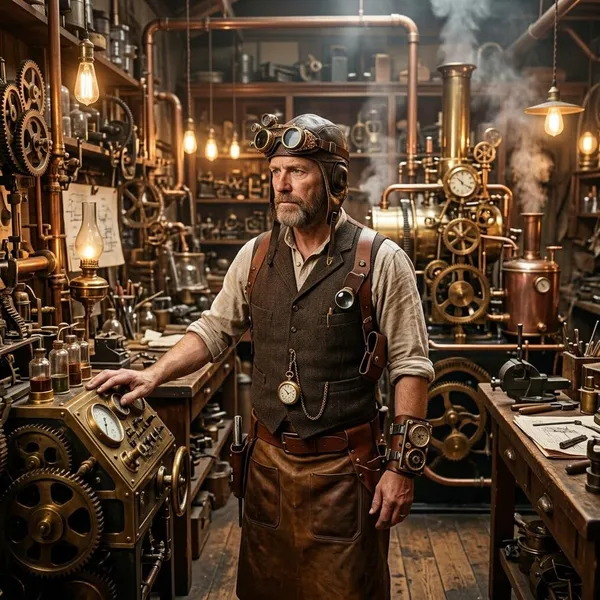
Biopunk vs steampunk key differences
The easiest way to separate the two genres is to ask what the world runs on. If the story depends on gene editing, altered bodies, lab-grown organs, synthetic organisms, or biotech monopolies, it leans biopunk. If it depends on boilers, gears, airships, clockwork tools, and alternate industrial invention, it leans steampunk.
| Category | Biopunk | Steampunk |
|---|---|---|
| Core technology | Biotech, genetic engineering, synthetic life | Steam power, mechanics, clockwork invention |
| Typical setting | Near-future cities, labs, clinics, corporate zones | Alternate industrial worlds, Victorian-inspired cities, workshops |
| Visual feel | Organic, clinical, altered, invasive | Brass, leather, smoke, gears, visible machinery |
| Main concerns | Bodily control, patents on life, medical inequality | Invention, industry, class, empire, exploration |
| Common tone | Darker, anxious, dystopian | Adventurous, theatrical, sometimes critical |
What defines biopunk?
Biopunk is science fiction built around the manipulation of living systems. It becomes recognizable when biotech is not just background decoration but the force that shapes jobs, health, identity, class, policing, and survival.
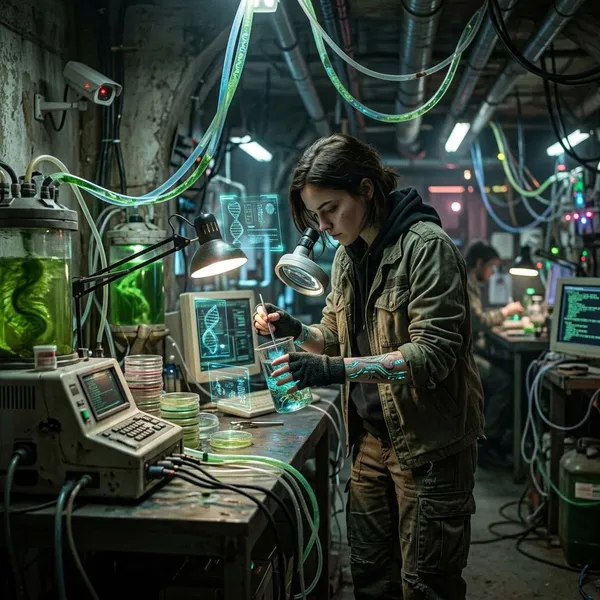
Biotechnology
Biotechnology is the base layer of biopunk. Instead of machines being the main breakthrough, living systems become tools: engineered bacteria, designer crops, artificial organs, synthetic tissues, adaptive drugs, or organisms built for labor and warfare.
The important part is scale. If biotech only appears in a lab scene, it may not define the genre. If food, healthcare, work, policing, and social status depend on biological engineering, the story is much more clearly biopunk.
Genetic engineering
Genetic engineering is one of the quickest biopunk signals because it changes identity at the source. Characters may be edited before birth, altered as adults, sorted by genetic value, or denied opportunities because their bodies do not meet a designed standard.
Body modification
Body modification in biopunk is rarely just style. It may include immune upgrades, artificial skin, modified organs, sensory enhancements, chemical dependencies, or changes required for work. A low-risk version might be a voluntary enhancement bought by someone with choices. A higher-risk version is a worker who must accept an unstable modification just to stay employed.
That distinction matters because biopunk often sits in the uncomfortable space between freedom and coercion. The question is not only "Can the body be improved?" but "Who benefits from making improvement necessary?"
Dystopian settings
Biopunk is strongly associated with dystopia because unequal access to biology creates immediate stakes. A wealthy district may have clean clinics and safe therapies, while poorer neighborhoods rely on counterfeit drugs, black-market edits, or risky experimental treatment.
Not every biopunk story has to be hopeless, but the genre usually works best when progress is uneven. The frightening part is not science itself; it is advanced science controlled by systems that already reward profit, status, and compliance.
Corporate control
Corporate control turns biotech into a social threat. If a company owns the patents, clinics, genetic data, organs, drugs, or maintenance plans that people need to live normally, biology becomes a subscription system rather than a private part of the self.
This is where biopunk often overlaps with cyberpunk in spirit. Both genres distrust concentrated power, but biopunk makes that power physical. The contract is not only on a screen; it may be in your blood, organs, fertility, or immune system.
What defines steampunk?
Steampunk is speculative fiction built around steam power, mechanical invention, and retro-industrial imagination. It usually starts from a nineteenth-century or early industrial influence, then pushes that world into impossible machines, alternate timelines, and exaggerated engineering.
Steam technology
Steam technology gives steampunk its basic logic. Boilers, pistons, valves, pressure systems, engines, and smoke are not just decorative objects; they explain how the world moves. Trains, factories, ships, weapons, elevators, and airships often become larger and stranger than real history allowed.
When checking whether something is steampunk, ask whether steam-era engineering actually powers society. If the steam machines could be removed without changing the world, the work may only be borrowing the look.
Mechanical invention
Mechanical invention gives steampunk its sense of play. Inventors, engineers, tinkerers, pilots, and machinists often solve problems through visible devices: automatons, clockwork tools, mechanical prosthetics, pressure weapons, and elaborate vehicles.
- For adventure stories: inventions create movement, danger, and spectacle.
- For political stories: machines reveal who controls labor, resources, and public infrastructure.
- For character-driven stories: a machine can show ambition, class, rebellion, or obsession.
Victorian influences
Victorian influence is common, but steampunk is not locked to one exact place or decade. It may borrow from Victorian Britain, Edwardian society, the American frontier, fictional empires, or other industrial cultures. The shared thread is a world shaped by older social codes and mechanical progress.
This is also where weaker steampunk can become shallow. Period fashion is not enough. The best versions use the historical flavor to create tension: new machines appear inside societies still shaped by class rules, gender restrictions, colonial ambition, or rigid etiquette.
Alternate history
Alternate history lets steampunk ask "What if industrial technology developed differently?" Maybe steam power became far more efficient. Maybe mechanical computing arrived early. Maybe airship travel changed warfare, trade, and empire. The setting may stay close to real history or branch into a fully invented world, as long as the industrial logic remains visible.
Industrial adventure
Industrial adventure is the mood many readers expect from steampunk: train chases, airship routes, workshop experiments, espionage, exploration, factory sabotage, or political plots moving through machine-filled cities.
That does not mean steampunk is always cheerful. A story can be critical of empire or industrial abuse and still feel steampunk if the action moves through public machines, invention, travel, and outward-facing conflict. Compared with biopunk, the danger usually feels less bodily and more mechanical or social.
How to tell biopunk from steampunk
When a book, game, film, or artwork seems hard to classify, do not start with the costume. Start with the system. The dominant genre is usually the one that explains how ordinary life works and what the main conflict depends on.
Check the technology
Start with the technology that people cannot easily avoid. If citizens need gene therapies, organ subscriptions, engineered food, or body upgrades to function in society, the work leans biopunk. If they depend on rail networks, steam engines, pressure systems, automatons, and mechanical infrastructure, it leans steampunk.
This helps in mixed-looking cases. A Victorian city with gene-controlled citizens is probably more biopunk than steampunk. A future city powered by retro steam engines and mechanical guilds may feel more steampunk, even if the date is futuristic.
Look at the setting
Setting confirms what the technology suggests. Biopunk settings often include corporate hospitals, restricted labs, contaminated districts, treatment checkpoints, or neighborhoods divided by biological access. Steampunk settings often include workshops, rail stations, industrial capitals, airship ports, academies, and factories.
One reader scenario is classification from cover art. If the cover shows a corset, goggles, and a syringe, do not decide too fast. Read the premise: if the plot is about patented bloodlines and illegal gene edits, biopunk is likely dominant; if it is about inventors racing to build a steam airship, steampunk is the safer label.
Compare the aesthetics
Aesthetics are useful as supporting evidence. Biopunk tends to look wet, clinical, organic, surgical, or mutated. Steampunk tends to look metallic, smoky, handcrafted, decorated, and repairable.
Identify the main themes
Themes settle many borderline cases. If the story keeps returning to medical inequality, genetic status, bodily autonomy, biological ownership, or corporate control over treatment, biopunk is doing the main work. If it keeps returning to invention, exploration, factories, empire, class, and industrial progress, steampunk is probably stronger.
For a writer or game designer, this is the most useful check before choosing a label. If you only want brass visuals over a biotech plot, calling it steampunk may attract the wrong audience. If you want adventure with machines but only add one experimental creature, calling it biopunk may oversell the biological side.
Can biopunk and steampunk overlap?
Biopunk and steampunk can overlap, but the mix works best when both technologies shape the world rather than sitting there as decoration. A hybrid might have steam-powered cities that depend on engineered beasts, or a Victorian-style empire where elite medicine is controlled through gene patents.
The balance matters. If the biological elements only provide monsters, the work may still be steampunk. If the machines are only set dressing around a story about body ownership and genetic control, it may still be biopunk.
Mixed technologies
Mixed technologies create the clearest overlap. A world might use steam trains and clockwork weapons while also relying on engineered soldiers, synthetic organs, or living machines. The hybrid feels convincing when both systems affect daily life, not just battle scenes or background design.
Hybrid settings
Hybrid settings can be especially interesting because they combine public machinery with private biological risk. Imagine an industrial capital where factories run on steam, but aristocratic families maintain power through inherited enhancements. Or a frontier expedition where mechanical drilling rigs depend on engineered animals that only one corporation can breed.
For readers, the cleanest hybrid settings establish three things early: what technology is common, what technology is restricted, and who controls each system. Without those rules, the mix can feel cluttered instead of intentional.
Shared themes
Both genres can examine inequality, exploitation, progress, and concentrated power. The difference is the route they take. Steampunk usually studies power through machines, industry, travel, and empire; biopunk studies it through bodies, medicine, genes, and ownership of life.
A hybrid can use both at once. The strongest version shows how external systems and internal bodies connect: a factory does not only exploit labor, for example, but may also require workers to accept biological modification to keep up with the machines.
Conclusion
The most reliable way to choose between biopunk and steampunk is to ask what the world cannot function without. If society depends on engineered life and controlled bodies, call it biopunk; if it depends on steam-era machines and alternate industrial invention, call it steampunk. When both systems genuinely shape the setting and conflict, the more honest answer is that the work sits in a hybrid space.
FAQ
Is biopunk a type of cyberpunk?
Often, yes. Biopunk is commonly treated as a cyberpunk offshoot, but it swaps digital networks and software control for biotechnology, genetics, medicine, and altered bodies.
Is steampunk always Victorian?
No. Victorian style is common, but steampunk can use other industrial-era influences or fully fictional worlds as long as retro-mechanical technology drives the setting.
Can biopunk and steampunk mix?
Yes. They mix best when both engineered life and steam-era machinery affect the plot, the social order, and the risks characters face.