
Clockpunk and steampunk can look similar when all you notice is brass, gears, and impossible machines, but the quickest split is this: clockpunk points back to Renaissance-style clockwork craft, while steampunk points to Victorian steam-powered industry. If you are trying to label an artwork, costume, game setting, or story world, check the era first, then ask what makes the machines move.
Clockpunk vs steampunk at a glance
| Clue | Clockpunk usually feels like | Steampunk usually feels like |
|---|---|---|
| Era | Renaissance, Baroque, early scientific discovery | Victorian age, Industrial Revolution, steam-age cities |
| Power | Springs, gears, weights, escapements, winding mechanisms | Boilers, steam pressure, pistons, furnaces, engines |
| Best setting | Workshop, observatory, court laboratory, inventor's studio | Factory, railway station, engine room, dockyard |
| Mood | Precise, ornate, clever, crafted | Loud, smoky, ambitious, industrial |
Renaissance vs Victorian inspiration
Clockpunk usually borrows from the Renaissance or nearby early modern periods: scholars, inventors, royal patrons, observatories, anatomical sketches, classical architecture, and machines that feel drawn from a notebook before they became practical industry.
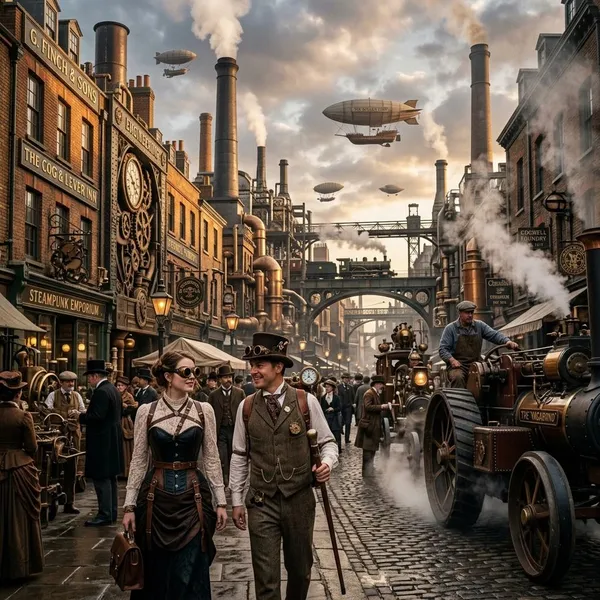
Steampunk sits later. Its visual world is closer to the 19th century: railways, gas lamps, factories, imperial uniforms, crowded cities, top hats, corsets, and public machinery. If the scene feels like a steam-age capital rather than an inventor's court workshop, steampunk is the better label.
Clockwork vs steam power
The machine's power source is the strongest practical test. Clockpunk technology tends to move through wound springs, counterweights, calibrated gears, pulleys, pendulums, and clever mechanical timing.
Steampunk technology looks as if it needs heat, pressure, fuel, vents, boilers, pistons, and constant maintenance. A brass automaton powered by a winding key leans clockpunk; a brass automaton with a pressure gauge and steam exhaust leans steampunk.
Craftsmanship vs industrial machinery
Clockpunk celebrates the master maker. The device may look like functional art: engraved plates, polished wood, lenses, miniature gear trains, and parts arranged with almost mathematical care.
- Clockpunk clue: the object feels handmade for a patron, scholar, navigator, or secret workshop.
- Steampunk clue: the object feels manufactured for travel, labor, war, transport, or city infrastructure.
Ornate workshops vs smoky factories
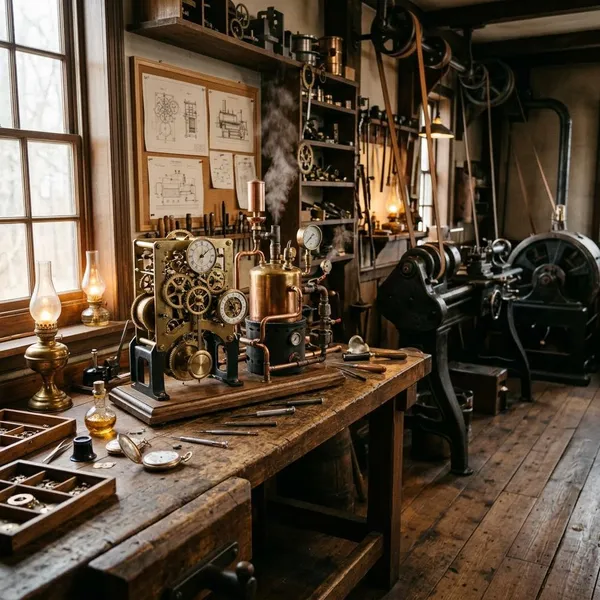
Setting often gives away the answer faster than the object itself. Put the same gear-covered machine in a marble observatory with star charts and brass instruments, and it reads clockpunk. Put it beside coal dust, pressure pipes, iron walkways, and factory workers, and it reads steampunk.
That matters for artists and worldbuilders too. If you want a delicate invention scene, lean into benches, sketches, tools, and measured movement. If you want industrial drama, add scale, smoke, noise, and machinery that changes the whole city around it.
What is steampunk
Steampunk is retro-futurism built around Victorian-era industry. It imagines a world where steam power, mechanical engineering, and 19th-century materials develop into advanced machines that real history never produced.
That is why steampunk often feels both elegant and dirty at the same time. A character might wear polished boots and a tailored coat while walking through a city of iron bridges, airship docks, soot-stained factories, and hissing vents.
Victorian and industrial settings
A steampunk setting usually points to the Victorian or Edwardian world, even when the map is fictional. Look for rail stations, brick warehouses, gas-lit streets, mechanical workshops, social class tension, and cities expanded by industry.
Steam engines and mechanical power
Steam power is not just decoration in steampunk; it shapes how the world behaves. Machines feel hot, heavy, noisy, and physical. You can imagine someone shoveling fuel, tightening valves, watching pressure, or repairing a piston before the invention works again.
Factories, airships, and large machines
Steampunk enjoys scale. Trains, airships, mechanical walkers, dock cranes, factory engines, armored vehicles, and city-wide systems fit naturally because the genre is interested in technology changing public life, not only private invention.
- Travel scene: a brass-trimmed airship leaving a smoky dock is strongly steampunk.
- Work scene: a factory line driven by belts, boilers, and pressure gauges is steampunk even without fancy costumes.
- War scene: a steam-powered walker or armored locomotive usually belongs to steampunk's industrial side.
Brass, iron, pipes, and industrial design
Steampunk uses brass often, but brass alone is not the point. The stronger signs are iron frames, rivets, leather straps, pipes, valves, gauges, vents, heavy joints, and visible construction. Even beautiful steampunk objects tend to look built for use, repair, and strain.
The main differences between clockpunk and steampunk
Historical era
Clockpunk is tied to Renaissance and early modern imagination: da Vinci-style invention, court science, astronomy, geometry, artisan guilds, and elite workshops. It often feels pre-industrial even when the machines are wildly advanced.
Steampunk belongs to the steam-age imagination: factories, railways, imperial trade, public infrastructure, urban crowding, and social change driven by machinery. If the clothing, buildings, and politics feel 19th-century, steampunk is usually the safer call.
Technology
Clockpunk technology is about precision: springs, cams, escapements, gear trains, counterweights, hidden mechanisms, automata, astrolabes, clock towers, and carefully balanced motion.
Steampunk technology is about force: boilers, combustion, pressure, pistons, steam engines, reinforced frames, vents, turbines, and large moving systems. Both can include impossible inventions, but they explain the impossible through different mechanical instincts.
Materials and design
Clockpunk often looks polished and deliberate: brass, bronze, wood, glass, enamel, mirrors, etched markings, and decorative mechanical detail. The design may feel suitable for an observatory, cabinet of curiosities, palace chamber, or private laboratory.
Steampunk can also be ornate, but it usually adds tougher materials and rougher surfaces: iron, steel, leather, rivets, dark wood, soot, repair marks, and pipework. If the object looks like it belongs on a factory floor after a long day of use, it is probably not pure clockpunk.
Scale of machinery
Clockpunk is often strongest at small to medium scale: automata, locks, instruments, navigational tools, intricate weapons, mechanical birds, prototype wings, or hidden palace mechanisms. The pleasure is in seeing how much complexity can fit into a crafted device.
Steampunk scales upward more easily. Locomotives, airships, city engines, industrial elevators, giant drills, and mechanical armies all make sense because steampunk imagines technology as infrastructure. For a quick judgment, ask whether the machine feels like a singular invention or part of a whole industrial system.
Overall atmosphere
Clockpunk tends to feel elegant, curious, ordered, and slightly scholarly. Even when it includes danger, the world often suggests invention through study and craft.
Steampunk tends to feel louder and more restless. It is full of movement, pressure, smoke, transport, social ambition, and mechanical risk. If the mood is "a brilliant artisan solved a problem," think clockpunk. If the mood is "an engine-powered society is pushing forward whether people are ready or not," think steampunk.
How to tell clockpunk from steampunk
When you are looking at a single image, cosplay outfit, game screenshot, or prop, use a priority order. Era comes first, power source second, scale third, and mood last as the tie-breaker.
Check the historical inspiration
Start with the easiest surrounding clues. Renaissance courts, scholars, domes, classical proportions, observatories, parchment sketches, and da Vinci-like prototypes point toward clockpunk. Victorian streets, railways, factories, gas lamps, waistcoats, corsets, and imperial uniforms point toward steampunk.
This is especially useful with costumes. A leather corset with goggles and a utility belt usually reads steampunk; an inventor in a fitted Renaissance coat surrounded by brass instruments and star charts reads clockpunk, even if both outfits include metal accessories.
Look at what powers the machines
Ask how the machine would move if it were real. Winding keys, spring tension, counterweights, pendulums, and escapements suggest clockpunk. Boilers, fuel, steam vents, pistons, pressure tanks, and valves suggest steampunk.
- Do not decide by color: brass appears in both.
- Do not decide by gears alone: gears can be decorative or functional in either style.
- Do decide by motion: clockwork timing and steam pressure tell different stories.
Notice the scale of the technology
A single clever device on a workbench often leans clockpunk. A city transport network, an engine room, or a machine that needs a crew to operate leans steampunk.
There are exceptions. A giant clock tower can still be clockpunk if its logic is timing, weights, and precision. A small handheld tool can be steampunk if it clearly uses pressure, fuel, and industrial fittings.
Study the clothing and architecture
Architecture can confirm what the machine only hints at. Clockpunk likes palaces, academies, libraries, observatories, carved stone, domes, and symmetrical interiors. Steampunk likes iron bridges, brick factories, warehouses, railway platforms, smokestacks, and dense urban streets.
Clothing works the same way. Courtly, scholarly, or early modern tailoring supports clockpunk. Victorian coats, boots, goggles, waistcoats, corsets, work aprons, and expedition gear support steampunk.
Judge the overall visual mood
Use mood only after checking the harder clues. Clockpunk usually feels precise, luminous, and intellectually playful. Steampunk feels heavier, grittier, more adventurous, and more public.
Where clockpunk and steampunk overlap
The boundary is not always clean, and that is part of the fun. Both styles reimagine older technology, both enjoy visible mechanics, and both can turn history into fantasy instead of strict reconstruction.
This overlap matters most when you are judging a hybrid world. A fantasy city might have clockwork scholars in one district and steam-powered factories in another. That is not a mistake if the setting shows why both technologies exist.
Both reimagine older technology
Neither style is trying to look like modern digital sci-fi. Clockpunk asks what could happen if precision mechanics, mathematics, and early invention went further. Steampunk asks what could happen if steam-age industry and mechanical engineering went further.
Both use gears and mechanical devices
Gears are shared visual language, not a final answer. In clockpunk, they often suggest timing, balance, secrecy, and artisan precision. In steampunk, they may be part of engines, transport systems, factory machinery, or rugged decorative design.
Both can feature advanced inventions
Automata, flying machines, mechanical limbs, alternate computers, weapons, and navigation devices can appear in either genre. The important question is not how advanced the invention is, but what kind of engineering fantasy supports it.
- Clockpunk version: a delicate automaton bird powered by winding, springs, and precise timing.
- Steampunk version: a mechanical bird with a tiny boiler, vents, pressure valves, and soot marks.
Both can mix history with fantasy
Magic, invented kingdoms, mythical creatures, and impossible physics can work in both styles. The historical influence only needs to remain readable enough that the technology still feels clockwork-driven or steam-driven.
A mixed setting can be especially convincing when it treats the technologies as serving different needs. Clockwork might belong to elite instruments, secret devices, and scholarly invention, while steam powers transport, factories, and war machines.
Conclusion
The best label depends on the world behind the machine. If the design feels Renaissance-inspired, precise, hand-crafted, and driven by clockwork mechanics, clockpunk is the stronger fit; if it feels Victorian, industrial, pressure-powered, and shaped by factories or transport, steampunk is the better choice. When the clues are mixed, do not let gears decide for you—look at era, power, scale, and mood, then choose the term that explains the whole scene most naturally.
FAQ
Is clockpunk a type of steampunk?
No. They are related retro-futuristic styles, but clockpunk is not simply a smaller version of steampunk. The main split is Renaissance-style clockwork craft versus Victorian steam-age industry.
Is clockpunk always set in the Renaissance?
No. It can be set in a fantasy world or alternate history, as long as the design language feels pre-industrial and clockwork-based. A literal Renaissance date is less important than the machinery, clothing, architecture, and mood.
Do gears make something clockpunk?
No. Gears only show that something uses visible mechanics. To call it clockpunk, you need stronger clues such as winding systems, precision timing, artisan construction, and early modern inspiration.
Can clockpunk and steampunk exist in the same world?
Yes. A believable hybrid world might use clockwork for refined instruments and automata, while steam powers factories, trains, and military machines. The mix works best when each technology has a clear role instead of being used as random decoration.