
The Difference Engine matters to steampunk because it treats Victorian machinery as the start of a different information age, not just as a cool brass-and-gears backdrop. If you want fast airship adventure, it may feel dense; if you want to understand why steampunk can be political, historical, and unsettling, this is one of the key novels to read.
Why is The Difference Engine steampunk?
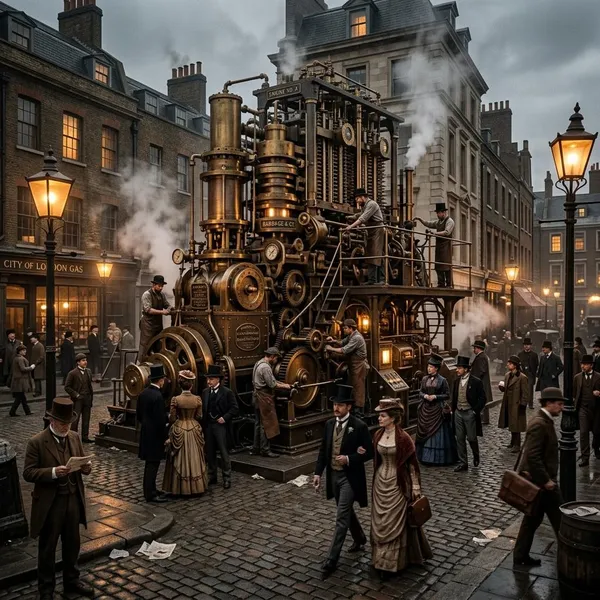
The Difference Engine is steampunk because it changes the Victorian age through advanced mechanical technology. The central idea is simple but powerful: Charles Babbage's computing machines work, spread, and begin shaping society decades before electronic computers exist.
That matters more than the visual style. The novel does not merely add unusual machines to 1855 London. It asks what would happen if computation became part of government, industry, class power, policing, and politics.
Victorian setting
The Victorian setting gives the novel its pressure. London is crowded, smoky, ambitious, and divided by class, with reform politics and industrial growth already pushing society into a faster, harsher shape.
Mechanical computing
The core steampunk device is not an airship or ray gun but a mechanical computer. Babbage-style engines use physical parts, punch cards, and calculation to process information in a way that feels Victorian and futuristic at once.
- They are large, institutional machines, not personal gadgets.
- They make information visible, expensive, and politically valuable.
- They turn computation into a public force rather than a private convenience.
Alternate history
The novel's alternate history works because the divergence is specific: Babbage succeeds. From that point, the book follows consequences rather than simply decorating the past with inventions.
Industrial change
Industrial change gives the book its darker edge. Faster calculation and better administration do not make society fairer by default. They create new winners, new experts, and new ways to control people.
That is where the novel feels close to cyberpunk despite its Victorian surface. The machines are made of metal and motion, but the anxiety is modern: whoever controls information gains leverage over everyone else.
What is The Difference Engine about?
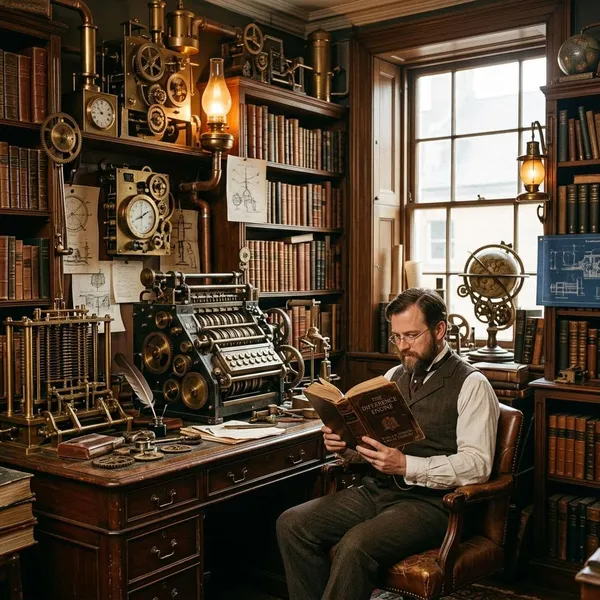
The Difference Engine is about an alternate 1855 Britain where mechanical computing has transformed public life. The story follows connected characters moving through a London shaped by data, political unrest, ambition, and hidden information.
A changed 1855 London
London is one of the strongest parts of the novel. It feels dirty, busy, unstable, and technically advanced in a way that still belongs to the 19th century.
The city matters because it shows the premise in daily life. Offices, streets, institutions, newspapers, and political factions all reflect a society where machines have made administration stronger and information more valuable.
Powerful mechanical engines
The engines are powerful because they belong to institutions. They help governments, elites, and organizations classify, calculate, plan, and manage.
That makes them more interesting than a fictional gadget sitting in a workshop. A private machine would be impressive; an institutional computing system changes how people are watched, ranked, and ruled.
Political conflict
Political conflict runs through the book because technology has shifted the balance of power. Technical experts and reformers gain influence, while older hierarchies and vulnerable groups face new pressure.
The novel is not asking whether machines are simply good or bad. It is asking who benefits first, who is pushed aside, and what happens when efficiency becomes a political weapon.
Connected character stories
The characters do not all serve one neat plotline. Their stories overlap through secrets, records, motives, and social pressure, giving the reader several angles on the same altered society.
This structure suits readers who enjoy world-first science fiction. If you prefer a tight emotional arc, the book may feel distant. If you like piecing together how a fictional society works, the fragmented approach becomes part of the appeal.
How The Difference Engine changes history
The novel changes history by moving mechanical computation from failed possibility to practical infrastructure. Once that happens, science, government, industry, and politics begin developing around calculation and data.
Babbage succeeds
The major historical change is that Charles Babbage's vision becomes workable and influential. In real history, his Difference Engine and later Analytical Engine designs were extraordinary but not completed as functioning public infrastructure during his lifetime.
Using Babbage gives the novel a strong historical anchor. The premise is speculative, but it begins with a real machine concept and a real gap between what was imagined and what the 19th century actually built.
Computing spreads
Computing spreads into the places where power already lives: government offices, commercial systems, scientific institutions, and elite networks. That is the turning point. A machine in a laboratory is a curiosity; a machine inside administration becomes part of how society makes decisions.
Industry advances
Industry advances in a way that feels impressive but uncomfortable. Better calculation supports planning, production, transport, and bureaucracy, yet it also intensifies the pressure of industrial life.
- For elites, computation creates new tools of influence.
- For technical workers, it creates new status and opportunity.
- For people without access, it can mean deeper exclusion.
Information gains power
Information becomes a form of authority. Records, punch cards, classifications, and calculations affect reputation, opportunity, policing, and political control.
What makes The Difference Engine different?
The Difference Engine stands apart because it is less interested in steampunk as style and more interested in steampunk as a historical argument. It asks how one plausible technical success could reshape an entire civilization.
That also explains why reactions to the book can be split. Some readers admire its density and ambition; others find it cold or difficult. Both responses make sense.
Plausible alternate history
The alternate history feels plausible because the authors do not begin with a random invention. They begin with Babbage, mechanical calculation, Victorian industry, and a society already moving toward bureaucracy and mass administration.
Dense worldbuilding
The worldbuilding is thick with altered names, institutions, social codes, technical details, and political hints. That richness is part of the pleasure if you enjoy being dropped into a world that does not explain itself too neatly.
It can also slow the book down. A good expectation check is this: read it for atmosphere, systems, and historical imagination before reading it for speed. That mindset makes the novel much easier to appreciate.
Cyberpunk ideas
The novel carries cyberpunk ideas in Victorian clothing. Instead of neon networks and corporate data systems, it gives readers punch cards, engines, political factions, and technical elites.
The underlying concern is the same: technology does not sit outside society. It creates new forms of dependence, inequality, surveillance, and control.
Political themes
The political themes are not side decoration. Reform, class, expertise, state power, and exclusion are built into the premise.
| Theme | What the novel does with it |
|---|---|
| Class | Shows how technical access can create new elites without removing old inequalities. |
| Information | Treats records and calculation as tools that can shape real lives. |
| Progress | Presents invention as powerful, but not automatically humane. |
| History | Suggests modernity could have arrived through a different machine path. |
Why The Difference Engine matters to steampunk
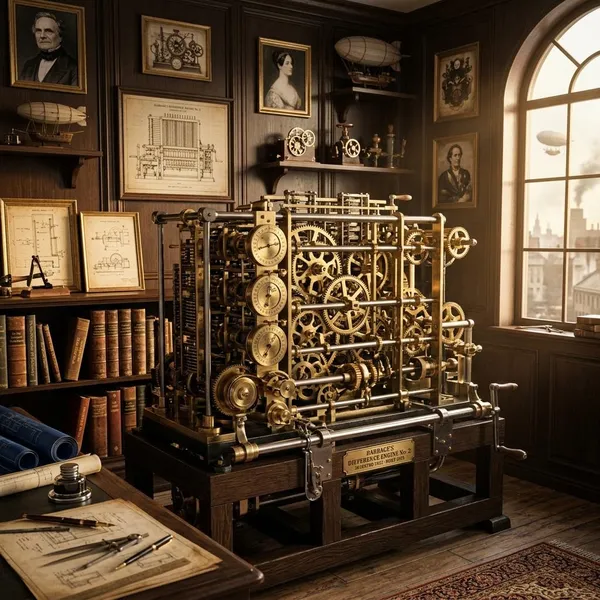
The Difference Engine matters because it helped show that steampunk could be serious speculative fiction. It gave the genre a model where retro technology changes history, politics, and society instead of existing only as visual flair.
Early genre influence
The novel arrived while steampunk was still becoming recognizable as a literary category. Its scale and seriousness helped define what the genre could attempt.
Later steampunk did not always copy it directly, but many works inherited its basic question: if old technology had taken a different path, what kind of society would follow?
Technology driven history
The book treats technology as a historical engine. Babbage's machines do not merely appear in the world; they reorganize the world around them.
That idea became one of steampunk's most useful habits. The strongest stories in the genre usually do more than display inventions. They show what those inventions change.
Social consequences
The social consequences keep the novel from becoming nostalgic. Its Victorian world is not a charming antique playground. It is unequal, unstable, polluted, and increasingly managed by systems most people do not control.
Literary steampunk
This is literary steampunk: dense, political, atmospheric, and more interested in systems than in constant action. It rewards patience more than it rewards casual dipping in and out.
Conclusion
The Difference Engine still matters because it makes steampunk think harder. Its best lesson is that a changed machine should create a changed society, with all the ambition, inequality, control, and unease that follows. Read it less as a breezy adventure and more as a landmark novel about what happens when the Victorian age discovers information power too early.
FAQ
Is The Difference Engine a steampunk novel?
Yes. It is widely considered a steampunk novel because it combines Victorian Britain, mechanical computing, alternate history, and social change.
Is the Difference Engine based on a real machine?
Yes. Charles Babbage designed a real Difference Engine in the 19th century to automate mathematical calculation, and the novel builds its alternate history from that real idea.
What did Babbage's Difference Engine do?
It was designed to calculate mathematical tables and reduce human error. Its importance comes from showing how calculation could be mechanized before electronic computers existed.