
Steampunk weapons work best when they are treated as safe, nonfunctional props first and character details second. For cosplay, fiction, or display, start by deciding who carries the piece, how realistic the world is, and whether the prop will be comfortable and acceptable at events.
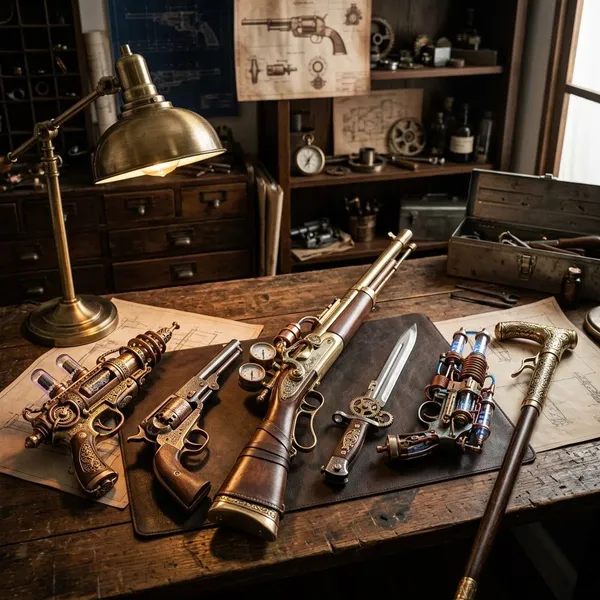
Main types of steampunk weapons
The strongest designs usually have a recognizable shape with one clear twist: brass fittings, wood grips, leather straps, pressure tanks, gauges, coils, or a deliberately aged finish. Random gears rarely make a prop feel steampunk by themselves; the details should look as if they belong to the object's supposed function.
Pistols revolvers and rifles
Pistols and revolvers are the easiest steampunk weapons to make convincing because the historical silhouette already does most of the work. A compact sidearm with a dark body, wood-style grip, brass trim, and a simple holster can suit captains, officers, bounty hunters, or duelists without overwhelming the costume.
Rifles and muskets create a stronger explorer or guard impression. They give you room for mock scopes, slings, pressure canisters, and field repairs, but they are also harder to manage in crowded convention halls or on public transport. For a long event day, a shortened rifle or clearly lightweight prop is usually the smarter choice.
Ray guns and energy weapons
Ray guns push the look toward retro-futuristic adventure. They suit characters tied to experimental science, ether engines, electrical labs, moon voyages, or strange inventions rather than grounded military realism.
- Use coils and copper if the weapon is meant to feel electrical.
- Use tubes and chambers if it runs on pressure, vapor, or fictional ether.
- Use crystals or glowing parts only when the whole setting supports a more fantasy-heavy tone.
Swords daggers and mechanical blades
Swords add rank, ceremony, and drama. A saber or dress sword fits officers, nobles, airship commanders, and duelists, while a rougher knife or cleaver-style blade works better for scavengers, mechanics, or frontier characters.
Mechanical blades should stay simple. A folding guard, gear-framed hilt, locking detail, or pressure-assisted look is enough. Too many moving ideas on one blade can make it look more like a craft project than an object someone would actually carry.
For public use, foam, blunt resin, or other clearly safe materials are the sensible choice. Sharp metal blades may look impressive at home, but they are usually a bad idea for conventions and crowded photoshoots.
Canes batons and walking sticks
A cane is one of the most practical steampunk choices because it adds character without taking over the whole outfit. It can suggest age, authority, wealth, secrecy, or a refined villain, even if it has no hidden blade or weapon feature.
For a detective, scholar, retired officer, or aristocrat, a walking stick with a compass cap, lantern mount, or mock instrument handle can be more interesting than another pistol. Batons feel more grounded and suit guards, inspectors, and city officers.
Bows crossbows and launchers
Bows and crossbows work well for scouts, hunters, ruin explorers, and frontier characters. They feel more self-reliant than firearms and can make a costume stand out when everyone else is carrying revolvers.
The important boundary is function: a cosplay launcher should not launch anything. A nonfiring crossbow with fixed limbs, a decorative harpoon device, or a disabled dart launcher keeps the visual idea without creating a safety issue.
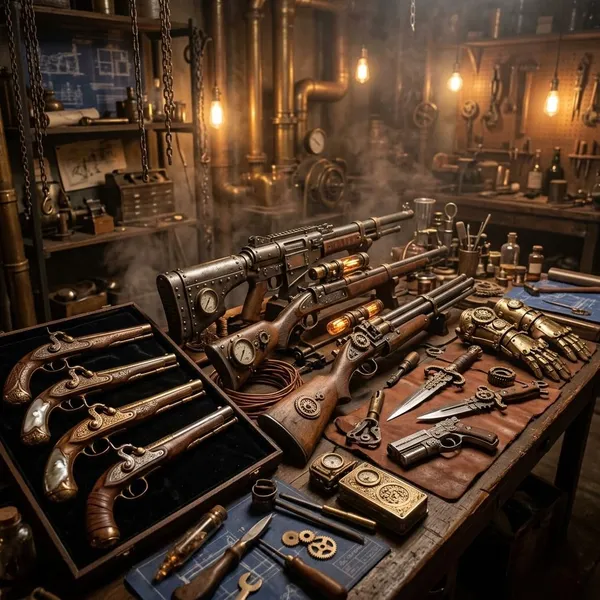
Best steampunk weapons for different characters
A good prop should make the character easier to understand at a glance. If the weapon only looks "cool" but says nothing about the person carrying it, the costume can start to feel generic.
Ornate pistols for airship captains
An airship captain usually needs a compact symbol of command, and an ornate pistol or revolver does that neatly. Polished brass, engraved grips, nautical markings, a compass motif, or a fitted leather holster can suggest rank without needing an oversized weapon.
Mechanical tools for inventors
Inventors are often more convincing with tools that could become weapons in a pinch: an electrical gauntlet, reinforced wrench, pressure syringe, coil projector, or adjustable hammer. The prop should look modified, repaired, and personally understood by the character.
- Good detail: labeled dials, patched tubing, spare screws, scorch marks.
- Weak detail: gears glued on with no visible purpose.
- Best use case: a character who builds, repairs, or tests dangerous devices.
Long rifles for explorers
Long rifles suit explorers because they imply distance, survival, and preparation. Add a leather sling, mock scope, weathered stock, map strap, or specimen tube to make the piece feel like expedition gear rather than a wall decoration.
Compact props for spies
Spies need subtle props: a hidden dagger, palm-sized ray device, compact pistol, lock-pick bracer, or disguised cane accessory. The best spy weapon looks controlled and clever rather than huge.
Small details matter here. A secret vial slot, coded engraving, fold-out tool, or dark finish can make a compact prop feel more memorable than a large weapon that does not fit the character's quiet role.
Swords and revolvers for officers
Officers often work best with a balanced loadout: a saber for rank and a revolver for practical authority. This pairing fits naval, military, policing, and security characters across many steampunk settings.
How to design a steampunk weapon prop
Designing a prop is easier when you start with a plain sentence: "This is a compressed-air scout pistol," or "This is an electrical inspector's baton." That one decision keeps the build from turning into a pile of unrelated parts.
Start with a nonfunctional base
Begin with something that cannot fire, cut, or launch anything. EVA foam, lightweight plastic, resin, cardboard, and 3D-printed shells are common choices because they are easier to shape, paint, carry, and repair.
Check the rules before you build if the prop is for an event. Some conventions restrict realistic firearm shapes, metal parts, sharp edges, moving triggers, or projectile mechanisms. It is much easier to design around those limits from the start than to rebuild the prop the night before.
Match the prop to the character
Ask what the character would actually choose. A wealthy officer may carry a polished sidearm; a mechanic may prefer a patched tool with visible repairs; a field doctor might carry a defensive device built into medical gear.
Choose one clear mechanical theme
Pick one system and let it control the details. Steam pressure suggests tanks, valves, hoses, and gauges. Electricity suggests coils, copper wire, ceramic-style mounts, and insulated grips. Chemistry suggests vials, clamps, dosage dials, and stained fittings.
Add brass wood and leather details
Brass, wood, and leather work because they feel handmade, aged, and mechanical. Use them where they make sense: grips, stocks, straps, guards, holsters, panels, and mounting points.
You do not need real brass or real wood for most cosplay props. Painted foam, faux leather, plastic trim, and printed textures can look convincing from normal viewing distance while keeping the piece light enough to wear all day.
Create an aged industrial finish
Weathering should appear where use would naturally happen: grip edges, corners, raised metal, straps, and contact points. Dry brushing, dark washes, and small scuffs usually look more believable than covering the whole prop in rust.
- Block the shape first. Make the silhouette readable before adding tiny details.
- Paint in layers. Base color, shadow, metallic highlights, then controlled wear.
- Seal high-touch areas. Handles and edges lose paint fastest during travel and posing.
- Stop before it looks abandoned. Used is better than filthy for most steampunk costumes.
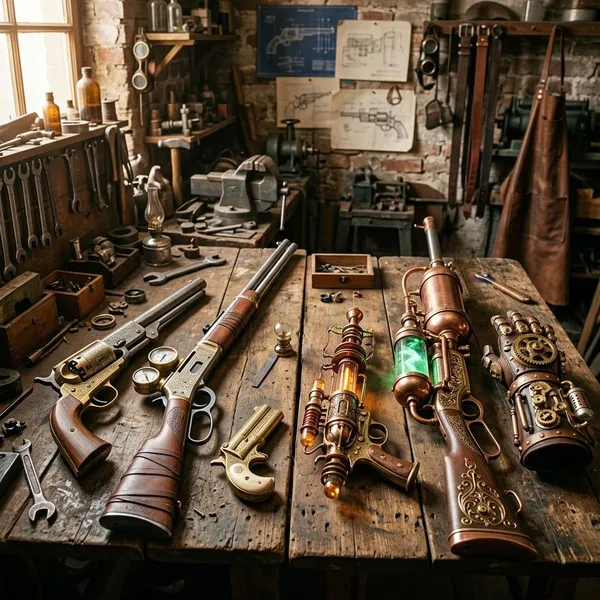
Choosing between realism and fantasy
The realism question changes the whole prop. Grounded designs feel like alternate history; fantasy-heavy designs feel like pulp adventure or retro science fiction. Neither is better, but mixing them carelessly can make the costume look confused.
| Direction | Best fit | Watch out for |
|---|---|---|
| Grounded historical | Officers, explorers, detectives, serious airship crews | Too many decorative parts with no purpose |
| Retro-futuristic | Inventors, scientists, ether engineers, moon adventurers | Oversized builds that become hard to carry |
| Pulp hybrid | Sky pirates, monster hunters, treasure raiders | Combining so many functions that the shape stops making sense |
| Decorative display | Home decor, photoshoots, lighter cosplay use | Realistic features that cause safety or event concerns |
Conclusion
The best steampunk weapon is not always the biggest or most decorated one; it is the one that looks safe, suits the character, and has a clear reason to exist. If you check event rules first, choose a prop that fits the role, and keep the mechanical idea consistent, even a simple pistol, cane, blade, or wrist gadget can feel more convincing than an overbuilt showpiece.
FAQ
Are steampunk weapons real or fictional?
Mostly fictional as finished props, but many are inspired by real historical weapons and old engineering ideas. For cosplay and display, they should be nonfunctional replicas rather than usable weapons.
Are ray guns essential in steampunk?
No. Ray guns fit retro-futuristic steampunk, but grounded characters may look better with revolvers, rifles, canes, blades, or mechanical tools.
What materials are safest for cosplay props?
Lightweight foam, EVA, plastic, cardboard, resin, and nonsharp 3D-printed shells are usually safer choices. Avoid heavy metal, sharp points, firing mechanisms, and anything that can launch a projectile.
Are steampunk weapons real or fictional?
Mostly fictional as finished props, but many are inspired by real historical weapons and old engineering ideas. For cosplay and display, they should be nonfunctional replicas rather than usable weapons.
Are ray guns essential in steampunk?
No. Ray guns fit retro-futuristic steampunk, but grounded characters may look better with revolvers, rifles, canes, blades, or mechanical tools.
What materials are safest for cosplay props?
Lightweight foam, EVA, plastic, cardboard, resin, and nonsharp 3D-printed shells are usually safer choices. Avoid heavy metal, sharp points, firing mechanisms, and anything that can launch a projectile.