
A steampunk time traveler stands out when the Victorian look, the time device, and the character's reason for crossing eras all feel connected. The quickest way to make the idea work is to decide what the traveler needs to survive first, then choose the coat, goggles, watch, tools, and machine around that purpose.
What is a steampunk time traveler
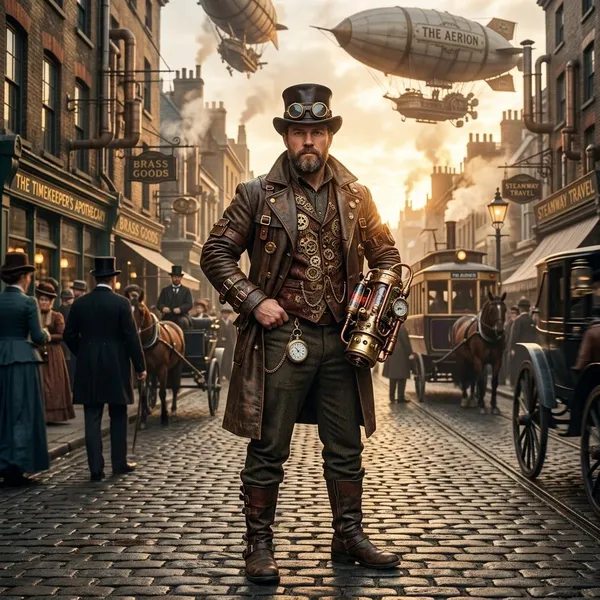
A steampunk time traveler is a character who moves through time using a world of brass mechanisms, steam pressure, clockwork parts, experimental science, and Victorian-inspired style. The concept works best when time travel feels physical: something that must be wound, calibrated, repaired, and sometimes feared.
A time traveler with steampunk styling
This character may deal with familiar time-travel problems such as paradoxes, altered history, lost relatives, or broken timelines, but the presentation is different from sleek science fiction. Instead of clean screens and silent portals, the traveler relies on levers, dials, pressure gauges, handwritten coordinates, and tools that look as if they were built in a workshop.
For a costume, that means the outfit should look ready for heat, smoke, field repairs, or sudden travel. For a story or game character, it means the machine should create problems as well as solve them.
Victorian influence with imagined technology
Victorian influence gives the traveler a recognizable base: tailored coats, waistcoats, high collars, corsets, boots, long skirts, pocket watches, formal manners, and industrial surroundings. Steampunk then bends that base with inventions that never existed but feel plausible inside the setting, such as analytical engines, airships, mechanical limbs, or clockwork navigation tools.
- Keep the silhouette historical: use clothing shapes that suggest the nineteenth century.
- Make the technology visible: show gears, tubing, lenses, valves, or controls.
- Avoid pure decoration: each major accessory should hint at a job or risk.
Time travel shaped by mechanical invention
Steampunk time travel usually feels unstable because the invention is still being tested, repaired, or hidden from the wrong people. A broken spring, overheated boiler, leaking valve, or misaligned chronometer can send the traveler to the wrong decade instead of simply causing a technical delay.
That mechanical weakness is useful. It gives the character limits. An inventor may understand the machine too well and trust it too much, while a fugitive may only know enough to make one dangerous jump before the device fails.
What does a steampunk time traveler look like
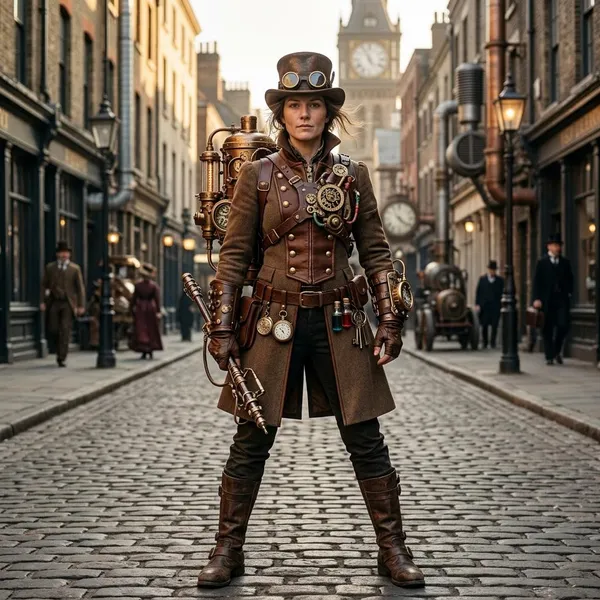
The look should combine elegance with survival. A good steampunk traveler can attend a formal salon, crawl under a malfunctioning engine, and step into an unknown century without seeming completely unprepared.
Start with the role before choosing accessories. A detective, engineer, explorer, and aristocratic inventor may all use brass and leather, but they should not look like the same person with different props.
Victorian-inspired clothing
Common clothing pieces include frock coats, waistcoats, tailored jackets, high-collared shirts, fitted trousers, corsets, long skirts, gloves, and sturdy boots. The practical version usually adds hidden pockets, reinforced seams, layered fabrics, and enough freedom of movement for travel or repair work.
A quick cosplay can lean on a strong coat, boots, goggles, and one clear time device. A fiction character needs more logic: clothes should show class, occupation, travel wear, and how often the person has been forced to repair things under pressure.
Brass and copper details
Brass and copper make the design feel mechanical rather than modern. Use them for buckles, buttons, tubing, watch cases, instrument frames, shoulder pieces, or small tools. Polished metal can suggest wealth or careful maintenance; tarnished metal suggests hard use, field travel, or a machine that has been repaired too many times.
Goggles and protective gear
Goggles are popular because they look dramatic, but they work best when they protect the traveler from something specific: steam bursts, sparks, smoke, glass fragments, bright energy flashes, or debris from a failed jump.
Other protective pieces can include leather gloves, bracers, aprons, masks, or reinforced sleeves. If nothing in the character's life threatens their hands, eyes, or lungs, heavy protective gear can start to look like decoration instead of design.
Pocket watches and chronometers
A pocket watch is one of the easiest ways to signal time travel, but it becomes stronger when it has a function. It might track temporal drift, warn when a timeline changes, lock onto a destination date, or hold the only stable coordinates back home.
- Family heirloom: good for a traveler motivated by loss or legacy.
- Scientific instrument: better for an inventor, engineer, or investigator.
- Damaged watch: useful when the story needs uncertainty and risk.
Tool belts and mechanical accessories
Tool belts, gear keys, miniature screwdrivers, coils of wire, vials, map tubes, and calibration tools make the traveler feel capable. The mistake to avoid is loading the outfit with random objects. If the character carries it, the reader or viewer should be able to guess why it matters.
Steampunk time travel technology
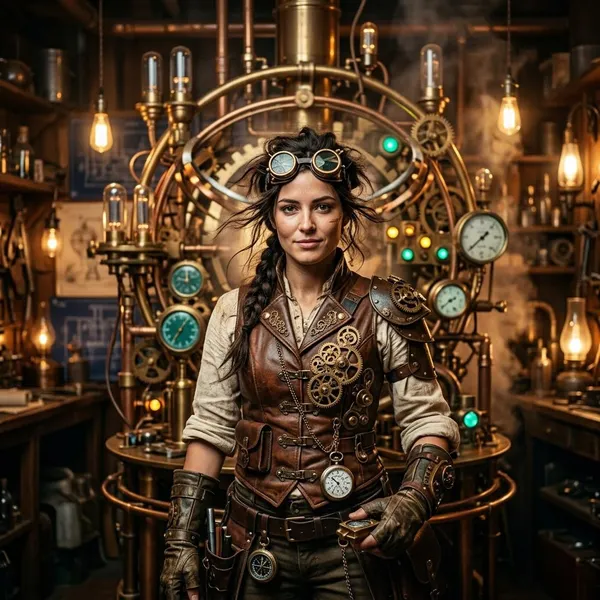
Steampunk time travel technology should feel powerful but imperfect. The best devices have visible controls, a clear power source, a targeting method, and at least one limitation that stops time travel from becoming too easy.
| Device choice | Best for | Main drawback to build around |
|---|---|---|
| Large machine | Dramatic labs, inventors, major experiments | Hard to move or hide |
| Portable device | Escapes, investigations, cosplay props | Limited power or range |
| Navigation instrument | Mystery plots and skilled travelers | Can be misread, damaged, or sabotaged |
Clockwork time machines
Clockwork time machines use gears, springs, escapements, rotating rings, and precise timing systems to make time feel like something mechanical. They suit stories where small faults matter. A bent gear tooth, slipped spring, or dirty escapement can become the reason a traveler lands two years late.
Steam-powered temporal engines
Steam-powered temporal engines bring weight and danger into the design. Boilers, pistons, pressure chambers, exhaust vents, and hot metal make the jump feel noisy and risky rather than clean.
Portable time devices
Portable devices can be watches, gauntlets, medallions, cane handles, compact brass consoles, or small engine packs. They are useful when the traveler needs mobility, secrecy, or repeated short jumps.
- Give it a limit: one jump before cooling, a narrow date range, or rare fuel.
- Make it personal: inherited, stolen, self-built, or repaired from wreckage.
- Show the cost: overheating, inaccurate landings, or damage after misuse.
Mechanical navigation instruments
Navigation tools make time travel feel like a skill instead of a button press. A traveler might use rotating date dials, star charts, timeline compasses, engraved coordinate plates, or a chronometer synchronized to a fixed historical event.
Experimental energy systems
Some steampunk settings use aether, galvanic current, stored lightning, crystals, alchemical fuel, or other fictional energy sources. These can work as long as the energy is handled through physical devices rather than vague power. Give it a container, a gauge, a danger sign, and a reason not everyone can use it safely.
Common steampunk time traveler character types
Character type helps decide what details matter and what can be left out. The same brass watch means something different in the hands of an inventor, detective, engineer, explorer, or fugitive.
Choose the type before filling the belt with gadgets. That one decision keeps the character from becoming a pile of attractive steampunk objects with no clear story.
Inventor testing a forbidden machine
The inventor builds or modifies the machine and usually believes the risk is worth it. This type is strongest when genius comes with a blind spot: arrogance, grief, ambition, or the belief that history can be corrected like a calculation.
Good visual cues include burned cuffs, annotated notebooks, prototype tools, loose wires, and a machine that looks brilliant but not fully safe.
Explorer trapped between eras
The explorer is useful when the story needs discovery. They may start with curiosity, a map, or a funded expedition, then lose control of the route home.
This type works well for a long-term travel scenario. After months or years of jumping between periods, the clothing should look patched, the tools should be practical, and the character may no longer feel fully at home in any single era.
Detective investigating timeline changes
A detective notices contradictions: records that changed, people who vanished, inventions appearing too early, or political events that no longer match memory. Their time device should support observation rather than brute-force travel.
- Best gadgets: chronometer, evidence tubes, lock picks, coded notebooks.
- Best conflict: restoring one timeline may harm someone in another.
- Best visual tone: controlled, discreet, slightly worn from fieldwork.
Engineer repairing temporal technology
The engineer keeps the impossible machine working. They may not be the person who wanted to travel, but they understand why the engine is shaking, why the pressure is dropping, and which part will fail next.
This role is ideal when you want practical tension. While others argue about destiny, the engineer is choosing whether to patch a valve now or risk one more jump.
Fugitive escaping through time
The fugitive adds urgency. They may be escaping a government, a rival inventor, a secret order, or the consequences of changing history. Their gear should be lighter, more hidden, and more damaged than a well-funded inventor's equipment.
A fugitive is not automatically heroic. They might be framed, guilty, or protecting knowledge too dangerous to leave in one century. That uncertainty makes the character more interesting than a simple runaway.
How to create a steampunk time traveler
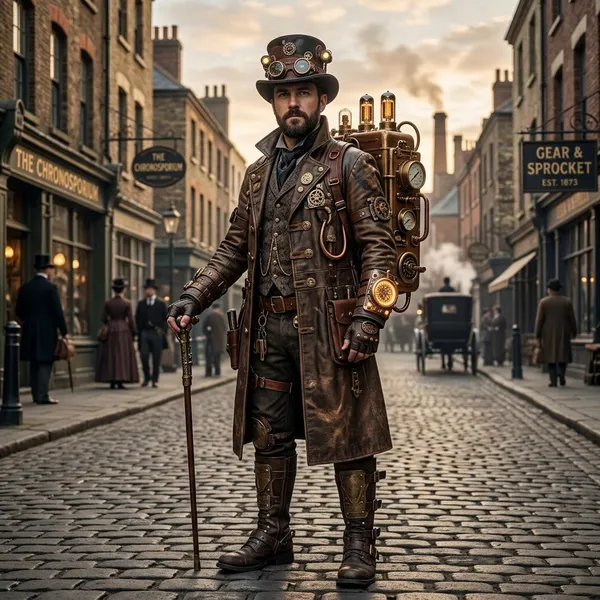
Build the character from purpose outward. The most useful order is era, motive, device, clothing, then gadgets. If you start with random accessories, the design may look busy but say very little.
For a simple illustration or one-day costume, one strong role and one readable device may be enough. For fiction, roleplay, or a game character, add limits, conflicts, and signs of use so the traveler feels lived-in.
Choose the character's home era
Pick the era that shaped the character's habits. An alternate Victorian scientist, a future engineer from a neo-Victorian empire, and a servant who stole a noble inventor's device will not speak, dress, or judge danger in the same way.
Do not stop at the year. Decide what the character thinks is normal: strict manners, class hierarchy, dangerous factories, experimental science, empire politics, or constant mechanical failure. Time travel becomes more interesting when it challenges those assumptions.
Define the reason for time travel
The motive should be strong enough to justify the risk. Saving someone, proving a theory, solving a timeline crime, escaping punishment, stealing forbidden knowledge, or preventing a disaster all give the traveler direction.
A weak motive makes the machine feel like a prop. A strong motive changes decisions: a grieving traveler may jump too soon, while a trained investigator may wait, observe, and risk missing the perfect moment.
Design a signature time device
Give the device a shape, a method, and a flaw. It might be a wrist chronometer that handles short jumps, a room-sized brass engine that needs two operators, or a pocket watch that can find one lost date but overheats after use.
- Shape: watch, gauntlet, engine, chamber, cane, compass, or console.
- Method: steam pressure, clockwork timing, aether charge, or hybrid system.
- Flaw: limited range, rare fuel, drifting coordinates, or dangerous cooling time.
Match clothing to the character role
Clothing should show what the traveler actually does. An engineer needs gloves, storage, and durable fabric. A detective may need dark tailoring and hidden pockets. An aristocratic inventor can look refined, but the outfit still needs access to tools and controls.
Give each gadget a clear purpose
Use fewer gadgets and make them easier to understand. A clear set of tools feels more convincing than a belt crowded with unexplained objects.
- Chronometer: detects drift or locks onto a destination date.
- Fuel canister: limits how many jumps the traveler can risk.
- Mechanical map reader: helps match place, date, and route.
- Repair kit: explains how the traveler survives breakdowns.
- Lens or scanner: reveals altered objects, hidden marks, or timeline residue.
If an item does not affect the story, costume, or role, leave it out. The empty space often makes the important pieces stand out more.
Conclusion
A memorable steampunk time traveler is not defined by goggles alone; the character works when the era, motive, machine, clothing, and tools all point in the same direction. Decide what risk the traveler faces first, then choose the details that help them survive it, and the design will feel far less like a generic steampunk costume and much more like someone who has actually crossed time.
FAQ
Does a steampunk time traveler need a time machine?
Usually, yes, but it does not have to be a large vehicle. A pocket watch, gauntlet, chamber, compass, or engine can work if it has a clear mechanical logic and a believable limit.
Can steampunk time travel use magic?
Yes, especially in fantasy-steampunk settings. It feels more steampunk when the magic is controlled through devices, alchemy, crystals, rituals, or instruments rather than appearing as effortless spellcasting.
How is a steampunk traveler different from a steampunk adventurer?
A steampunk adventurer explores dangerous places within their own era. A steampunk time traveler is defined by crossing eras, dealing with altered history, and depending on technology or power that can move them through time.