
Steampunk symbols work best when they feel like clues, not random decoration. Gears, goggles, clocks, airships, keys, and tools all point to different parts of the steampunk world: invention, risk, precision, travel, secrecy, and craft. If you are choosing symbols for a costume, story, room, logo, or artwork, start with what the object is meant to say before adding more brass and clockwork.
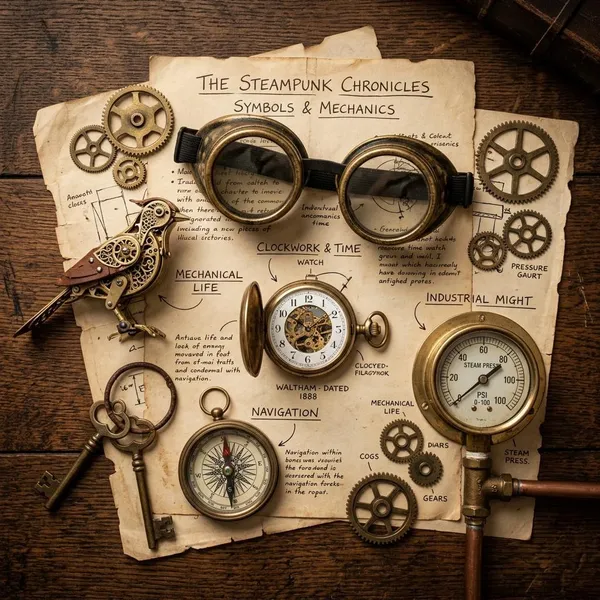
Common steampunk symbols and their meanings
The most familiar steampunk motifs come from Victorian style, industrial machinery, exploration, and retro-futurist fantasy. They are popular because they tell the viewer very quickly what kind of world they are seeing: handmade technology, visible mechanics, old materials, and a future imagined through nineteenth-century tools.
Gears and cogs for invention and machinery
Gears and cogs are the quickest visual shorthand for steampunk because they make machinery visible. They suggest invention, motion, engineering, and systems that can be repaired by hand rather than hidden behind modern plastic casing.
A single gear can work well on a pin, logo, or book cover when you need a clean industrial signal. Interlocking gears feel more complex and can imply a machine, a workshop, a city system, or a character who thinks in mechanisms. The mistake is using loose gears everywhere with no sign that they connect to anything.
Goggles for experimentation and adventure
Goggles add risk. They make a character look ready for sparks, steam, dust, wind, or an engine test that might go wrong.
- Inventor or mechanic: goggles suggest hands-on work near machines.
- Airship pilot: they imply altitude, speed, and weather.
- Explorer: they make travel feel rougher and more dangerous.
For a simple costume, goggles can instantly move a Victorian outfit into steampunk territory. For a more serious character design, they should look as if they are actually used, not just parked on a hat for decoration.
Clocks for time and precision
Clocks, pocket watches, and exposed watch parts symbolize time, order, precision, memory, and obsession. They fit steampunk naturally because clockwork is delicate, visible, and mechanical.
Use clock imagery when the project involves deadlines, fate, navigation, invention, or a character who values control. A clock face on its own may feel antique; a clock linked to a device, map, lock, or machine feels more steampunk.
Airships for exploration and imagination
Airships represent travel, freedom, ambition, and adventure. They are especially useful when you want the design to feel larger than a workshop or drawing room.
Keys for discovery and hidden mechanisms
Keys point to secrets, access, locked rooms, hidden compartments, and knowledge that not everyone can reach. They are softer and more mysterious than gears, which makes them useful for jewelry, invitations, tattoos, mystery stories, or character props.
A plain antique key reads as Victorian. A key connected to a coded lock, machine, laboratory, or map starts to feel steampunk because it suggests a hidden mechanism behind the surface.
Tools for craft and ingenuity
Tools show that someone in the world actually builds, fixes, measures, and adapts things. Wrenches, calipers, screwdrivers, hammers, and measuring instruments can make steampunk feel lived-in instead of purely decorative.
They are also useful when you want a character to feel practical. A socialite with a pocket watch may look elegant; a traveler with a compact tool roll feels prepared. For a workshop-style room, tools usually do more convincing work than dozens of glued-on watch parts.
Why gears and goggles became steampunk icons
Gears and goggles became icons because they solve the genre's biggest visual problem: they separate steampunk from ordinary Victorian imagery. A frock coat, lace dress, or brass lamp may look historical, but visible machinery and adventure gear make the setting feel altered, experimental, and retro-futuristic.
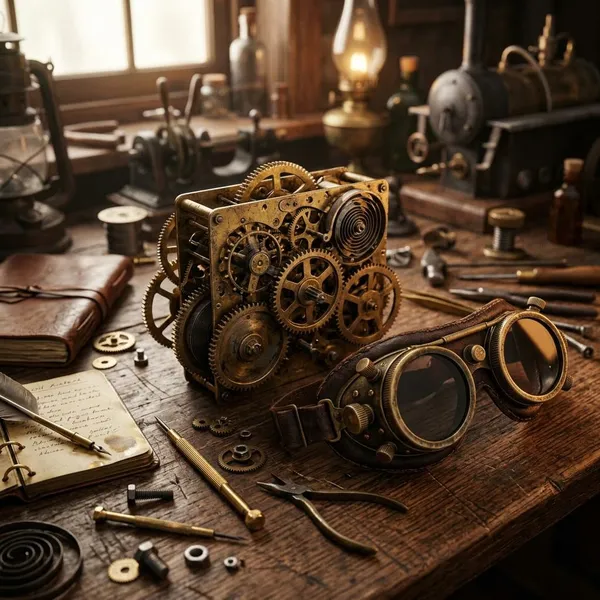
Visible machinery reinforces invention
Exposed gears, valves, pistons, rivets, and gauges tell the viewer that technology is meant to be seen. That matters because steampunk often celebrates machines that feel understandable, adjustable, and slightly dangerous.
Industrial details create retro-futurism
Industrial details make old materials feel futuristic in an alternate-history way. Brass, copper, leather, glass, wood, and iron can suggest a world where advanced technology developed through steam power, clockwork, and mechanical engineering instead of electronics.
That is why a pocket watch can become a navigation device, a cane can hide a mechanism, and a pair of goggles can look like equipment from a different timeline. The object stays rooted in the past, but its purpose points forward.
Adventure gear suggests dangerous technology
Goggles became popular because they make invention feel risky. They imply smoke, sparks, pressure leaks, high winds, or flying debris without needing a long explanation.
- Low-risk costume: clean goggles on a hat can be enough to signal the theme.
- Character or cosplay build: scratched lenses, straps, and wear marks make them feel used.
- Poster or cover art: goggles can immediately suggest action instead of a static period portrait.
Repetition made the motifs recognizable
Repeated use turned gears and goggles into a shared visual code. Fans, makers, events, covers, costumes, and online shops used them so often that even people with only a loose understanding of steampunk can usually identify the style.
Steampunk symbols vs Victorian imagery
Steampunk and Victorian design overlap, but they are not the same thing. Victorian imagery reflects a real historical period; steampunk borrows from that period and adds imagined technology, visible mechanics, and alternate progress.
Victorian design reflects a historical period
Victorian imagery includes lace, parasols, corsets, carved furniture, floral wallpaper, portraits, candleholders, tailored coats, and formal domestic details. These elements suggest history, class, etiquette, craftsmanship, and social atmosphere.
On their own, they do not automatically become steampunk. A top hat is historical. A top hat with fitted goggles, a hidden lens, or a signaling device starts to tell a different story.
Steampunk adds imagined technology
Steampunk begins when the historical look gains invented technical logic. A writing desk becomes a control station, a carriage becomes a steam-powered vehicle, or a dress gains utility straps, tools, and small instruments.
Machinery becomes part of the visual identity
In Victorian imagery, machinery may exist in the background. In steampunk, machinery often becomes part of the identity of the person, object, or place.
Retro-futurism separates the two styles
Retro-futurism is the clearest dividing line. Victorian style looks back to a real past, while steampunk imagines a future that might have grown from that past.
How to use steampunk symbols effectively
The strongest steampunk designs are usually not the busiest ones. A focused set of symbols feels more believable than a pile of gears, keys, clocks, wings, goggles, and brass corners all competing for attention.
Start with the role of the project. A one-night party costume can rely on a few obvious signals. A novel character, brand identity, or room design needs tighter logic because people will spend more time looking at the details.
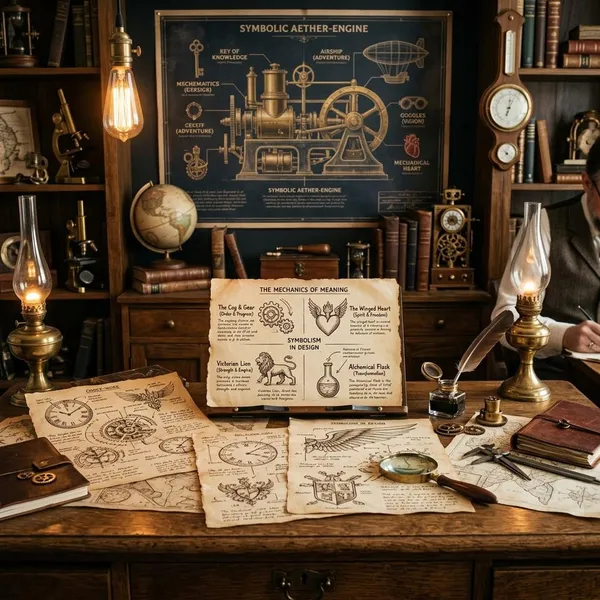
Match symbols to the character or story
Choose symbols that match the person, setting, or message. An explorer fits airships, maps, goggles, compasses, and telescopes. A locksmith or spy fits keys, locks, hidden compartments, and fine tools. A clockmaker fits pocket watches, escapements, calipers, and neat rows of parts.
Give mechanical details a purpose
Mechanical details should look as if they do something. A gauge should appear to measure pressure, a strap should secure equipment, a pipe should connect two parts, and a gear should belong to a visible mechanism.
- Keep: parts that protect, measure, unlock, steer, power, repair, or record.
- Question: loose gears with no connection to anything.
- Remove: repeated decorations that hide the main idea.
Mix fashion with functional technology
Steampunk often works because it combines elegance with utility. A structured jacket becomes more interesting with a tool harness. A dress feels more character-driven with a wrist device, pouch, or small instrument. A hat becomes more adventurous when the goggles look like equipment rather than costume trim.
For home décor, the same balance helps. Pair softer materials such as leather, aged paper, fabric, and wood with harder details like brass, glass, metal frames, and instrument-style pieces. Too much machinery can feel cold; too much fabric and antique furniture may drift back into plain Victorian style.
Limit repeated gears and decorative clutter
Use gears sparingly unless the whole point is a machine interior. One clear cluster near a hinge, clock, engine, or control panel is more convincing than scattered gears on every corner.
If the design already has a clock face, pressure gauge, compass, and key, adding five more gear decals probably will not add meaning. Editing is often what makes steampunk look intentional rather than like a craft box exploded.
Keep materials and motifs consistent
Consistency makes the illusion easier to accept. Brass, copper, dark iron, leather, stained wood, glass, and aged paper usually sit well together because they feel tactile and mechanical. Sleek plastic, bright chrome, or modern digital elements can work only if the contrast is deliberate.
Use a small decision filter before finishing:
- Theme: travel, laboratory, espionage, workshop, aristocratic, or survival?
- Main symbols: choose two or three that carry the idea.
- Support details: add only what strengthens the theme.
- Final edit: remove anything that repeats without adding function.
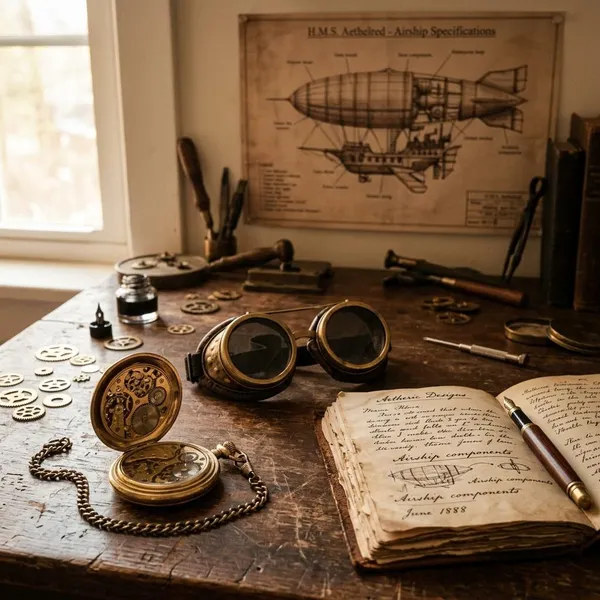
Conclusion
Steampunk symbols are most effective when they help the viewer understand the world at a glance: who builds, who travels, what is hidden, and what kind of technology shapes the setting. Gears and goggles are useful starting points, but the better choice is always the symbol that fits the character, object, or space you are creating. If every detail has a reason to be there, the result feels more imaginative and far less like generic clockwork decoration.
FAQ
What symbol represents steampunk best?
A gear is usually the most recognizable steampunk symbol because it immediately suggests visible machinery and invention. For adventure-focused designs, goggles may communicate the style faster.
What do gears symbolize in steampunk?
Gears symbolize mechanical thinking, motion, industry, and hand-built technology. They work best when they appear connected to a device rather than used as loose decoration.
Why do steampunk characters wear goggles?
They wear goggles to suggest protection from sparks, steam, dust, wind, or experimental machinery. Visually, goggles also turn formal Victorian clothing into adventure gear.