
The steampunk submarine escape room is worth booking if your group wants a hands-on, story-driven challenge rather than an easy room of simple codes. The main thing to check before you book is whether your team enjoys searching, communicating, and working under pressure, because the setting is fun precisely because it asks more from you.
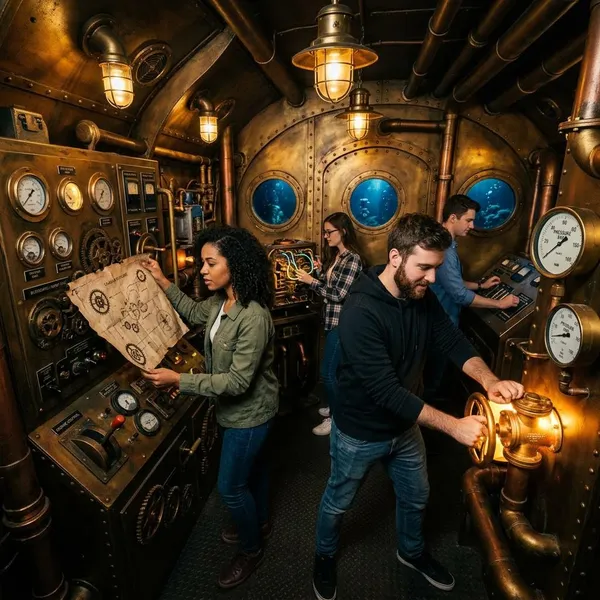
What happens in the Steampunk Submarine room
The room puts your team inside a failing vessel where the goal is not just to "find the key," but to understand what is broken and bring the submarine back under control. That makes the experience feel more like an adventure mission than a standard puzzle room.
If you are choosing between this and a lighter beginner room, the difference is tone and pace. This one is better for a group that wants a busy hour with discoveries, mechanical fixes, and a real countdown feeling.
Repair a mysterious failing vessel
Your team enters as engineers dealing with an old submarine that is no longer behaving as it should. That repair premise matters because it gives the puzzles a reason to exist: controls, panels, valves, and systems feel connected to the vessel instead of dropped into the room as random obstacles.
Explore hidden submarine compartments
The room appears to reward curiosity. Hidden spaces and progressive reveals are a big part of why this theme works, especially for groups that enjoy opening up the environment piece by piece.
- Search low, high, and behind unusual details.
- Revisit earlier areas after something changes.
- Tell the group when you find a new compartment, even if you do not know what it means yet.
Restore its mechanical systems
This is where the steampunk setting earns its place. The best moments are likely to be physical and mechanical: adjusting something, connecting clues to a device, or seeing a system respond after the right action.
That makes the room a good fit for players who prefer solving by doing. If your group enjoys tactile puzzles more than long written riddles, this theme is probably a better match than a purely detective-style room.
Escape before the submarine sinks
The countdown fits the story naturally. A sinking submarine gives the 60-minute timer more weight, so delays feel more urgent than they might in a slower, calmer room.
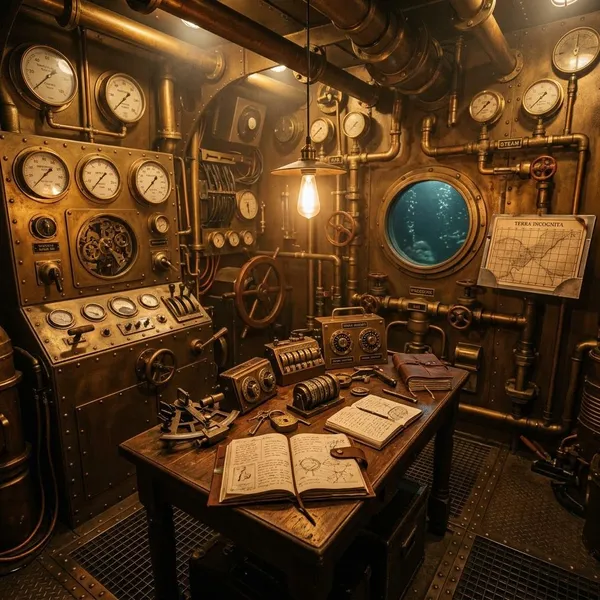
What the Steampunk Submarine puzzles are like
The puzzles are best suited to players who enjoy connected problem solving. Expect the room to ask your group to combine observations, physical interactions, and information found in different places rather than solving one neat puzzle at a time.
Before the timer starts to feel tight, agree on one simple rule: nothing stays private. A symbol, switch, gauge, strange label, or opened compartment may be useless to the person who found it and essential to someone else.
Hands-on mechanical tasks
Mechanical tasks are the main reason this room sounds more memorable than a basic lock-heavy game. Turning, aligning, activating, repairing, or triggering parts of the set gives more players something to do and makes the submarine feel active.
This can also help mixed groups. Someone who is not great at word puzzles may still be excellent at spotting how a mechanism moves or noticing what changed after a control was used.
Connected multi-step puzzles
Do not expect every solved clue to give an immediate final answer. One step may reveal a part, another may explain how to use it, and a third may only make sense once another player finds the missing connection elsewhere.
| What your team notices | Best response |
|---|---|
| A clue seems incomplete | Announce it and keep it visible for later. |
| Two players are stuck on one station | Send one person back to search or compare clues. |
| A device reacts but does not finish | Look for a second input, sequence, or matching symbol. |
Clues hidden throughout the rooms
Because clues are likely spread across the environment, a quick first sweep is worth doing before everyone crowds around the first obvious puzzle. Look for anything that feels deliberately placed: repeated symbols, unusual textures, labels, gauges, panels, or objects that seem too specific to be decoration.
Challenges built around teamwork
Teamwork matters more than having one very clever player. A strong group keeps information moving, avoids five people staring at the same puzzle, and notices when someone has gone quiet with a half-solved clue.
- For 2 or 3 players: move fast and talk constantly, because coverage is limited.
- For 4 to 6 players: split searching, solving, and tracking used clues.
- For 7 or 8 players: avoid crowding; too many hands on one puzzle can slow everything down.
A coordinated smaller team can easily have a better experience than a larger group that never shares discoveries.
How difficult is Steampunk Submarine
Steampunk Submarine should be treated as a hard room, not a casual warm-up. The original listing mentions a 60-minute game, a hard difficulty rating, and a 44% success rate, so the safer expectation is a demanding but manageable challenge if your team stays organized.
The first thing to check is your group's comfort with pressure. If your players enjoy intense puzzle solving, this difficulty can be part of the appeal. If the group mainly wants a relaxed social activity, a lower-difficulty room may be a better first choice.
Harder than a typical beginner room
A beginner room usually gives clearer clue paths and more forgiving pacing. This room seems less forgiving because exploration, mechanical systems, and connected puzzle chains can all create bottlenecks.
Easier with clear team roles
Loose roles make the room much easier to manage. One person can keep track of used clues, one or two can continue searching, and others can work on active mechanisms. These roles can change, but having some structure prevents the classic escape room problem where everyone does the same thing while important clues sit untouched.
Demanding under time pressure
The room's pressure is not only about the clock; it is about how quickly the team can recover from wrong assumptions. A group that argues over one theory for ten minutes will feel the difficulty much more than a group that tests, shares, and moves on.
Manageable with well-timed hints
Hints are useful when they protect the experience instead of replacing it. If your team understands the general direction but cannot see the next connection, a small nudge can keep the adventure moving without ruining the satisfaction.
- Ask sooner if the whole team is stalled.
- Wait if two players are actively making progress.
- Use a hint if frustration is replacing curiosity.
For a family group with younger players or a team doing one of its first escape rooms, well-timed hints can be the difference between a fun challenge and a rushed final ten minutes.
Who will enjoy Steampunk Submarine
The best audience is a group that wants atmosphere, interaction, and a bit of pressure without needing horror. It is especially appealing if your idea of a good escape room is "give us a strange world to explore and a machine to fix," not "give us a quiet room of padlocks."
It may be less ideal for players who want a very easy first escape room, dislike searching, or get frustrated when puzzles depend on several connected discoveries.
Experienced escape room players
Experienced players are likely to appreciate the layered design. If your group has already done common themes like prison breaks, detective offices, or haunted rooms, the submarine setting gives a different kind of atmosphere and puzzle logic.
It also suits teams that already know how to divide work without losing communication. That habit matters more here than in a simple linear room.
Fans of mechanical puzzles
This is probably one of the safest matches. Mechanical puzzle fans usually want visible cause and effect: adjust something, hear a response, unlock a system, or reveal a new part of the room. The steampunk submarine concept naturally supports that kind of play.
Groups that enjoy exploration
Exploration-focused groups should enjoy the hidden compartments and environmental clue placement. This is the kind of room where careful looking can feel just as important as clever decoding.
Players who prefer adventure over horror
The room sounds better for adventure fans than horror fans. The tension comes from a failing vessel and limited time, not from scares as the main attraction.
That makes it easier to recommend for mixed groups, teens, coworkers, or families who want excitement without choosing a fear-heavy room. If the listed age guidance and venue rules fit your group, this can be a strong middle ground: dramatic, but not built around frightening people.

Conclusion
The steampunk submarine room is a good pick when your group wants a challenging, tactile escape room with a strong setting and a real sense of urgency. Book it with a team that will communicate, search carefully, and use hints without pride getting in the way; choose an easier room if the group mainly wants a relaxed first try.
FAQ
How hard is the Steampunk Submarine room?
It is hard enough that you should not treat it as a casual beginner room. The listed 44% success rate suggests many teams need strong communication and timely hints to finish.
How many people should play together?
The room supports 2 to 8 players, but 4 to 6 is likely the most comfortable range. That gives enough people to search and solve without turning every puzzle station into a crowd.
How long does the experience last?
The game itself is listed as 60 minutes. Plan extra time for check-in, briefing, and any post-game wrap-up at the venue.
How hard is the Steampunk Submarine room?
It is hard enough that you should not treat it as a casual beginner room. The listed 44% success rate suggests many teams need strong communication and timely hints to finish.
How many people should play together?
The room supports 2 to 8 players, but 4 to 6 is likely the most comfortable range. That gives enough people to search and solve without turning every puzzle station into a crowd.
How long does the experience last?
The game itself is listed as 60 minutes. Plan extra time for check-in, briefing, and any post-game wrap-up at the venue.