
A believable steampunk mech should look as if it could be built, fueled, repaired, and argued over inside an industrial-age world. Brass trim and gears help the style, but the design only works when the machine has a clear job, a visible power logic, and limits that affect how people use it.
What makes a mech steampunk
A mech feels steampunk when its shape, materials, and movement come from Victorian industry rather than clean futuristic engineering. The first things to check are simple: can you see how it is powered, where it vents heat, how a crew reaches broken parts, and why its society would build something so expensive?
Victorian industrial styling
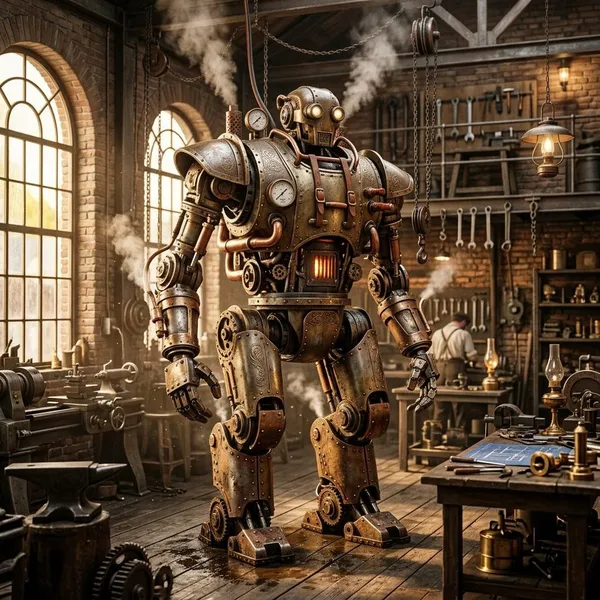
The styling should borrow from locomotives, ironclads, cranes, boilers, diving suits, foundries, and railway yards. Thick struts, inspection plates, cast-metal housings, smokestacks, ladders, and reinforced joints usually feel more convincing than smooth armor painted bronze.
Exposed gears pistons and boilers
Visible mechanisms are not just decoration. Gears, pistons, belts, tanks, and boilers should suggest how force travels through the frame. A shoulder piston should look as if it helps lift the arm; a rear boiler should look heavy enough to affect balance.
- Expose parts that explain motion.
- Protect parts that would be hit constantly.
- Leave some access space for repair crews.
- Avoid random gears that do not seem connected to anything.
Riveted armor and analog controls
Riveted armor makes the mech feel cut, forged, patched, and repaired by people rather than manufactured by impossible future tools. Damaged plates can be replaced, dents can stay visible, and uneven repairs can show the machine's history.
Steam clockwork and early electric power
Steam is the classic choice, but a believable design can mix systems. Steam may provide brute force, clockwork may handle timing, and early electric circuits may support lamps, signals, ignition, or crude stabilization.
Use the power mix to show status and setting. A wealthy city-state might field electric-assisted police walkers for short urban patrols, while a frontier mining camp may rely on rough boiler frames because coal and spare iron are easier to get than precision electrical parts.
Visible wear smoke and heat
A working machine should show strain. Soot around vents, heat discoloration near the boiler, oil streaks below joints, patched armor, dented footplates, and scorched exhausts all tell the reader that the mech costs effort to run.
Keep the wear matched to the role. A parade unit can be polished but still have darkened vent ports. A long-term battlefield walker should look more tired: replaced plates, mismatched rivets, cracked paint, and crew notes marked near access hatches.
How steampunk mechs work in fiction
Fictional steampunk mechs do not need perfect engineering, but they do need consistent rules. If the machine can move, fight, and survive without fuel, warm-up time, heat problems, crew support, or breakdown risk, it starts to feel like magic with brass attached.
Boilers generate power
A boiler gives the mech a strong industrial heart, but it also brings useful constraints. It needs fuel, water, pressure, safety valves, and time. That means a steam walker may not be ready the instant the pilot climbs in.
Pistons move the limbs
Pistons make heavy motion easy to understand. They can drive knees, elbows, lifting arms, stabilizers, or weapon braces. The movement should usually feel forceful rather than graceful: push, lock, brace, release.
Do not make piston limbs behave like a silent gymnast unless your world has a strong reason. Slower steps, awkward turns, and exposed pressure lines often make the machine more memorable than perfect agility.
Levers control movement
Levers make the cockpit tense. The pilot is not tapping a screen; they are hauling controls, watching pressure, listening for knocks, and feeling the machine lag behind their intention.
- One-person control works for smaller frames.
- Two-person crews suit armed patrol or cargo machines.
- Larger war mechs may need a pilot, engineer, gunner, and stoker.
Vents release heat and pressure
Vents should matter. Releasing steam may prevent damage, but it can also reveal position, reduce pressure, blind nearby allies, or leave a vulnerable port open at the wrong moment.
For a game or action scene, venting is a clean decision point: push the engine for one more charge, or vent now and lose momentum. That kind of trade-off makes the machine feel mechanical instead of decorative.
Crews handle fuel and repairs
No convincing steampunk mech lives on pilot skill alone. Someone loads fuel, fills water tanks, clears ash, tightens bolts, replaces hoses, greases joints, and patches armor after every hard use.
This support chain is especially useful in long campaigns. A short arena duel can get away with one dramatic machine; a war story or RPG journey needs depots, spare parts, exhausted mechanics, and awkward choices about what to repair first.
How to design a believable steampunk mech
Start with purpose before silhouette. A strong design usually comes from one clear answer: what problem is this machine supposed to solve better than horses, trains, cranes, tanks, ships, or ordinary workers?
Define its main purpose
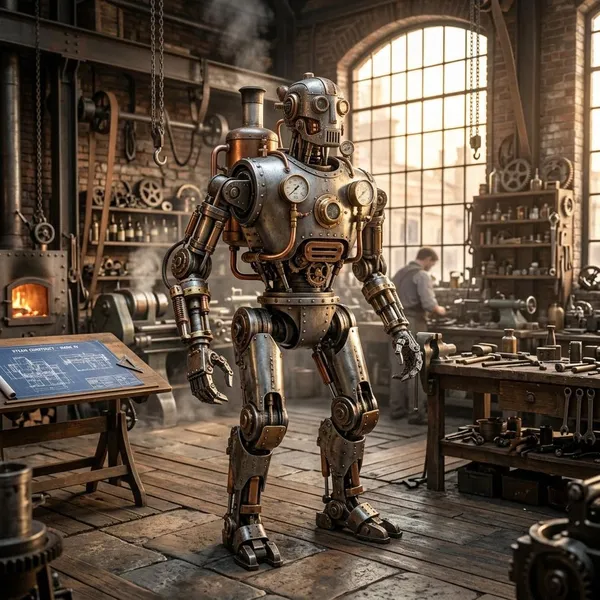
Give the mech one main job and, at most, one secondary job. A trench breaker, dockyard loader, mining frame, polar survey walker, city patrol unit, and artillery carrier should not all have the same body.
| Role | Design should prioritize | Avoid |
|---|---|---|
| Mining or cargo work | Stability, lifting arms, repair access | Overbuilt weapons |
| Urban patrol | Compact size, visibility, controlled heat | Huge boilers that fill streets with smoke |
| Siege or trench assault | Frontal armor, short powerful legs, crew protection | Delicate exposed controls near the front |
| Exploration | Range, balance, field repairs | Parts that require a full factory to replace |
Choose a fitting power source
The power source should create both ability and trouble. Pure steam fits heavy machines near rail lines or depots. A steam-electric hybrid suits advanced cities, expensive prototypes, or short-range elite units. Clockwork systems work best for timing, stored motion, or small automata-like functions, not endless battlefield power.
Match the body to its role
The body should show terrain and load at a glance. Wide feet make sense for mud, docks, or heavy cargo. Short legs suit armored assault. A tall frame may improve visibility but becomes a better target and needs stronger balance.
If the boiler sits high on the back, the hips, ankles, and feet must look ready for that weight. If the mech carries a cannon on one side, give it a counterweight, brace, or firing stance. Small structural clues stop the design from looking like a costume placed on a human body.
Add clear limits and weaknesses
Limits make the mech easier to believe and more fun to use. Pick flaws that change behavior, not vague weaknesses that never matter.
- Overheats after long bursts of movement.
- Turns poorly in narrow streets.
- Needs clean water more often than fuel.
- Exposes knee pistons when climbing.
- Cannot cross weak bridges without preparation.
Connect it to the wider world
A mech should leave marks beyond the battlefield. Roads may need reinforcement, rail yards may carry spare boilers, factories may specialize in replacement plates, and newspapers may turn famous pilots into public symbols.
- Choose the main job.
- Select a power system with a real cost.
- Shape the frame around terrain and load.
- Decide what fails first.
- Show how people fuel, repair, fear, or profit from it.
Where steampunk mech ideas work best
Steampunk mech ideas work best when the format can use both the visual appeal and the inconvenience of the machine. Smoke, weight, crew labor, slow startup, repair drama, and social impact are strengths, not problems to hide.
Alternate-history fiction
Alternate history gives the machine a political reason to exist. A nation might build walkers for prestige, colonial warfare, difficult terrain, industrial labor, or because its rail and steel industries push military doctrine in that direction.
Tabletop games and RPGs
Tabletop play benefits from clear trade-offs. A mech can hit hard, carry the party through dangerous ground, or intimidate enemies, but fuel, repairs, noise, and crew needs should turn each deployment into a choice.
For a one-shot adventure, a half-broken mech that must survive one desperate mission can be exciting. For a long campaign, it needs ongoing costs: spare parts, workshop access, trained crew, and moments where leaving it behind is smarter than forcing it into every scene.
Video game worlds
Video games can make the machine feel alive through sound and feedback. Hissing valves, heavy footfalls, pressure warnings, shaking gauges, furnace glow, and delayed limb movement all separate it from a sleek sci-fi mech.
The most useful mechanic is readable stress. If players can see pressure building or hear the engine struggling, they can make choices: vent, slow down, overdrive, retreat, or risk damage for one last attack.
Concept art and illustration
Concept art should make function readable before adding ornament. Viewers should quickly find the cockpit, boiler, vents, main joints, access ladders, and the part of the frame that carries the most weight.
Models and miniatures
Models and miniatures are perfect for testing whether the design holds together in three dimensions. Balance issues, impossible joints, oversized weapons, and awkward boiler placement become obvious once the machine has to stand on a base.
For display pieces, weathering does much of the storytelling. Rust, chipped paint, brass polish on handled parts, ash around vents, and dark grease near joints can tell whether the mech is a proud parade unit, a neglected battlefield survivor, or a hardworking industrial loader.
Conclusion
The strongest design choice is usually restraint: give the mech a job, make its power source visible, and let its limits shape the story or artwork. If the machine looks costly, noisy, useful, dangerous, and repairable, it will feel far more convincing than a giant brass robot covered in decorative gears.
FAQ
Could a steam-powered mech work in real life?
Not in the dramatic giant-warrior form most fiction shows. Weight, balance, fuel, water, control, and maintenance would be major obstacles, so a small specialized industrial walker is easier to imagine than a fast battlefield titan.
What powers a steampunk mech?
Usually steam, clockwork, early electricity, combustion, or a hybrid of those systems. For believable fiction, the power source should also create a cost, such as warm-up time, limited range, heat, smoke, or difficult repairs.
Is a steampunk mech the same as a robot?
Usually no. A mech is normally piloted or crew-operated, while a robot acts automatically or semi-independently; some steampunk settings blur the line with clockwork control or primitive automation.
How large should a steampunk mech be?
Only as large as its role justifies. Smaller loaders, patrol walkers, and mining frames are easier to believe, while enormous machines need stronger reasons such as siege warfare, national prestige, or unusual terrain.
Could a steam-powered mech work in real life?
Not in the dramatic giant-warrior form most fiction shows. Weight, balance, fuel, water, control, and maintenance would be major obstacles, so a small specialized industrial walker is easier to imagine than a fast battlefield titan.
What powers a steampunk mech?
Usually steam, clockwork, early electricity, combustion, or a hybrid of those systems. For believable fiction, the power source should also create a cost, such as warm-up time, limited range, heat, smoke, or difficult repairs.
Is a steampunk mech the same as a robot?
Usually no. A mech is normally piloted or crew-operated, while a robot acts automatically or semi-independently; some steampunk settings blur the line with clockwork control or primitive automation.
How large should a steampunk mech be?
Only as large as its role justifies. Smaller loaders, patrol walkers, and mining frames are easier to believe, while enormous machines need stronger reasons such as siege warfare, national prestige, or unusual terrain.