
A steampunk D&D campaign works best when the machines change the adventure, not just the scenery. Start with one city under pressure, decide what powers its technology, and make every invention create both convenience and trouble. If the party can see who benefits from progress and who gets burned by it, the setting will feel playable right away.
What makes a D&D campaign feel steampunk
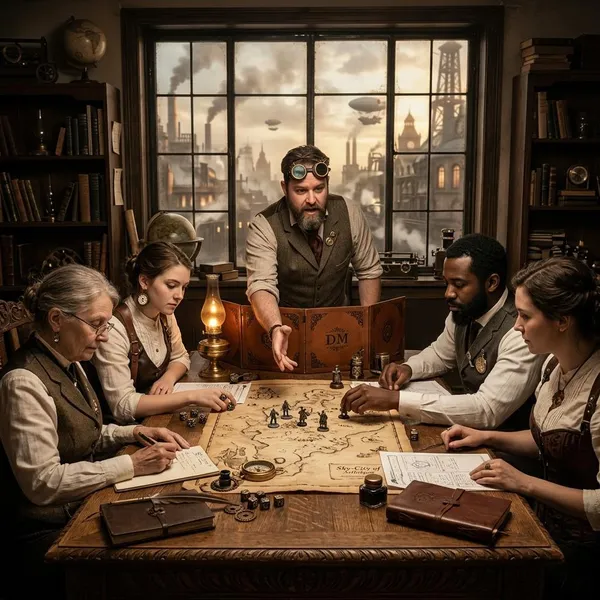
Steampunk in D&D is not only brass goggles, clock faces, and smoke stacks. Those details help the mood, but the real test is whether industry changes how people travel, work, fight, trade, and survive.
If you could remove the machines and the campaign would still run the same way, the setting is only wearing steampunk clothes. Make technology part of the problems the party has to solve.
Industry reshapes daily life
Show industry first through ordinary routines. Factory whistles mark the hour, street vendors sell replacement valves, workers line up at bathhouses to scrub off soot, and wealthy districts use private lifts while poor streets sit beside leaking heat pipes.
This gives players useful information without a lecture. A boiler failure is not just background danger if it cuts heat to a tenement. A strike at a gearworks matters if trains stop, food prices jump, and city guards start breaking picket lines.
Magic powers machines
Magic lets a steampunk D&D world stay fantasy instead of becoming a separate rules system. A telegraph can be paired sending stones, a lift can run on bound air elementals, and a factory engine can be stabilized by runes rather than modern engineering.
The practical question is who controls that magic. If only licensed guilds can maintain spell batteries, a missing engineer becomes a city problem. If engines rely on bound spirits or elementals, the campaign gains an ethical pressure point instead of another piece of cool equipment.
Airships and railways connect the world
Fast travel changes the scale of the campaign. Railways move soldiers, grain, prisoners, mail, and contraband; airships turn mountain borders and sea crossings into political chokepoints. A party that can board a night train or sneak into a sky-dock has access to stories that feel very different from another road ambush.
- Use trains for pressure: tight spaces, fixed schedules, sabotage, inspections, and passengers with secrets.
- Use airships for risk: storms, piracy, diplomatic cargo, altitude danger, and dramatic escapes.
- Use rail maps for politics: whoever controls routes can starve a district or protect it.
Class conflict drives the setting
Industrial progress rarely lands evenly. One group owns patents, fuel contracts, private guards, and clean upper streets; another group works the furnaces, breathes the smoke, and pays when machines fail. That tension gives the setting a human center.
Keep it playable rather than preachy. A workers' league might be right about unsafe factories but split over violent tactics. A factory owner might be exploitative yet funding a machine that keeps the city alive. Those gray areas give players real choices instead of obvious villains in expensive coats.
Invention creates danger and opportunity
New devices should be tempting enough that destroying them is not always the obvious answer. A medical automaton may save lives but misread magical curses. A predictive engine may prevent rail crashes but require surveillance records. A prototype boiler may power a district and still be one bad valve away from disaster.
- Good invention hook: useful, unstable, and wanted by more than one faction.
- Weak invention hook: obviously evil, obviously safe, or only included for style.
How to start a steampunk D&D campaign
The easiest start is not a full continent. Build one city, one power source, three factions, and one public crisis. That gives players enough context to make characters who already care about the world.
For a short campaign, keep the crisis local: a rail bombing, a failed engine core, a missing inventor. For a long campaign, let that same crisis reveal something larger, such as a fuel monopoly, a planar machine, or a timeline being quietly rewritten.
Choose one main power source
Pick the thing most machines depend on before you design gadgets. Steam gives you pressure, coal, heat, smoke, and dangerous maintenance. Arcane crystals feel cleaner but can create scarcity, licensing, and smuggling. Bound elementals add speed and power, with an obvious moral cost.
Set the technology level
Decide what is common, what is specialist, and what should still make people stop and stare. This prevents every new device from feeling arbitrary.
| Technology status | What it means at the table | Example |
|---|---|---|
| Common | Players can expect it in daily life | Rail stations, public lamps, simple prosthetics |
| Specialist | Guilds, armies, or rich patrons control it | Repeating pistols, armored carriages, coded message machines |
| Secret | It belongs in the plot, not a shop window | Time engines, city-scale automatons, forbidden fuel cores |
If firearms exist, decide this early. A campaign where pistols are common sidearms plays differently from one where a rifle is a rare military prototype. Balance is easier when availability, noise, reload limits, and legal consequences matter as much as damage.
Build one signature city
A strong city gives the campaign a home base and a personality. Give it one economic reason to exist, one unforgettable landmark, and one problem everyone can feel. A city built around a colossal engine tower will produce different stories than a port suspended under airship chains.
Make the districts readable. Players should quickly understand where the money is, where the workers live, where inventions are tested, and where illegal parts change hands. That clarity makes choices easier: help the dock workers, bargain with the guild, expose the minister, or steal the prototype first.
Create three competing factions
Three factions are usually enough. Give each one a public face, a private goal, and a method the players can recognize in play.
- Inventors' consortium: promises progress, hides dangerous trials.
- Workers' league: demands safer conditions, struggles with radical members.
- Security bureau: protects order, expands surveillance when frightened.
Center the story on one public crisis
Open with a crisis that ordinary people cannot ignore. A blackout across the factory district, a sabotaged railway bridge, a poisoned canal, or a stolen airship engine gives the party a reason to act immediately.
Low-risk version: the party investigates a contained accident and chooses which faction to trust. Higher-risk version: the same accident threatens food supply, martial law, or a city-wide explosion if no one intervenes. That lets you tune the campaign for a casual group or a table that wants heavier political stakes.
Best D&D settings for steampunk
The best setting depends on how much work you want to do. Use an existing setting if you want quick access to magitech, factions, and travel systems. Use homebrew if the campaign needs a very specific city, fuel source, or social conflict.
Eberron for ready-made magitech
Eberron is the smoothest official starting point for most groups. It is more magitech than pure steampunk, but it already has lightning rail, airships, artificers, dragonmarked houses, warforged, espionage, and cities shaped by practical magic.
Choose Eberron if you want to start playing quickly. You can make it feel more steampunk by emphasizing smoke, labor disputes, patent wars, unsafe workshops, and the gap between wealthy magical convenience and dangerous industrial work.
Lantan for invention-heavy fantasy
Lantan works well when you want steampunk ideas entering a more traditional Forgotten Realms-style world. The contrast is useful: one island or trade network produces devices that merchants want, rulers fear, and spies try to steal.
This is a good choice for a campaign where technology is new rather than normal. A Lantanese inventor enclave, embassy, dockyard, or stolen prototype can bring industrial pressure into an otherwise familiar fantasy region.
Mechanus for clockwork adventures
Mechanus is not classic smoke-and-factory steampunk, but it is excellent for clockwork logic taken too far. Use it for stories about automation, perfect order, machine law, modrons, inevitables, and systems that value efficiency over living people.
It works especially well as a threat behind the setting. Maybe a mortal city copies Mechanus designs, or a clockwork intelligence starts "correcting" labor, crime, weather, and time itself. That gives steampunk a colder, stranger edge.
Homebrew for complete creative control
Homebrew is best when the campaign depends on details official settings do not provide. You can decide exactly how common airships are, who owns the fuel, whether firearms are legal, and how much ordinary people trust machines.
Pick homebrew if your main fun is building a city with its own pressure points. It takes more prep, but you avoid lore friction and can borrow only the parts you need from Eberron, Lantan, or Mechanus.
Conclusion
A steampunk campaign becomes memorable when invention forces choices: who gets power, who pays for it, and what happens when the machine fails. Start small, make the city depend on one unstable system, and let factions fight over its future. Once players understand what is at stake, the airships and engines stop being decoration and become the reason the adventure moves.
FAQ
Can D&D work as a steampunk game?
Yes. D&D works well for steampunk if technology changes the setting's problems, travel, economy, and conflicts. You can usually reskin spells and magic items instead of replacing the rules.
Is Eberron steampunk or magitech?
Eberron is better described as magitech. It overlaps with steampunk through airships, industrial magic, artificers, urban intrigue, and social change, but its machines are mainly powered by practical magic.
How do you balance firearms in D&D?
Set their role before play starts. Firearms are easiest to manage when damage stays near existing ranged weapons and the real limits come from cost, reloads, noise, supply, training, and where carrying one is illegal.
Can D&D work as a steampunk game?
Yes. D&D works well for steampunk if technology changes the setting's problems, travel, economy, and conflicts. You can usually reskin spells and magic items instead of replacing the rules.
Is Eberron steampunk or magitech?
Eberron is better described as magitech. It overlaps with steampunk through airships, industrial magic, artificers, urban intrigue, and social change, but its machines are mainly powered by practical magic.
How do you balance firearms in D&D?
Set their role before play starts. Firearms are easiest to manage when damage stays near existing ranged weapons and the real limits come from cost, reloads, noise, supply, training, and where carrying one is illegal.