
A steampunk car works when it looks like a believable machine from an alternate Victorian timeline, not just a normal car with gears glued on. The fastest way to judge one is to check three things first: the silhouette, the visible mechanics, and whether the materials feel intentional together.
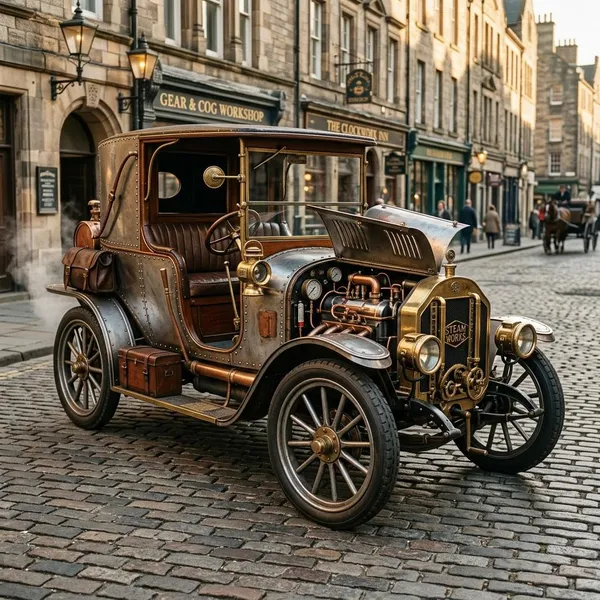
Key steampunk car design features
The strongest designs usually combine an old coach-built shape with exposed machinery, brass or copper details, wood, leather, rivets, and aged finishes. One or two decorative gears rarely carry the whole look. If the car would still feel steampunk in a plain garage, without costumes or smoke effects, the design is probably working.
Visible engines pipes and controls
Exposed mechanical parts are usually the first clue. Side pipes, visible linkages, external exhausts, pulleys, levers, and open engine details make the car feel operated by hand rather than hidden electronics.
The mistake is adding pipes that go nowhere. Even decorative tubing looks better when it appears to connect to cooling, pressure, exhaust, fuel, or some fictional but understandable system. For a drivable build, exposed parts also need sensible placement so they do not create heat, visibility, or safety problems.
Riveted panels and wooden trim
Rivets suggest boilers, ships, locomotives, and early industrial construction, but they work best where fasteners would make sense: around seams, hood panels, access doors, and wheel arches. Random rows of rivets can quickly look like costume decoration.
- Use rivets for structure: place them along believable joins and panel edges.
- Use wood for warmth: stained trim, floor sections, or carriage-style inserts soften the metal.
- Avoid overload: too much wood can feel like furniture; too much metal can drift toward dieselpunk or rat rod.
Gauges switches and old instruments
A dashboard can make or break the illusion. Analog gauges, pressure dials, toggle switches, pull knobs, old clock faces, marine compasses, and aircraft-style controls all support the idea of a hands-on machine.
Carriage-inspired shapes and interiors
Steampunk cars often borrow from horse-drawn carriages and early automobiles: upright cabins, narrow seating, curved body sides, lamp-like lighting, tall roof supports, and coach-style trim. This is what separates the look from a normal custom car with exposed metal.
Worn industrial colors and textures
Bright modern paint often weakens the theme. Weathered bronze, blackened steel, dark green, tobacco brown, burgundy, oxidized copper, stained wood, and worn leather usually feel more natural.
The finish should look aged, not neglected. Slight patina, rubbed edges, heat-marked metal, and uneven brass polish can add history. Heavy fake rust everywhere may push the car toward rat rod instead of steampunk.
Are steampunk cars real
Yes, but "real" can mean several things. Some are roadworthy custom vehicles, some are show cars, some are props, and many exist only as digital concepts. The important question is what the vehicle needs to do: drive legally, impress at an event, appear on camera, or simply work as a design idea.
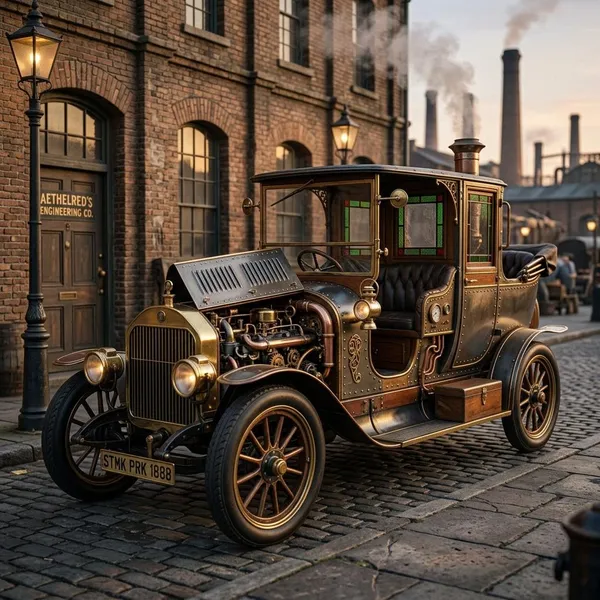
Roadworthy custom vehicles
A roadworthy build usually starts with a functional chassis and conventional drivetrain, then adds the steampunk bodywork and interior around it. That is the practical route because brakes, steering, lighting, visibility, registration, and local road rules still matter.
Show cars built for display
Show cars can be much bolder because they do not have to behave like normal transport. Builders can use oversized pipes, delicate ornaments, unusual seating, dramatic lighting, and dense brass detail purely for visual impact.
Props created for events and film
Props are often the smartest choice for festivals, theater, themed venues, and film work. A prop may be built on a golf cart base, trailer, lightweight frame, or partial shell, yet still look convincing from the audience's point of view.
- Best for crowds: slower movement and controlled spaces are easier to manage.
- Best for camera work: only the visible side may need full detail.
- Not ideal for roads: a prop-like build usually lacks the engineering needed for public driving.
Digital concepts with fictional mechanics
Digital steampunk cars can ignore real weight, heat, steering geometry, and safety, which is why they often look so dramatic. They are useful for exploring silhouettes, material combinations, and fantasy mechanisms before anyone spends money on fabrication.
How steampunk cars differ from other retro styles
Steampunk overlaps with hot rods, rat rods, dieselpunk, and retro-futurism, but the center of the style is different. It leans toward Victorian craft, visible mechanical logic, and ornate alternate-history design. A rusty old car with exposed parts is not automatically steampunk.
More Victorian than a hot rod
Hot rods usually focus on speed, stance, stripped bodywork, and American performance culture from a later period. A steampunk build may borrow the exposed engine drama, but it needs older references: carriage shapes, brass fittings, analog controls, lamps, and handcrafted trim.
If the car looks built mainly to race, it reads as a hot rod. If it looks like an eccentric inventor's machine that could have rolled out of a steam-age workshop, it moves closer to steampunk.
More decorative than a rat rod
Rat rods often celebrate roughness, mismatched parts, visible repairs, and an unfinished attitude. Steampunk can use weathering, but the details are usually more deliberate and composed.
Less industrial than dieselpunk
Dieselpunk tends to feel later, heavier, and more militarized, with influences from the 1920s to 1940s, aviation, factories, and wartime machinery. Steampunk is usually warmer and more ornate, with brass, wood, leather, lamps, and decorative metalwork softening the industrial side.
More mechanical than retro-futurism
Retro-futurism is a broad category. It can include atomic-age curves, space-age cars, chrome rockets, and smooth mid-century future design. Steampunk is more specific because it wants the mechanics to look touchable: valves, dials, gears, rivets, pipes, levers, and repairable parts.
When a design makes you imagine pressure, heat, noise, and moving linkages, steampunk is the better label. When it looks sleek, sealed, and futuristic in a mid-century way, it belongs somewhere else in retro-futurism.
Where to find steampunk car inspiration
The best inspiration rarely comes from copying one finished build. A stronger approach is to collect references from several places, then decide what kind of vehicle you are making: an elegant carriage conversion, a rough explorer's runabout, a showpiece, a film prop, or a digital fantasy machine.
Custom hot rods and show cars
Custom hot rods and show cars are useful for real-world proportions. Study wheel placement, engine bay framing, side pipes, dashboards, and how builders transition from one material to another.
Victorian carriages and early vehicles
Carriages and early motorcars give the style its historical backbone. Look at rooflines, lantern placement, upright seating, large wheels, curved body panels, leather straps, and polished trim.
This is especially helpful if you want a refined design rather than a heavy industrial one. A carriage reference can stop the project from turning into a generic rusty machine.
Industrial machinery and nautical equipment
Boilers, pumps, flywheels, pressure gauges, ship telegraphs, brass lamps, and navigation instruments are excellent detail sources. They bring in real mechanical language, which helps the car feel engineered instead of decorated.
- For the dashboard: marine gauges, toggle switches, and compass-like instruments.
- For the exterior: pipe brackets, valves, vents, hinges, and riveted access panels.
- For the mood: aged brass, black iron, dark wood, and glass lenses.
Film game and concept art
Film, games, and concept art are best for mood, scale, and imagination. They show how far a silhouette can be pushed and how fictional mechanics can still feel visually consistent.
Use them with caution if you plan to build something physical. A digital boiler placed where the driver's legs should be may look great in art and fail completely in a real cabin.
Steampunk festivals and exhibitions
Festivals and exhibitions let you see the difference between clever fabrication and flat decoration. In person, you can judge patina, rivet spacing, leather quality, switch feel, and whether a vehicle is a working build or a display shell.
- Collect mixed references: include cars, carriages, machines, ships, interiors, and props.
- Choose one story: explorer, inventor, luxury coach, industrial courier, or theatrical vehicle.
- Limit the palette: pick a few main materials before adding details.
- Check function early: decide whether it must drive, roll slowly, sit on display, or exist only as art.
Conclusion
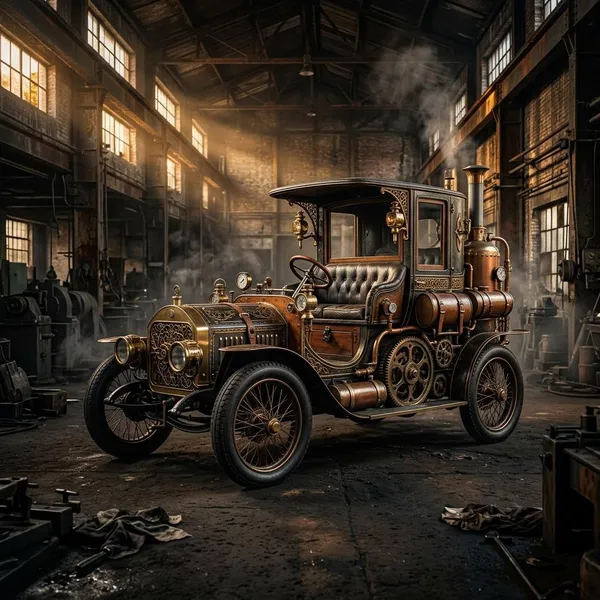
A convincing steampunk car is less about adding more decoration and more about making every visible choice support the same imagined machine. Start with the purpose, then build the look around a Victorian silhouette, believable mechanics, aged materials, and a controlled set of details. If the car feels handcrafted, functional in its own fictional way, and clear about its story, it will read as steampunk without needing to shout it.
FAQ
Does steampunk include cars?
Yes. Steampunk can include cars when the vehicle uses the same alternate-history design language: Victorian influence, visible machinery, analog controls, and handcrafted materials.
Are steampunk cars steam-powered?
Usually not. Most real builds use conventional engines because they are easier to operate and maintain; the steam-age feeling usually comes from the design rather than the actual power source.
What materials make a car look steampunk?
Brass, copper, riveted metal, dark iron finishes, stained wood, leather, aged glass, and analog instruments are the usual building blocks. They work best when repeated consistently instead of scattered randomly.
Is a steampunk car the same as a rat rod?
No. A rat rod leans into rough, unfinished custom culture, while a steampunk car needs a stronger Victorian or alternate-invention theme.
Does steampunk include cars?
Yes. Steampunk can include cars when the vehicle uses the same alternate-history design language: Victorian influence, visible machinery, analog controls, and handcrafted materials.
Are steampunk cars steam-powered?
Usually not. Most real builds use conventional engines because they are easier to operate and maintain; the steam-age feeling usually comes from the design rather than the actual power source.
What materials make a car look steampunk?
Brass, copper, riveted metal, dark iron finishes, stained wood, leather, aged glass, and analog instruments are the usual building blocks. They work best when repeated consistently instead of scattered randomly.
Is a steampunk car the same as a rat rod?
No. A rat rod leans into rough, unfinished custom culture, while a steampunk car needs a stronger Victorian or alternate-invention theme.