
A steampunk artificer works best when you keep the D&D rules normal and change the way the magic looks at the table. Pick the inventor fantasy first, then choose the subclass that makes that image show up every session: powered armor, arcane cannon, clockwork companion, strange formulas, or navigation gear. The safest fit for most campaigns is fantasy technology powered by magic, not real-world machinery dropped into a medieval world.
What is a steampunk artificer
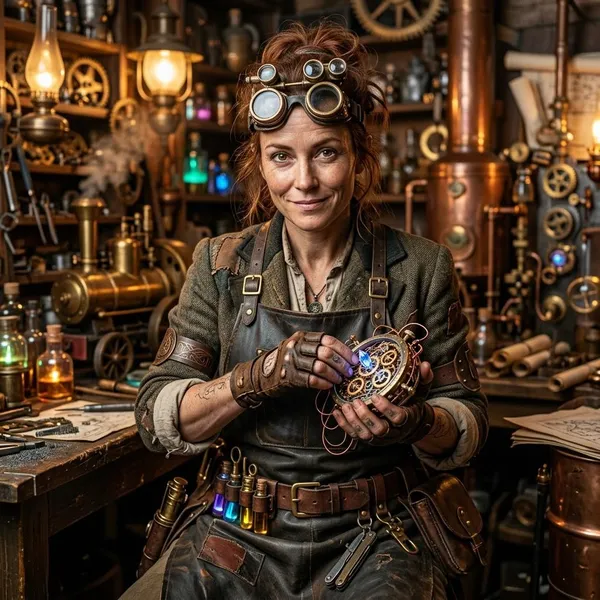
A steampunk artificer is an Artificer whose magic is described through brass devices, clockwork parts, pressure valves, alchemical glassware, and handmade prototypes. The class features do not need to change. Your Fire Bolt can still be Fire Bolt, even if it fires from a wrist-mounted ignition tube instead of a bare hand.
An artificer with steampunk flavor
The character is still an Artificer first. Steampunk flavor changes the presentation: a spellcasting focus becomes a folding brass instrument, an infused shield clicks open with rotating plates, and a set of tools feels like a portable workshop instead of generic gear.
Magic presented as invention
This concept becomes much easier to play when every "invention" is understood as a magical device. A healing spell might be a glass injector filled with glowing restorative vapor. A protective spell could come from a pressure seal and a ring of runes snapping into place.
Fantasy technology with brass and clockwork
Use brass, copper, leather, smoked glass, ticking gears, and gauges for the visual style, then make the power source arcane. A good quick test is this: if the item sounds like something a wizard could enchant and an inventor could assemble, it probably fits. If it sounds like a modern device with the serial numbers filed off, pull it back toward magic.
Which Artificer subclass fits steampunk best
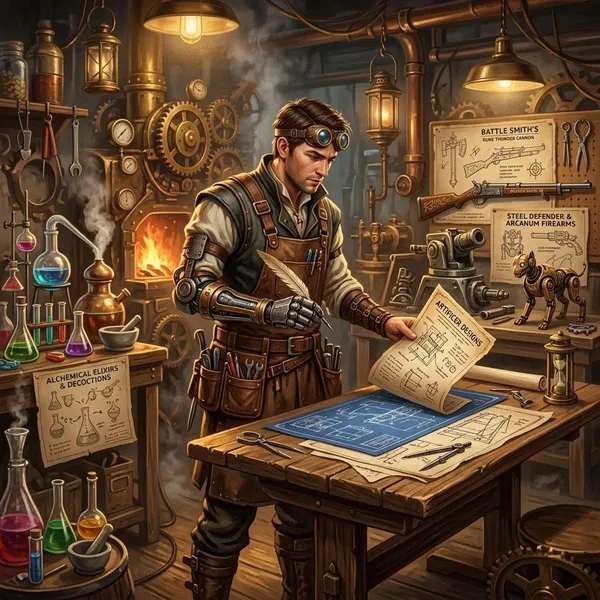
The best subclass depends on what the other players will actually see you doing. If your signature image is a suit, choose around the suit. If it is a weapon platform, choose around the cannon. If it is a loyal machine, build around the companion.
| Steampunk fantasy | Best fit | Why it works |
|---|---|---|
| Powered armor engineer | Armorer | Your invention is visible in almost every scene. |
| Battlefield gadgeteer | Artillerist | The cannon gives you a clear steampunk centerpiece. |
| Clockwork pet maker | Battle Smith | The Steel Defender becomes your signature creation. |
| Plague-doctor chemist | Alchemist | Spells can become tonics, fumes, and unstable treatments. |
| Airship or route specialist | Cartographer concept | Navigation tools support exploration-heavy campaigns. |
Armorer for a powered suit
Armorer is usually the cleanest choice if you want the character to look steampunk immediately. The armor can be a brass-plated exosuit with piston joints, heat vents, rune-insulated gauntlets, and a chest gauge that rises when magic flows through it.
Artillerist for arcane cannons
Artillerist fits players who want deployable machines and loud table presence. The Eldritch Cannon can be a tripod mortar, shoulder rig, spider-legged turret, or compact brass projector with a glowing chamber.
Battle Smith for a mechanical companion
Battle Smith is the strongest pick when the invention should feel alive. The Steel Defender can be a clockwork hound, brass raven, riveted guardian, or small automaton with a humming arcane heart.
- For a warmer character: make the defender loyal, expressive, and carefully maintained.
- For a rough field mechanic: give it dents, replacement plates, and visible repair marks.
- For a tragic hook: connect its design to someone or something the artificer failed to protect.
Alchemist for experimental formulas
Alchemist works best when you want steampunk to feel smoky, medical, and slightly unsettling. Spells can become serums, atomized vapors, powders, acids, stimulants, or carefully labeled vials kept in a reinforced case.
This subclass is a better fit for gothic campaigns than for a bright gadgeteer tone. A plague-mask alchemist in a city of disease, war, or forbidden research will feel more natural than one dropped into a lighthearted treasure romp with no room for that mood.
Cartographer for arcane navigation
Cartographer is best treated as a concept unless your table uses an official, third-party, or homebrew option with that name. The idea still works: build an artificer who solves problems with rune compasses, brass sextants, pressure-stabilized ink, enchanted charts, and instruments for storms, ruins, or planar routes.
Pick this direction for airship campaigns, sea voyages, desert expeditions, hexcrawls, or planar travel. If the campaign rarely cares about movement, maps, weather, or vehicles, the concept may need a second hook so it does not fade into background flavor.
How to build a steampunk artificer
Start with the image you want other players to remember, then make every major choice support it. The common mistake is collecting too many cool details: goggles, cannon, hound, airship tools, plague mask, automaton obsession. One strong idea with a few repeated details usually feels better than six competing aesthetics.
Choose your inventor fantasy
Write the character concept as one plain sentence before choosing every detail. For example: "a battlefield engineer who trusts armor more than people," "a plague doctor trying to make healing predictable," or "an airship navigator who treats every storm like a puzzle." If the sentence is clear, your subclass, tools, spells, and backstory will be easier to align.
Pick a matching subclass
Choose the subclass based on what you want to do repeatedly, not just what sounds stylish on a character sheet.
- Choose Armorer if the suit should be the main invention.
- Choose Artillerist if you want cannons, projectors, and battlefield devices.
- Choose Battle Smith if the companion is the emotional and visual anchor.
- Choose Alchemist if formulas, fumes, and risky treatments matter most.
- Use a Cartographer concept if the campaign rewards travel, maps, vehicles, or exploration.
Choose signature tools and gear
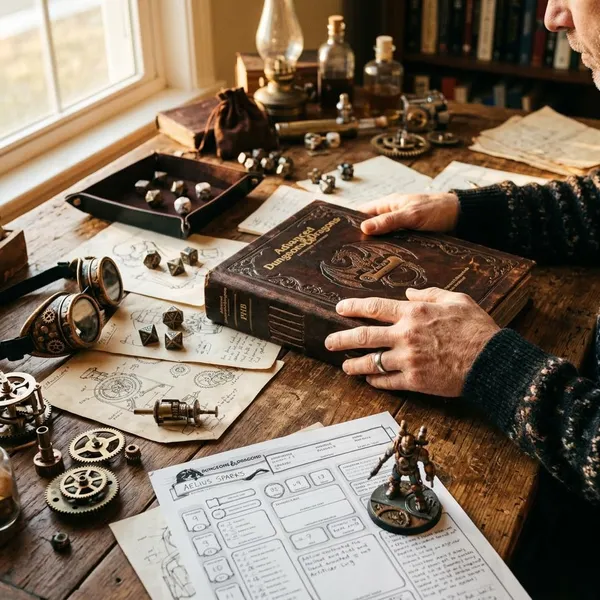
Pick three to five recurring items and describe them consistently. Good choices include calibration goggles, engraved smith's tools, folding tinker's tools, a leather parts belt, alchemical syringes, a rune-powered lantern, or a brass-cased spell focus.
Small sensory details do more work than long explanations. A lens clicking into place before a spell, a valve hissing after a hit, or a gauge trembling during concentration gives the table an image without slowing play.
Create one defining invention
Give the character one invention that people remember first. It might be an armored suit called the Iron Hymn, a clockwork hound named Copper, a shoulder cannon with too many safety locks, or a silver inhaler that releases restorative mist.
Build the backstory around your craft
The best backstory explains why the artificer builds. Maybe invention was survival in a mining town, guilt after a failed automaton, ambition to make magic useful for ordinary people, or fear of being helpless again.
- Survival inventor: practical, cautious, always repairing things before they break.
- Failed prototype survivor: driven, guilty, and careful around uncontrolled magic.
- Public-minded maker: wants tools that help workers, travelers, patients, or soldiers.
How to make an Artificer feel steampunk
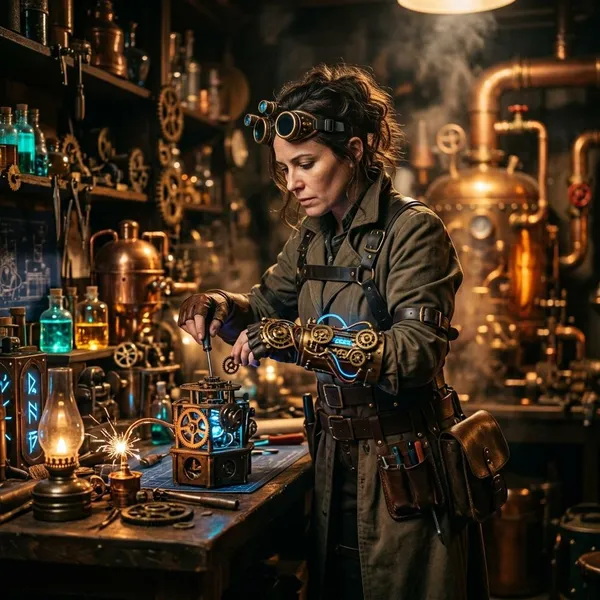
The subclass gives you mechanics, but the table experience comes from description. Use a consistent material palette, keep actions quick to explain, and let the machinery show strain without changing the rules. That balance makes the character vivid without forcing everyone else to sit through engineering lectures.
Reflavor spells as gadgets
Describe the spell effect through a device, then stop. "I twist the gauntlet valve and fire a crackling bolt" is usually better than a full technical breakdown. For healing, use injectors, warm mist, sealing foam, or glowing stitch-runes. For defenses, use shield emitters, pressure locks, rotating plates, or a burst of force from the armor frame.
Treat magic items as prototypes
Magic items can feel personal if the artificer adapts them into their own workshop style. A Cloak of Protection might become a lined travel coat stitched with conductive thread. Winged Boots could become stabilizer greaves with folding brass fins.
This is especially useful in long campaigns. Treasure stops feeling like random loot and starts feeling like the artificer's growing body of field-tested work.
Give equipment a mechanical look
Ordinary gear should carry the theme too. A crossbow can have a ratcheting reload arm, a shield can unfold in layered plates, and a journal can be locked with rotating brass dials. These details do not need rules; they make non-combat scenes feel connected to the same character fantasy.
Add gauges, valves, and moving parts
Moving parts give the character life. A pressure needle climbing before a spell, a tiny gear train spinning during concentration, or silver steam venting from armor after a fight creates a strong image with very little text.
- Use often: one quick visual cue for important actions.
- Use sparingly: long device descriptions during every combat turn.
- Save for drama: jams, overheating, sparks, and warning bells.
Keep the technology powered by magic
This is the rule that keeps the character from becoming too sci-fi. The device can look engineered, but the force inside it should be enchantment, alchemy, bound elemental energy, runes, planar sparks, or another fantasy source.
For a high-magic setting, the artificer can be openly advanced and celebrated. For a low-magic village campaign, make the inventions rare, temperamental, and a little suspicious so they do not feel out of place.
Steampunk artificer character ideas
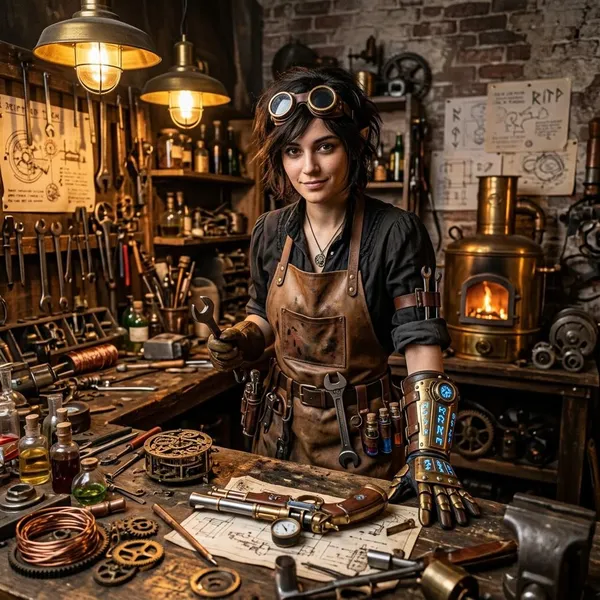
A good character idea should suggest a subclass, a visual style, and a roleplay problem at the same time. Use one of these as a base, then adjust it to match the campaign's tone. A bright adventure can handle polished gadgets and playful inventions; a grim campaign may call for smoke, scars, debt, and dangerous prototypes.
Steam-powered armor engineer
This artificer treats armor as a second body. The suit absorbs impact through piston joints, vents heat after spellcasting, and locks the gauntlets with a heavy metallic snap. Armorer is the obvious fit, especially for a character who wants to protect others by standing in the worst part of the fight.
Brass cannon inventor
The brass cannon inventor is built around precision, spectacle, and a dangerous amount of confidence. Artillerist supports the concept cleanly: the Eldritch Cannon might be a wheeled field gun, a shoulder launcher, or a spider-legged turret with engraved stabilizers. For a fun twist, make the character nervous and overprepared instead of loud and reckless.
Clockwork hound mechanic
This Battle Smith travels with a defender that ticks softly when alert and limps when damaged. The hound might have gemstone eyes, a copper spine, and replacement plates from past repairs. It works well for a loyal, warm character, but it can also carry grief if the hound was built after losing a real companion.
Plague-mask alchemist
A plague-mask alchemist fits campaigns with disease, war, city politics, or forbidden research. Their spells come through vials, atomizers, bitter tonics, and vapor filters. They can be kind without being comforting: the sort of healer who saves lives while making everyone nervous about the side effects.
Arcane airship navigator
This artificer reads the world through instruments: rune compasses, barometers, folding sextants, star charts, and lenses that reveal magical currents. The concept shines in travel-heavy games, especially with airships, sea routes, floating cities, or planar crossings. In a dungeon-only campaign, tie the navigation tools to traps, ruins, and mapping unknown spaces.
Automaton maker
An automaton maker is interested in the uncomfortable line between tool and life. They may build helpers, guards, toys, workers, or humanoid constructs that almost seem to understand. Battle Smith supports the companion side, Armorer supports the "becoming the machine" angle, and Alchemist can make the idea stranger if artificial life involves fluids, flesh, or galvanic magic.
Conclusion
The strongest version is not the one with the most gears glued onto every item; it is the one with a clear invention fantasy, a subclass that supports it in play, and a magical power source that still belongs in D&D. Choose the image you want the table to remember, give it one defining prototype, and keep the descriptions sharp enough that the character feels built rather than overexplained.
FAQ
Is a steampunk artificer an official D&D class?
No. Artificer is the official class; steampunk is a flavor and character concept. Use the normal rules unless your DM approves homebrew.
Which Artificer subclass is best for steampunk?
Armorer is the easiest all-around fit because the powered suit is always visible. Artillerist is just as strong if you would rather make the cannon or turret the centerpiece.
Can a steampunk artificer work outside Eberron?
Yes, if the technology stays magical and the DM is comfortable with the tone. In lower-tech settings, make the inventions rare, handmade, and slightly mysterious.
How do you flavor Artificer spells as steampunk gadgets?
Keep the spell mechanics unchanged and describe the casting tool. A bolt can come from a wrist coil, healing from a serum injector, and protection from a pressure-sealed rune plate.
Is a steampunk artificer too sci-fi for D&D?
Not if the machines run on magic instead of modern science. The concept usually becomes a problem only when it starts introducing technology the campaign world cannot reasonably support.