
If you are trying to picture a steampunk airship, start with a real lighter-than-air craft and then ask what a Victorian engineer, novelist, and stage designer would all add to it. The strongest designs are not just balloons with gears glued on; they show lift, steering, machinery, and a reason for people to live or fight aboard them. That mix of historical logic and theatrical invention is what makes the idea so durable.
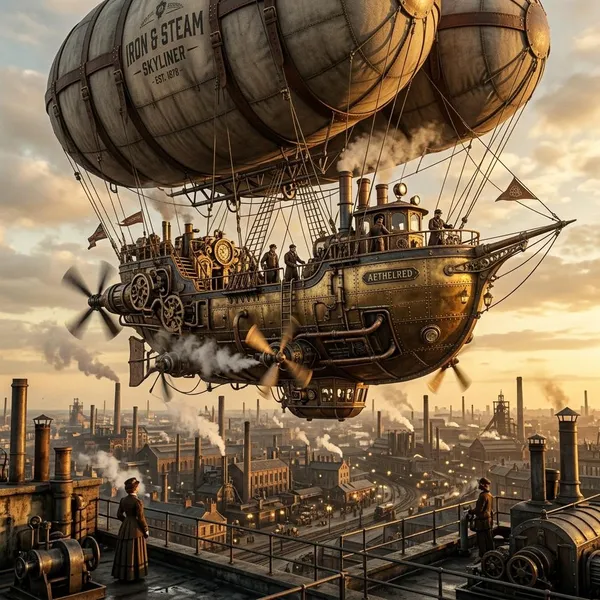
Why airships define the steampunk style
Airships fit steampunk because they sit right between history and fantasy. Real dirigibles and zeppelins give the idea a believable base, while brass fittings, exposed engines, ornate cabins, and impossible routes give artists and writers room to exaggerate.
They capture Victorian dreams of flight
Victorian-era inventors and readers were fascinated by the possibility of controlled flight, even before aviation became practical. A steampunk version leans into that optimism: polished cabins, wide windows, and slow travel above industrial cities turn flight into an elegant public spectacle rather than a routine commute.
They turn machinery into visual spectacle
Steampunk rarely hides the working parts. Pipes, pistons, belts, gauges, boilers, propeller shafts, vents, and riveted panels all make the airship feel noisy, heavy, and maintained by hand.
- Good detail: machinery that suggests a function, such as steering, lift control, heating, or propulsion.
- Weak detail: gears placed everywhere with no connection to how the craft might work.
- Best balance: enough visible mechanics to feel engineered, but not so much clutter that the silhouette becomes unreadable.
They support exploration and adventure
An airship is more than transport; it can be a moving base. It can carry maps, supplies, crew quarters, weapons, laboratories, cargo, or passengers, which makes it useful for adventure stories without needing a separate setting for every scene.
They make alternate history feel believable
Airships help alternate history because audiences already know that lighter-than-air travel existed. The fiction only has to bend the timeline, not invent the entire concept from nothing.
This is also where restraint matters. If a design adds huge armor plates, oversized cannons, and massive steam engines, it may look exciting but less plausible. That can still work for fantasy, but a more grounded alternate-history airship should show trade-offs: lighter structure, exposed risk, limited space, and weather-sensitive travel.
The history behind steampunk airships
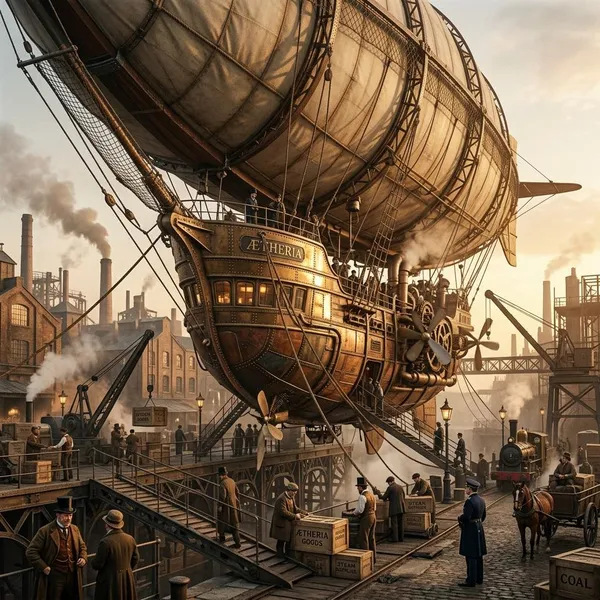
The appeal of a steampunk airship comes partly from real aviation history. Lighter-than-air craft were once serious inventions, military tools, passenger vehicles, and symbols of modern progress before airplanes became dominant.
Early flying ship concepts
The idea of a ship sailing through the air appeared long before practical airships. One famous early example is Francesco Lana de Terzi's seventeenth-century concept for a flying vessel lifted by vacuum spheres. It was not practical with the materials of the time, but the image of a nautical craft crossing the sky stayed powerful.
That old connection between sea travel and flight explains why many steampunk airships have decks, rails, masts, cabins, and captain's bridges. They feel like ships first and aircraft second.
Nineteenth-century powered airships
During the nineteenth century, inventors moved from passive balloons toward steerable dirigibles. Rudders, engines, and improved envelopes made the idea of controlled lighter-than-air travel more credible, even if weather, power, and materials remained serious limits.
Zeppelin-era passenger travel
The zeppelin era gave the airship its most iconic real-world form: large rigid hulls, internal frames, passenger spaces, and a sense of grand travel. These vessels were not just machines; they were public symbols of engineering confidence.
- Use this influence for luxury: lounges, dining rooms, broad windows, wood trim, and polished fittings.
- Use it for authority: rigid frames, national markings, formal uniforms, and controlled docking systems.
- Avoid one common mistake: making every steampunk airship a zeppelin. Smaller non-rigid or hybrid designs can feel more adventurous.
Famous disasters and public decline
Airship history also carries danger. The 1937 Hindenburg disaster became the most famous image of that risk, and public confidence suffered. At the same time, airplanes became faster, more practical, and better suited to mainstream travel.
That decline gives steampunk airships their melancholy edge. They feel like a future that almost happened, which is far more interesting than a machine that exists only because it looks cool.
Key steampunk airship design features
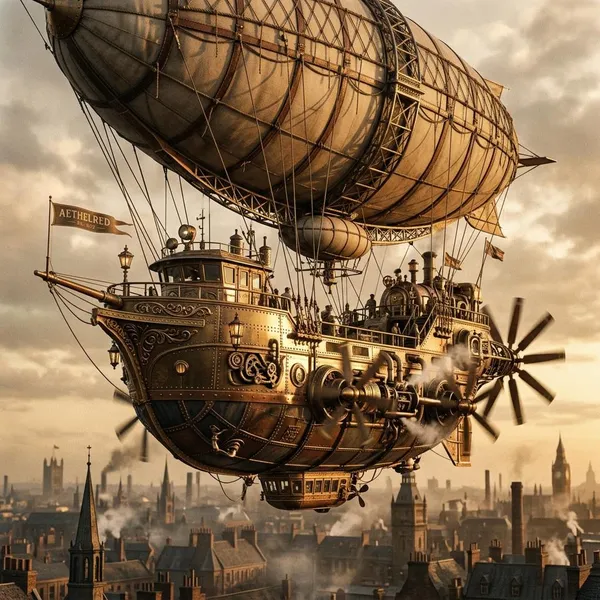
A convincing steampunk airship design usually needs four things in priority order: a believable lift structure, a place for people or cargo, visible propulsion and steering, and style details that match the craft's role. Decoration should come last, not first.
A large gas envelope or rigid hull
The gas envelope or rigid hull is the visual anchor. A soft balloon-like envelope can make the craft feel improvised, fragile, or exploratory. A rigid hull feels more organized, expensive, military, or industrial.
For a model, this choice affects materials too. A lightweight hanging display may work better with foam, paper, or thin plastic for the envelope, while a tabletop model can handle heavier frames, ribs, and painted surface detail.
A ship-like gondola and deck
The gondola tells the viewer how the airship is used. A narrow suspended cabin suggests a small crew or scientific mission; a full ship-like lower hull suggests cargo, passengers, weapons, or long-range travel.
- Passenger craft: windows, railings, lounges, lamps, and clean walkways.
- Explorer craft: cargo nets, ladders, maps, spare equipment, and weathered panels.
- Battle craft: armor, lookout posts, gun mounts, reinforced decks, and fewer decorative comforts.
Brass engines and exposed machinery
Exposed machinery is where the design becomes unmistakably steampunk. Brass, copper, iron, pressure gauges, vents, rotating shafts, and patched engine housings all suggest a machine that needs constant attention.
Propellers fins and control surfaces
Propellers, fins, rudders, and stabilizers make the airship look steerable instead of merely floating. They also add direction to the silhouette, which is important in art, games, and miniature building.
Oversized parts can work if the style is dramatic, but they should still feel balanced. A tiny gondola under enormous engines may look unstable unless the design is clearly meant to be comic, experimental, or fantasy-heavy.
Victorian cabins and viewing platforms
Victorian cabins and viewing platforms add the human side: comfort, class, danger, and spectacle. Wood paneling, upholstered seating, brass lamps, patterned walls, portholes, and open railings make the craft feel inhabited rather than purely mechanical.
Open platforms are great for drama, but they change the tone. A high-risk pirate vessel can get away with exposed decks and rope ladders. A refined passenger airship should look safer, with enclosed viewing rooms or protected promenades that match its luxury role.
Famous steampunk airships in fiction
Fiction shaped the modern image of the steampunk airship as much as history did. Games, fantasy worlds, and visual art use these craft because they can carry a setting's technology, politics, class divisions, and sense of adventure in one instantly readable object.
Battle airships in Guns of Icarus
Guns of Icarus treats airships as working battle platforms, not background scenery. The crew has to pilot, repair, fire weapons, and keep the vessel alive under pressure, which matches the steampunk idea of machinery as something physical and demanding.
The airborne world of BioShock Infinite
BioShock Infinite is not pure steampunk, but its airborne city and flying machines share the genre's love of alternate history, spectacle, and technology used as ideology. The vessels in Columbia help make the world feel grand, controlled, and unsettling.
Fantasy airships in Final Fantasy
Final Fantasy often uses airships as a reward and a turning point. Once players gain one, the world opens up, hidden places become reachable, and the adventure feels larger.
The designs vary by game, but many use the same ingredients that steampunk fans recognize: metal hulls, propellers, engine rooms, hybrid technology, and the romance of elevated travel. They are useful references when strict historical realism matters less than wonder and movement.
Flying machines in steampunk art
Steampunk art may be the richest source of airship variation. Illustrators, concept artists, and model makers have imagined everything from delicate survey craft to fortress-like dreadnoughts.
- For elegance: long hulls, clean curves, warm lighting, and passenger details.
- For danger: dark metal, exposed boilers, weapons, patched panels, and cramped decks.
- For handmade charm: visible seams, mixed materials, tiny ladders, fabric texture, and asymmetry.
Conclusion
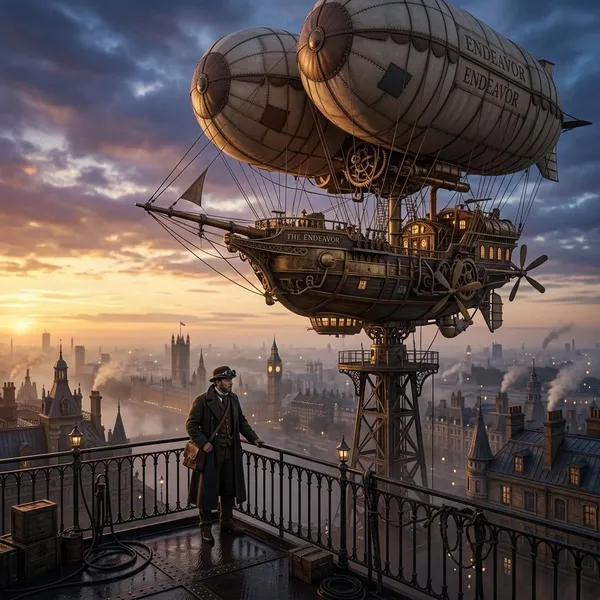
A steampunk airship works because it feels both possible and impossible at the same time: real airship history gives it structure, while Victorian style and alternate-history imagination give it character. The best versions make a clear choice before adding detail: luxury liner, battle craft, explorer vessel, pirate ship, or handmade model. Once that role is visible, every propeller, cabin, pipe, and viewing deck starts to feel like part of a living world rather than decoration.
FAQ
Is a steampunk airship the same as a zeppelin?
No. A zeppelin is a real type of rigid airship, while a steampunk airship is a fictional or artistic design style that may borrow zeppelin shapes along with Victorian and fantasy details.
What powers a steampunk airship?
In fiction, it is often powered by steam engines, propellers, pressure systems, clockwork-like machinery, electrical hybrids, or invented energy sources. The power system should look connected to lift, steering, or movement, not just placed on the hull for decoration.
Could a steampunk airship work in real life?
A basic airship can work because lighter-than-air flight is real, but many steampunk versions would be too heavy or impractical if built exactly as drawn. Heavy armor, open decks, oversized boilers, and decorative structures are usually better treated as fantasy elements.
Is a steampunk airship the same as a zeppelin?
No. A zeppelin is a real type of rigid airship, while a steampunk airship is a fictional or artistic design style that may borrow zeppelin shapes along with Victorian and fantasy details.
What powers a steampunk airship?
In fiction, it is often powered by steam engines, propellers, pressure systems, clockwork-like machinery, electrical hybrids, or invented energy sources. The power system should look connected to lift, steering, or movement, not just placed on the hull for decoration.
Could a steampunk airship work in real life?
A basic airship can work because lighter-than-air flight is real, but many steampunk versions would be too heavy or impractical if built exactly as drawn. Heavy armor, open decks, oversized boilers, and decorative structures are usually better treated as fantasy elements.