
If you want nautical steampunk to look intentional rather than like a pile of ship props, start with the mood first: dark wood, aged metal, warm light, and one believable maritime focal point. The style works best when it feels like a captain's cabin, chart room, or imagined submarine workshop, not a novelty display. A few strong pieces will usually do more than a shelf full of tiny gears and anchors.
What is nautical steampunk
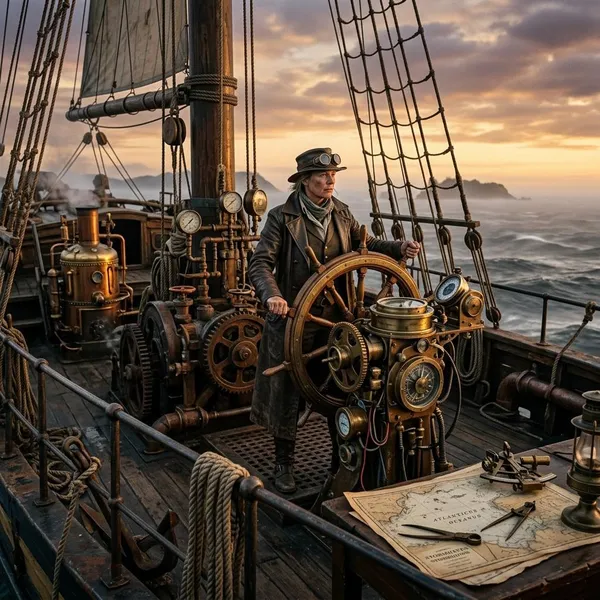
Nautical steampunk blends Victorian seafaring style with steam-age invention. It borrows from ship cabins, brass instruments, portholes, pressure gauges, old maps, diving gear, and retro-futuristic ocean exploration.
Victorian maritime influence
The historical side comes from captain's cabins, chart rooms, ocean liners, naval instruments, and expedition stories. Dark timber, leather, brass trim, framed charts, ship clocks, and telescope-like forms all help create that old-world maritime mood.
This does not mean the room has to be historically perfect. A modern desk can still work if the surrounding details feel weighty and well chosen. The mistake to avoid is mixing too many unrelated "vintage" items just because they look old.
Steam-age mechanical design
Gears, valves, rivets, pipes, gauges, and exposed fasteners give the style its engineered feel. They work best when they appear to have a purpose, such as lighting, measurement, storage, or imagined propulsion.
- Good use: a cage lamp, brass pressure gauge, riveted shelf bracket, or valve-style handle.
- Weak use: loose plastic gears scattered on shelves with no connection to the room.
Exploration and retro-futurism
This is where the fantasy enters. Nautical steampunk often hints at submarines, diving bells, impossible machines, lost maps, and journeys below the surface. It should feel inventive, but still grounded enough that the room seems usable.
Industrial details with a seafaring feel
The seafaring part is what keeps the style from turning into generic industrial decor. Round porthole shapes, rope used sparingly, hatch-like panels, marine lights, wheel forms, and weathered metal finishes all point the room back toward ships and ocean travel.
Choose fewer cues with stronger shape. One porthole mirror or one heavy marine sconce usually reads better than ten small anchor ornaments.
Essential nautical steampunk decor
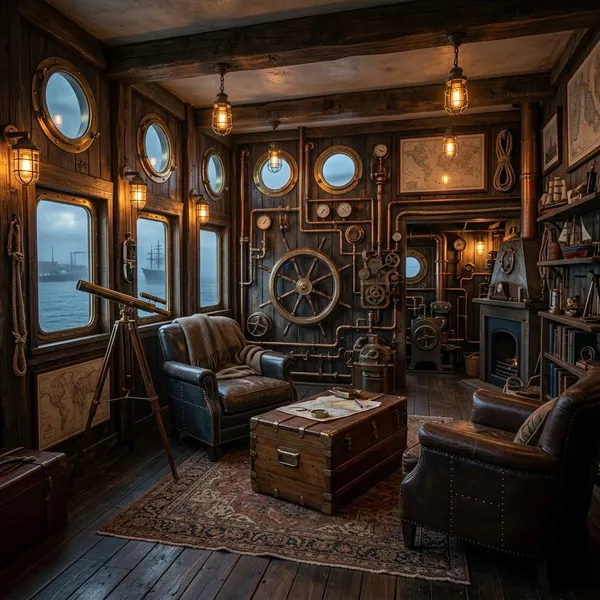
The most useful decor pieces are the ones that do more than look themed. Lighting changes the atmosphere, instruments add credibility, and ship hardware gives the room structure. Start there before buying small accessories.
A simple priority order works well:
- Lighting first: it sets the mood every evening.
- One maritime anchor: porthole, diver helmet, map wall, or ship hardware.
- Supporting instruments: compass, sextant, clock, gauge, or chart.
- Final edit: remove anything too shiny, flimsy, or cartoonish.
Cage and marine lighting
Marine lighting is often the fastest way to make the room feel nautical steampunk. Cage sconces, brass bulkhead lights, passageway lamps, tripod spotlights, and warm desk lamps all suggest ships, engine rooms, or expedition workspaces.
Use warm bulbs rather than cold white light. Cold lighting can make brass look cheap and dark wood look flat, while warmer light brings out patina and shadow. In a small room, wall sconces or a single desk lamp are usually better than a large pendant that crowds the space.
Compasses and sextants
Compasses and sextants add the navigator's side of the look. They feel more convincing when displayed like tools, not souvenirs: one on a desk tray, one under glass, or grouped with a chart and a clock.
Portholes and ship hardware
A porthole mirror, hatch-style cabinet front, cleat hook, pulley block, hand wheel, or riveted bracket can make a room feel built rather than decorated. These pieces are especially useful because they create maritime identity without needing many words or labels.
Scale matters. In a living room or bar, choose one larger piece and let it carry the theme. In a hallway or apartment corner, use a smaller porthole mirror or a pair of sturdy hooks instead.
Diver helmets and pressure gauges
Diver helmets and pressure gauges bring in the deep-sea exploration mood. A helmet replica has strong sculptural presence, so it usually needs empty space around it. Gauges are easier to use in smaller doses: mounted on a wood panel, placed near a lamp, or worked into a bar or shelf display.
Maps, clocks, and maritime instruments
Maps and clocks make the room feel more like a chart room than a themed shop window. Choose muted maps, naval-chart colors, or aged paper tones instead of bright tourist prints.
For a home office, a framed chart behind the desk can be enough. For a bedroom, a small ship clock or barometer is usually more restful than a wall packed with instruments.
How to create a nautical steampunk room
Build the room in layers rather than buying every themed object at once. The safest order is base materials, one focal point, mechanical details, lighting, then editing. That keeps the room usable and stops the theme from taking over.
Two different situations need different restraint. A home bar or game room can handle stronger props and darker drama. A daily living room, bedroom, or work area needs more breathing space so the style feels atmospheric instead of heavy.
Start with dark wood and aged metal
Use dark wood and aged metal as the base before adding decorative objects. Walnut tones, mahogany-style finishes, distressed oak, blackened steel, bronze, and aged brass all support the look. Bright chrome, glossy plastic, and pale beachy woods usually pull the room in the wrong direction.
Choose one strong maritime focal point
Pick one piece that tells the room what it wants to be. That might be a porthole mirror above a console, a diver helmet on a shelf, a marine pendant over a bar, or a large map behind a desk.
If you are decorating for long-term daily use, avoid making every surface compete with that focal point. If you are decorating for a party, photo corner, or themed event, you can be more theatrical because the space does not have to stay comfortable every day.
Layer mechanical and navigation details
Add smaller details only after the focal point is in place. A compass, gauge, sextant, chart, clock, or valve handle should support the main idea rather than start a new one.
- Desk: map, task lamp, compass, and one storage box.
- Shelf: books, ship clock, small gauge, and one open space.
- Bar: brass rail, warm pendant, pressure gauges, and dark bottle storage.
Add warm industrial lighting
Warm industrial lighting makes the materials look richer and the room feel more immersive. Use one main light for visibility, then add task or accent lighting near the focal point. A reading chair, desk, or bar corner often looks better with a focused lamp than with brighter overhead light.
Keep decorative clutter under control
Clutter is the easiest way to weaken nautical steampunk. The style already uses detailed objects, so shelves need open space. If a room feels busy, remove the smallest or shiniest items first.
Nautical steampunk ideas for different spaces
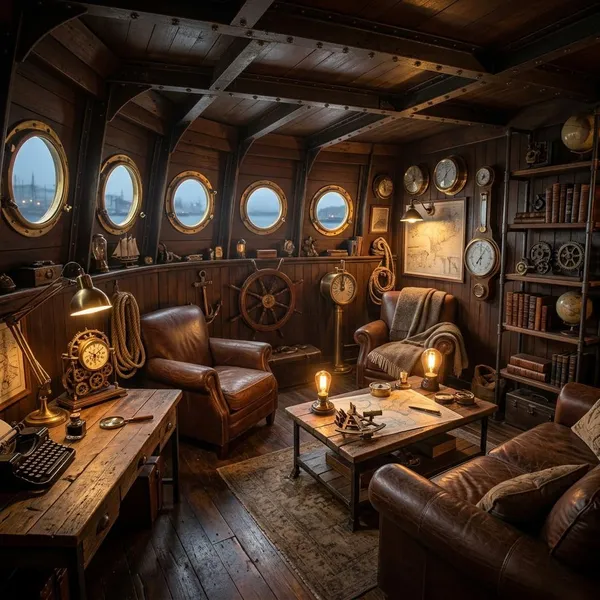
The same style should not be applied equally in every room. Living rooms can take larger statement pieces, offices suit maps and instruments, bedrooms usually need a softer version, and bars can lean into the drama.
Use the room's function as the limit. If the space is used every day, keep the theme practical. If the space is mainly for entertaining or display, you can use heavier hardware, darker colors, and more theatrical props.
Living rooms with maritime statement pieces
A living room can handle a porthole mirror, hatch-cover coffee table, marine spotlight, or large chart wall because there is usually more visual space. Keep seating comfortable and let leather, canvas, wool, or textured cotton soften the metal and wood.
For a family living room, choose one dramatic feature and keep the rest calmer. For a lounge-style room used mostly for guests, stronger lighting and ship hardware can feel more appropriate.
Offices with maps and instruments
Offices are a natural fit because navigation tools already suggest focus, planning, and study. A map behind the desk, a brass lamp, a wood tray, and one instrument display can create the mood without interrupting work.
- Best office pieces: task lamp, framed chart, ship clock, drawer labels, and compact storage boxes.
- Avoid: bulky props that steal desk space or make the room harder to use.
Bedrooms with subtle nautical details
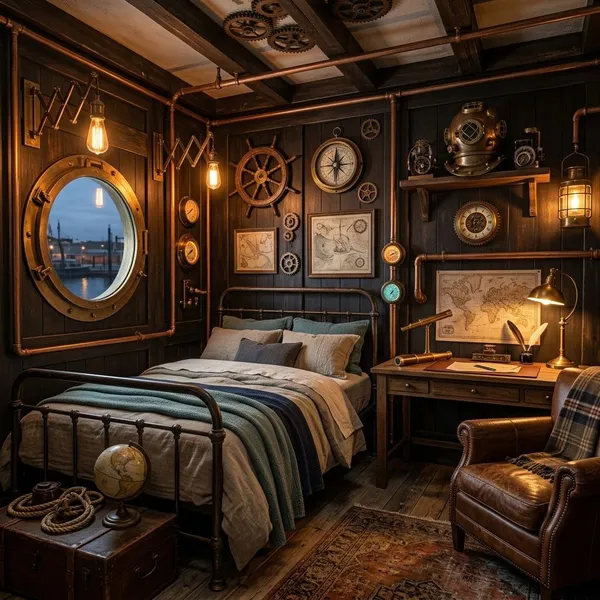
Bedrooms usually need the lightest touch. Warm bedside lamps, darker wood, muted navy or charcoal textiles, and one framed maritime print are often enough.
Heavy diver helmets, large gauges, and harsh metal fixtures can make a bedroom feel more like a set than a place to rest. If you want the theme here, aim for quiet captain's cabin rather than engine room.
Bars with ship-inspired hardware
Bars can take the boldest version of the style. Brass rails, porthole accents, riveted panels, dark shelving, pressure gauges, and warm pendants all make sense because bars already benefit from atmosphere and evening light.
Still, function has to lead. Good storage, comfortable seating, and clear task lighting matter more than novelty props. A bar that works well will feel more convincing than one that only looks themed in photos.
Small corners with compact displays
A small corner can carry the style if the display is tight and deliberate. Use a narrow shelf, side table, or console with a marine lamp, two old books, a small compass, and a framed chart. That is enough to suggest a navigator's station without taking over the room.
Nautical steampunk beyond interior design
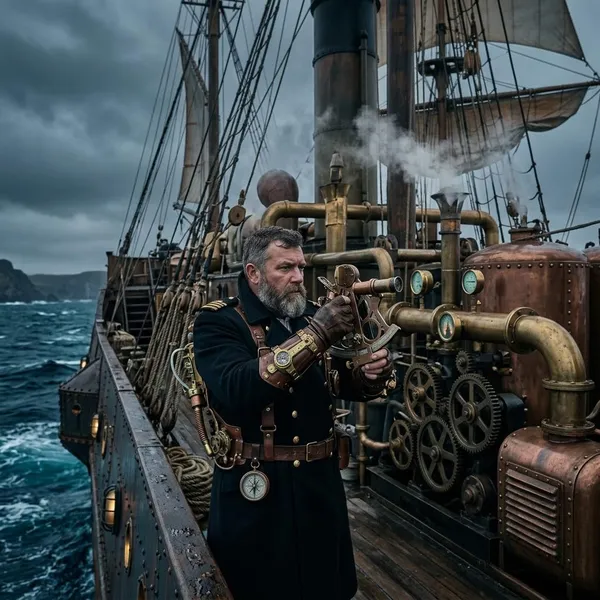
Nautical steampunk also works in fashion, costumes, props, worldbuilding, themed events, and cosplay. The same rules still apply: use maritime cues, aged materials, mechanical details, and a clear role or story.
The difference is intensity. A home may need restraint, while a costume or event can use stronger silhouettes, larger props, and more obvious symbolism.
Captain and explorer fashion
Captain and explorer outfits usually start with structured coats, vests, brass buttons, boots, belts, gloves, leather straps, and weathered bags. Navy, brown, black, cream, and aged brass keep the look maritime without turning it into a pirate costume.
Deep-sea diver costumes
Deep-sea diver costumes are instantly recognizable because of the helmet shape, weighted suit idea, heavy boots, and brass details. For events, lightweight replicas are usually more practical than realistic heavy materials.
The finish matters more than exact accuracy. Aged brass, dark canvas, black, brown, and muted green tend to look better than shiny synthetic colors.
Submarine-inspired props
Submarine props should look as if they control or measure something. Riveted panels, labeled dials, periscope shapes, porthole frames, levers, and gauges feel stronger when arranged with a believable purpose.
- Small project: a desk console with two gauges and one lever.
- Room project: a porthole wall, warm lighting, and a control-panel accent.
- Event project: larger panels, signage, and dramatic low light.
Maritime worldbuilding
For writing, games, or visual art, nautical steampunk can suggest underwater cities, steam-powered fleets, diving guilds, floating laboratories, or trade routes through dangerous seas. The key is consistency: if the world uses brass instruments and steam engines, let that affect travel, clothing, maps, tools, and social roles.
Octopuses, weathered trunks, charts, rivets, and pressure gauges work because they quickly signal deep water, invention, danger, and discovery.
Themed events and cosplay
Events work best when guests understand the theme quickly. Warm light, chart-style graphics, marine hardware, brass accents, and one dramatic prop can set the mood faster than covering every wall.
For cosplay, decide the character before choosing accessories. Captain, engineer, navigator, diver, explorer, and submarine mechanic each need different details. That prevents the outfit from becoming a random collection of goggles, gears, and anchors.
Conclusion
Nautical steampunk works when the room or costume has a clear maritime story and enough restraint to let the best pieces stand out. Start with dark wood, aged metal, warm light, and one strong focal point, then add instruments or mechanical details only where they strengthen the mood. If the space still feels usable, atmospheric, and a little mysterious, you are much closer than if every surface is filled with props.
FAQ
What colors work best for nautical steampunk?
Deep navy, charcoal, dark brown, blackened metal, aged brass, bronze, muted green, cream, and warm gray work best. Use the darker colors for mood, then add lighter neutrals if the room starts to feel too heavy.
Which objects make a room look nautical steampunk?
The strongest objects are marine lights, porthole mirrors, compasses, sextants, ship clocks, pressure gauges, old maps, diver helmets, and ship-style hardware. Choose one large anchor piece before adding smaller accessories.
Can nautical steampunk work in a small space?
Yes, but it needs editing. Use one compact focal point, wall-mounted lighting, a tight color palette, and a few objects with real presence instead of many small decorations.
Why are octopuses common in nautical steampunk imagery?
Octopuses fit the style because they suggest the deep sea, intelligence, mystery, and old adventure fiction. They work best as one strong motif, not as a repeated pattern on every surface.