
Medieval steampunk works best when the machines do not replace the medieval world, but put pressure on it. Start with a feudal society, choose one believable source of power, then decide who controls the workshops, fuel, and repairs. If those rules are clear, knights in pressure armor, steam siege towers, and sacred boiler temples feel like part of the world instead of decoration.
How medieval steampunk differs from related styles
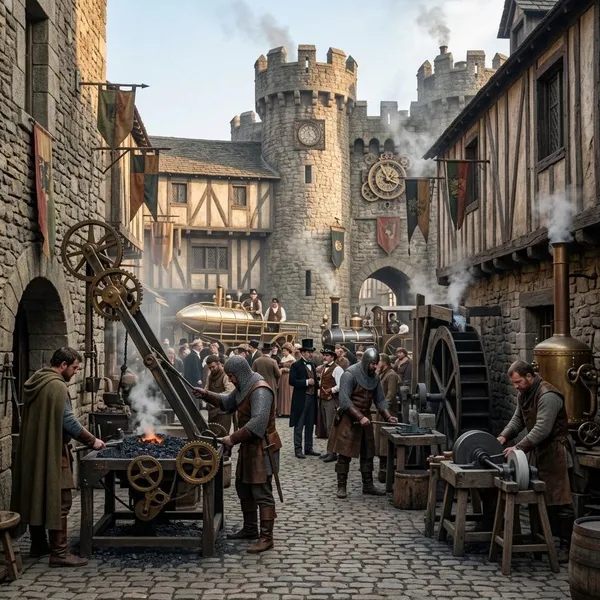
The easiest mistake is treating medieval steampunk as "castles plus brass gears." The style becomes stronger when it keeps medieval power structures intact: land ownership, oaths, guild privilege, church authority, slow travel, and uneven education.
If you are building a short story or an illustration, one strong visual contrast may be enough. For a novel, game, or tabletop campaign, the differences between nearby genres matter more because they decide what the world can and cannot support.
More feudal than Victorian steampunk
Victorian steampunk usually leans toward industry, empires, factories, inventors, and modernizing cities. Medieval steampunk should still feel ruled by inheritance, land, loyalty, and local authority. A steam engine may belong to a duke, abbey, or sworn order rather than a private industrial company.
- Good fit: a noble house controls the only boiler forge in its valley.
- Weak fit: every town has modern public transport with no change to feudal life.
More steam-driven than clockpunk
Steam should do the heavy work: lifting gates, driving siege engines, powering pumps, moving armored frames, or turning fortress machinery. Clockwork can still exist, but it works better as precision technology rather than the main energy system.
More mechanical than medieval fantasy
Medieval fantasy often solves problems through spells, divine gifts, monsters, or enchanted relics. Medieval steampunk needs visible systems: pipes, pistons, seals, valves, fuel stores, repair crews, and failure points.
Magic can still exist, but it should push machinery rather than erase it. A rune-heated boiler feels more steampunk than a spell that simply makes a tower move with no mechanism attached.
Less modern than dieselpunk
Dieselpunk tends to feel closer to the twentieth century: mass production, modern war, oil engines, aircraft, propaganda states, and heavier industrial systems. Medieval steampunk should not jump that far forward. Most people may still farm, pay dues, travel slowly, and depend on local protection.
What powers medieval steampunk technology
Pick the power source before designing the gadgets. Fuel decides where cities grow, who becomes rich, what wars are fought over, and which machines are common enough for daily life.
Coal and steam
Coal and steam give the most recognizable steampunk texture: smoke, boilers, pressure gauges, pistons, blackened workshops, and dangerous heat. In a medieval society, coal should not feel effortless. Mining, hauling, storing, and burning it all require labor and protection.
Use coal when you want dirty wealth and military pressure. Mining towns become strategic targets, forests may be cut for charcoal where coal is scarce, and a castle with reliable fuel can dominate neighbors that still rely on muscle, wind, and water.
Water and geothermal heat
Water and geothermal heat make the world more regional. Rivers can power mills, cranes, bellows, pumps, and workshop shafts. Hot springs or volcanic vents can support forge-cities, bath-temples, defensive engines, and sacred industrial sites.
| Power source | Best worldbuilding use | Natural limit |
|---|---|---|
| Rivers | Mill towns, river trade, hydraulic workshops | Machines stay near waterways |
| Geothermal heat | Temple boilers, mountain forges, sacred engines | Power is tied to rare locations |
Clockwork and spring mechanisms
Clockwork is strongest when it handles precision, not brute force. Use it for locks, timers, navigation tools, ceremonial automata, traps, prosthetic joints, or delicate targeting devices.
The built-in limit is maintenance. Fine gears need skilled hands, good metal, clean storage, and frequent adjustment. That makes clockwork perfect for guilds, monasteries, noble collections, and elite military units, but less convincing as everyday peasant technology.
Alchemy and magical energy
Alchemy is useful when you want compact engines, strange fuels, or materials that ordinary medieval metallurgy would struggle to explain. Aether gas, crystal catalysts, rune batteries, or distilled monster oil can all work if they behave like controlled resources.
- Make it costly: unstable, poisonous, sacred, rare, or hard to refine.
- Give it gatekeepers: alchemists, priests, licensed engineers, or crown inspectors.
- Set one hard rule: what it cannot power, heal, lift, or survive.
Lost knowledge and rare materials
Lost knowledge lets advanced machines exist without making the whole society industrial. A kingdom might copy ancient engines but fail to understand the original alloy, pressure seal, or control system.
This works especially well for a more mysterious tone. Engineers argue over damaged diagrams, nobles fund ruin expeditions, and priests may treat relic machines as holy objects. The important boundary is scarcity: if everyone can reproduce the old technology easily, it stops feeling lost.
How to build a believable medieval steampunk setting
Build the rules in the same order a reader will test them: power, limits, builders, consequences, purpose. If a machine exists, someone must fuel it, repair it, protect it, pay for it, and justify why an older method was not enough.
Choose one main power source
Choose one dominant source even if smaller systems exist. Coal creates mining politics and smoke. Sacred heat creates religious control. River power creates fortified valleys and trade bottlenecks. Alchemy creates secrecy and regulation.
Set clear technological limits
Limits make the machines believable. Decide what is too heavy, too expensive, too fragile, too slow, too dangerous, or too rare. A steam suit may hit hard but overheat in summer. An airship may scout well but fail in storms. A siege engine may crush a gate but need days of setup.
Do not treat limits as a way to make the world less exciting. They create better choices. A commander who must choose between speed, fuel, armor, and repair crews has a more interesting problem than one who owns perfect machines.
Define who builds and repairs machines
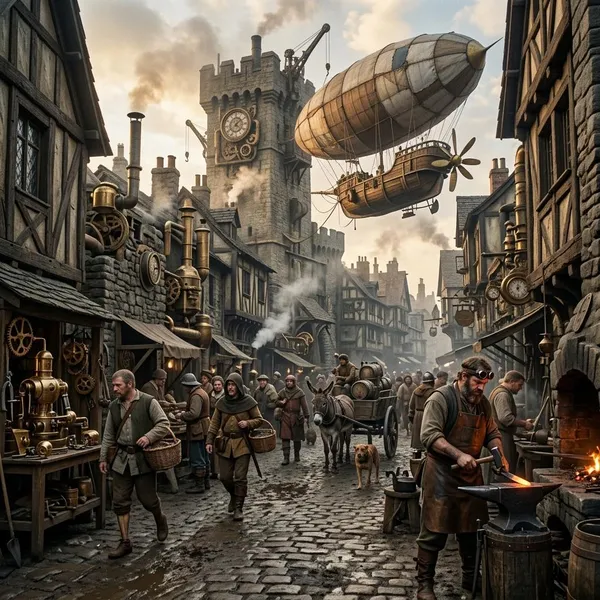
The repair network matters as much as the invention. Machines can belong to guild workshops, abbeys, royal foundries, knightly orders, merchant cities, or wandering artificer families. Each option creates different politics.
- Guild control: cities gain bargaining power over nobles.
- Church control: technical knowledge becomes sacred and policed.
- Royal control: engines become military assets and symbols of authority.
- Wandering repairers: remote armies and border towns depend on fragile personal ties.
Show the effects on trade and warfare
Technology should change more than battle scenes. Steam pumps deepen mines. Mechanical hoists speed wall-building. River engines turn one town into a manufacturing hub. Better cranes, roads, and locks can shift wealth faster than one flashy war machine.
In warfare, keep the old and new side by side. Castles still matter, but roofs gain anti-air platforms. Knights still matter, but their armor needs technicians. Merchants still matter, but now they trade copper tubing, seals, fuel, springs, treated leather, and pressure-safe fittings.
Match every invention to its purpose
Before adding a gadget, ask three questions: who needed it, what problem did it solve, and why was the old method not enough? A steam winch makes sense if a quarry must lift heavier stone. Mechanical armor makes sense if elite troops face stronger crossbows, monsters, or siege weapons.
Medieval steampunk setting ideas
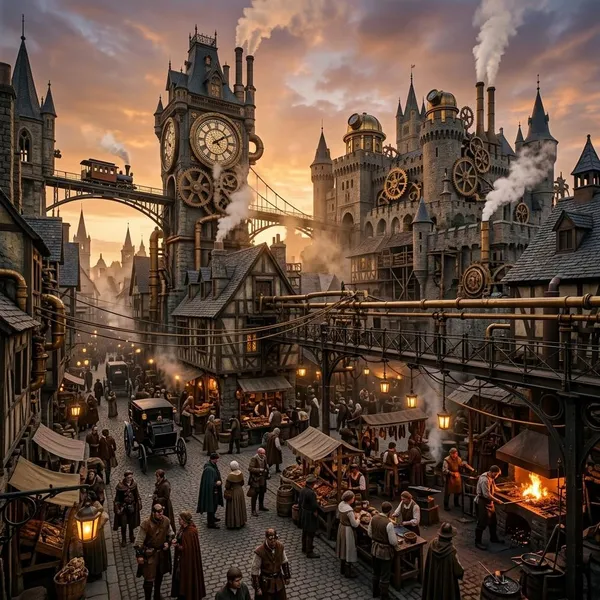
A strong setting idea should create conflict immediately. The best concepts do not just look good; they decide who has power, who is excluded, what is illegal, and what ordinary people fear or need.
Use these as starting points, then narrow them to fit your project. A single illustration may only need one iconic machine, while a campaign setting needs supply lines, laws, factions, and failure points.
A kingdom powered by sacred steam
Volcanic vents beneath the capital are treated as divine gifts. Priests bless pressure chambers, temple engineers maintain royal engines, and the monarch claims authority as guardian of the holy heat.
The conflict almost writes itself: distant lords resent dependence on the capital, smugglers steal blessed condensate, and reformers argue that sacred steam should serve villages rather than only cathedrals and armies.
A church that bans aether machines
A church ban works best when aether machines are genuinely useful. If the devices are weak, nobody risks much by suppressing them. If they are compact, efficient, and poorly understood, the ban creates fear, hypocrisy, black markets, and secret workshops.
- Public reason: aether corrupts souls or invites forbidden forces.
- Private temptation: clergy use hidden devices for vaults, messages, or war.
- Story pressure: mechanics become heretics as well as criminals.
Knightly orders using mechanical armor
Mechanical armor fits naturally because medieval knighthood already carries ritual, cost, training, and status. Piston-assisted joints, locking braces, cooling tubes, and pressure gauges turn the knight into both warrior and machine platform.
Keep the weakness visible. A suit may need a technically trained squire, jam after a fall, overheat during a long charge, or become useless without spare seals. That makes the order impressive without making it unbeatable.
Merchant cities built on mobile fortresses
Mobile fortress-cities push the setting toward big spectacle without losing medieval logic. A moving citadel can carry guild halls, cranes, boiler rooms, markets, chapels, guards, and its own laws across dangerous borders.
Border wars fought with airships and siege towers
Airships and siege towers work best when neither one solves war completely. Airships scout passes, carry messages, drop small raiding parties, or threaten exposed towers. Steam siege towers do the slow, ugly work of approaching walls under fire.
This keeps the border recognizably medieval. Castles adapt instead of disappearing: watchtowers gain signal lamps, keeps hide boiler lifts, and frontier villages learn to fear both shadows overhead and smoke on the road.
Conclusion
A believable medieval steampunk world starts with restraint: one main power source, a few important machines, and clear limits that let older institutions survive. If the technology changes trade, war, religion, and status without making every village modern, the setting gains the right tension between wonder and weight.
FAQ
Is medieval steampunk historically accurate?
No. It is an alternate or speculative style, not a historically accurate version of the Middle Ages. It only needs enough internal logic for readers to believe its rules while they are inside the world.
How is medieval steampunk different from clockpunk?
Medieval steampunk uses steam, pressure, heat, and heavier machinery as its main identity. Clockpunk is more about springs, gears, precision mechanisms, and automata.
Does medieval steampunk need magic?
No. It can run on coal, water, geothermal heat, and mechanical engineering alone. Magic helps when you want compact engines or strange materials, but it should still have limits.
Is medieval steampunk historically accurate?
No. It is an alternate or speculative style, not a historically accurate version of the Middle Ages. It only needs enough internal logic for readers to believe its rules while they are inside the world.
How is medieval steampunk different from clockpunk?
Medieval steampunk uses steam, pressure, heat, and heavier machinery as its main identity. Clockpunk is more about springs, gears, precision mechanisms, and automata.
Does medieval steampunk need magic?
No. It can run on coal, water, geothermal heat, and mechanical engineering alone. Magic helps when you want compact engines or strange materials, but it should still have limits.