
Chinese steampunk works best when it feels like a believable Chinese alternate history, not just standard steampunk with dragons and red silk added on. Start by asking three things: which Chinese setting is being reimagined, what problem the machinery solves, and whether the symbols, clothing, buildings, and tools all belong to the same world.
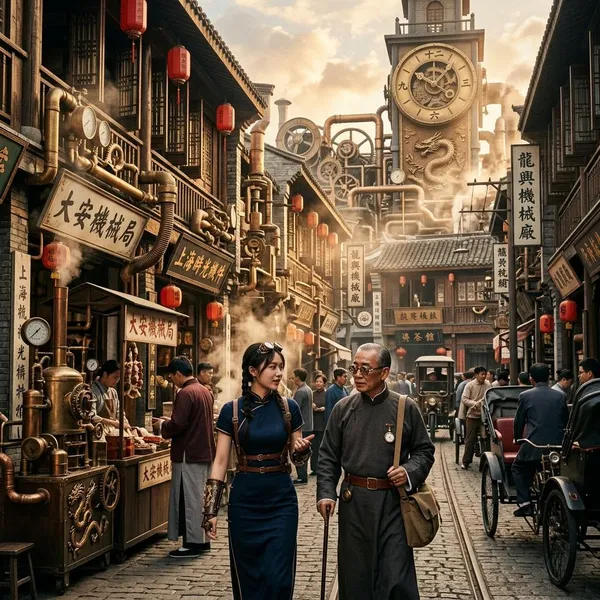
What defines the Chinese steampunk aesthetic?
The Chinese steampunk aesthetic is a mix of retrofuturist machinery and Chinese historical design, but the important word is mix. The style becomes convincing only when the mechanical parts, clothing, architecture, and symbols seem to have developed together.
Historical clothing and silhouettes
Clothing is often the first clue that a design is Chinese steampunk rather than generic steampunk. A mandarin-collared coat, layered robe, scholar silhouette, Qing-inspired jacket, military vest, embroidered panel, or rank-style detail can give the viewer a period and social setting before any machine appears.
Mechanical tools and machines
The machinery should look as if it came from the setting. Instead of adding gears to a robe, think of steam-powered sedan chairs, boiler lanterns, pressure-sealed scroll tubes, mechanical abacuses, canal pumps, astronomical devices, or signal towers attached to city walls.
If you are designing a single cosplay prop, one focused object is usually stronger than five unrelated gadgets. A courier's message tube with valves and seals tells a clearer story than a generic brass gun with a tassel.
Traditional materials and textures
Chinese steampunk loses its identity when everything becomes polished brass. Bronze patina, lacquered wood, silk cord, carved panels, bamboo ribs, ceramic glaze, ink-black surfaces, jade tones, and embroidered trim make the industrial elements feel more local and more handmade.
- For a cleaner, courtly mood: use lacquer, silk, jade-like colors, and controlled metal details.
- For a workshop or dockside mood: use darker wood, soot marks, patched cloth, rivets, and worn bronze.
- For fantasy-heavy designs: let talismans, painted seals, or ritual textures sit beside the machinery.
Chinese architecture and cityscapes
Architecture gives the style scale. Courtyards, tiled rooflines, watchtowers, city gates, moon gates, temple halls, canal streets, bridges, and walled compounds all change how machines would be built and used.
A canal city might need steam pumps, dredging engines, ferries, and warehouse lifts. A mountain settlement might develop cable systems and compact climbing machines. A capital city with heavy bureaucracy might produce archive machines, seal presses, and message-tube networks. Those choices make the world feel designed, not decorated.
Mythic and symbolic details
Mythic details can make Chinese steampunk memorable, but they need context. A dragon on a state airship may suggest imperial power. A crane on an official's clothing may imply refinement or rank. Talismans on an engine can hint that dangerous machinery is treated with ritual caution as well as technical skill.
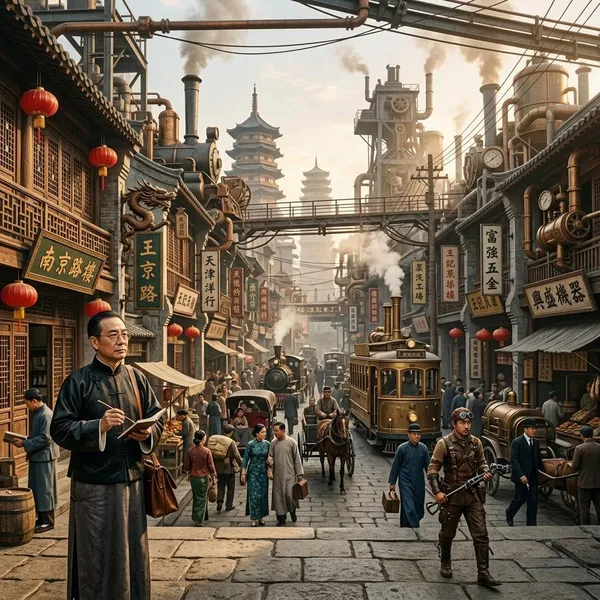
Where does Chinese steampunk draw its historical inspiration?
Chinese steampunk usually draws from late imperial history, older craft traditions, industrial-era pressure, and Chinese myth or folklore. It does not need one fixed dynasty, but it does need a clear point of departure.
Late imperial China
Late imperial China, especially the Qing period, gives Chinese steampunk an obvious tension between inherited systems and new machinery. Treaty ports, river trade, military reform, court politics, workshops, and urban change all provide useful points where an alternate industrial path could begin.
This era is a good choice if you want social conflict to matter. Steam technology could affect who controls transport, who owns factories, how messages move, and whether regional powers become more independent.
Traditional craft and engineering
Traditional craft is where many of the best visual ideas come from. Bronze casting, wood joinery, ceramics, papermaking, weaving, canal engineering, astronomical instruments, printing, and mechanical toys all offer shapes and methods that feel more Chinese than a copied Western engine.
Industrial change and foreign influence
Foreign influence can be part of Chinese steampunk, but it should create a story rather than a collage. Imported machinery, military pressure, rail technology, and global trade might lead to resistance, adaptation, imitation, or a parallel local industry.
- Resistance scenario: local engineers build machines to defend autonomy.
- Port-city scenario: foreign devices are repaired, copied, and altered by Chinese workshops.
- Reform scenario: officials use steam systems to strengthen administration and military control.
Chinese myths and folklore
Folklore lets the style move beyond industrial realism. Mechanical dragons, spirit-guided engines, celestial diagrams, Daoist talismans, mountain immortals, underworld officials, or alchemical materials can all fit if the world explains how belief and engineering interact.
The balance depends on tone. A detective story may keep myth subtle, using symbols and rumors. A fantasy adventure can make ritual technology central. Both can work, but the reader should understand whether the machine is powered by fuel, magic, ritual authority, or some deliberate blend.
Chinese steampunk in art and fiction
Chinese steampunk is especially effective in visual media and speculative storytelling because every design choice can carry worldbuilding. A coat, seal press, airship, bridge, boiler, or lantern can show social rank, technology, politics, and belief at the same time.
Alternate-history worlds
Alternate history is one of the most natural uses of Chinese steampunk. A single change, such as steam power spreading through imperial workshops or regional foundries, can reshape transport, warfare, communication, taxation, and urban growth.
A late Qing river empire with steam ferries will feel different from a Ming observatory culture using pressure-driven navigation devices. Pick the historical break first, then let the consequences spread through the setting.
Character and costume design
A character should not look like a mannequin wearing every cool idea at once. Start with the role: engineer, pilot, magistrate, merchant, courier, soldier, dockworker, rebel, scholar, or ritual specialist. Then choose clothing, tools, and wear marks that match that life.
- Engineer: practical sleeves, tool loops, soot, reinforced panels, repairable gear.
- Official: cleaner fabrics, rank cues, seal devices, controlled ornament.
- Courier: compact storage, weather protection, message tubes, light movement.
- Rebel: adapted equipment, stripped symbols, patched materials, hidden mechanisms.
Machines and props
Props are a good entry point because one object can express the whole style. A steam lantern, coded abacus, ritual-vessel boiler, mechanical brush case, pressure scroll tube, or incense-burner engine can be enough if it has a clear use.
Steampunk fantasy stories
Steampunk fantasy can bring together machinery, court politics, martial adventure, ghosts, ritual specialists, and urban mystery. The key is to decide how far the fantasy goes. If spirits can affect engines, that should change engineering, law, religion, and fear around machines.
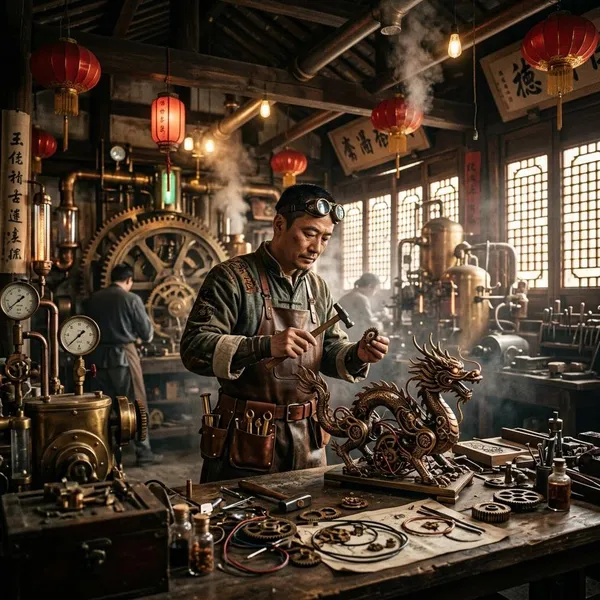
How to create Chinese steampunk
To create Chinese steampunk, work from the setting outward. The order matters: choose the historical frame, decide what the technology does, research visible details, use symbols with care, and remove anything that belongs to a different visual language without a story reason.
Choose a historical starting point
Begin with a one-sentence premise. For example: "a late Qing canal city with local steam workshops" or "a Ming observatory developing pressure-powered navigation." That sentence becomes the filter for clothing, machines, buildings, and props.
A vague idea like "ancient China with gears" usually leads to blurred design. A specific time, place, and social setting gives the project edges.
Build technology around the setting
Technology should answer local needs. River towns need pumps, ferries, locks, and cargo lifts. Mountain cities need cable systems and compact engines. Bureaucratic capitals need document machines, seal devices, secure message tubes, and archive systems.
Research clothing and architecture
Clothing and architecture keep the style from floating in fantasy space. Sleeves affect workshop safety. Rooflines affect where signal towers can sit. Courtyards change ventilation, privacy, and delivery routes. Narrow streets change vehicle size.
- For costume design: study collars, closures, sleeve shapes, shoes, belts, and layers.
- For city scenes: study gates, bridges, courtyards, shopfronts, roof forms, and street width.
- For props: study boxes, seals, tubes, vessels, lamps, tools, hinges, and handles.
Use cultural symbols with context
Symbols should tell the viewer something. A dragon may imply imperial power, not just "China." A talisman on an engine may suggest danger or ritual protection. A bat motif may point toward fortune. A crane may suggest rank, longevity, or refinement depending on use.
Avoid mixing unrelated Asian influences
Chinese steampunk becomes weaker when Chinese, Japanese, Korean, Tibetan, Mongolian, and Southeast Asian elements are blended only because they look old or ornate. Cross-cultural influence can be believable, especially in ports, border regions, trade routes, or military settings, but it needs a reason inside the world.
Conclusion
The most convincing Chinese steampunk has a clear backbone: a specific setting, technology that serves that setting, and cultural details used with purpose. If a design still works after you remove the obvious motifs, the foundation is probably strong; if it falls apart, spend more time on clothing, materials, architecture, and historical logic before adding more gears.
FAQ
Does Chinese steampunk need to be historically accurate?
Not perfectly. It can be speculative, but it should be historically grounded enough that the clothing, symbols, tools, and buildings feel chosen rather than random.
Which Chinese era works best for steampunk?
Late Qing is often the easiest starting point because industrial change and political pressure are already present. Song or Ming settings can also work well if the machinery follows a clear alternate-history path.
Where did steampunk originally come from?
Steampunk grew from Western speculative fiction shaped by nineteenth-century industry, Victorian-era imagery, and writers such as Jules Verne and H. G. Wells. Later creators expanded it into many regional and cultural variations.