
A convincing steampunk train station should look beautiful, but the first test is simpler: can a passenger, a porter, and a mechanic all use it without the design falling apart? Start with a believable railway layout, then add Victorian architecture, visible steam systems, and weathering where they support the station's purpose.
What makes a train station steampunk
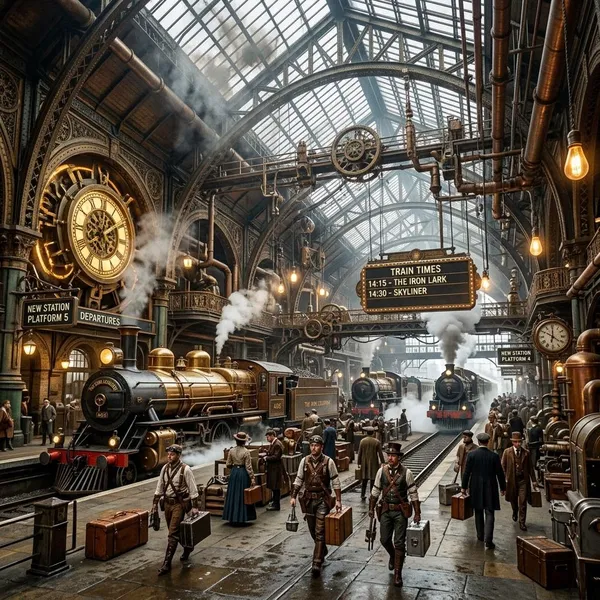
A train station feels steampunk when historical railway design and imagined machinery work together. Brass trim and gears are not enough on their own. The station needs to suggest a world where clocks, signals, lifts, lighting, cargo handling, and passenger movement all run through steam-era logic.
Victorian railway architecture
Victorian railway architecture gives the station its believable shell: high glass roofs, iron trusses, masonry facades, arched entrances, tall windows, clock towers, and broad concourses. These elements make the fantasy parts easier to accept because the building already feels like a real transport hub.
For a grand city terminal, lean into symmetry, civic scale, and a dramatic ticket hall. For a small frontier stop or mining depot, use the same language in a rougher way: fewer arches, heavier ironwork, patched roofing, and a stronger link to freight yards or workshops.
Steam-powered imagined technology
The steam-powered technology should solve station problems. A mechanical departure board, piston-driven baggage lift, pressure-regulated platform clock, or steam-assisted signal system feels much stronger than a wall covered in random gears.
- Good use: a visible pipe feeding a lift beside the luggage route.
- Weak use: oversized gears placed on a wall with no job.
- Best test: a viewer should be able to guess what the machine does in a few seconds.
Brass copper iron and glass
Use brass, copper, iron, and glass with roles rather than spreading them everywhere. Iron works well for structure, copper for pipework, brass for controls and trim, and glass for roofs, lamps, and ticket hall windows.
Visible machinery with a clear purpose
Visible machinery is one of the quickest ways to make the design feel steampunk, but it needs a reason to exist. Put cranes near freight tracks, signal levers near a control room, ventilation around the boiler area, and lifts where luggage or cargo actually changes level.
This matters even more in models, games, and Minecraft builds because viewers often read the design from a distance. A few purposeful machines create a stronger impression than dozens of decorative parts competing for attention.
A weathered retro-futurist atmosphere
The atmosphere should feel advanced for its world but worn by daily use. Soot near vents, polished handrails, fogged glass, patched pipes, stained stone, old route maps, and scuffed platform edges all suggest a station that has been running for years.
Keep the weathering selective. Put grime where smoke, heat, hands, wheels, and maintenance would naturally leave marks. That small bit of discipline stops the station from becoming visually noisy.
How to plan the station layout
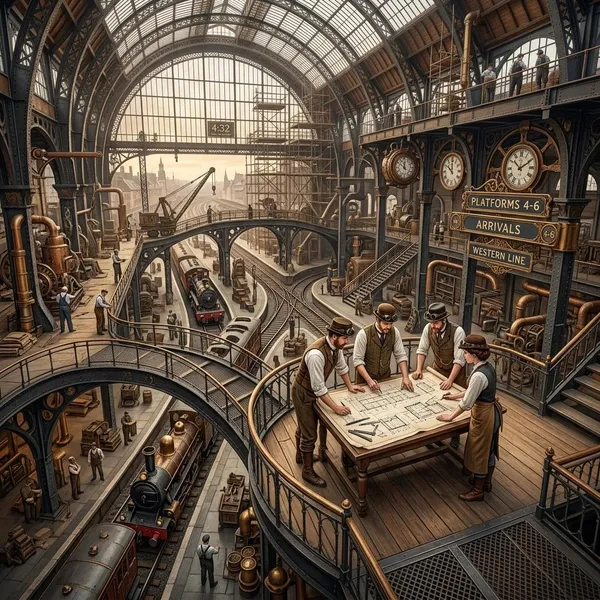
Plan the layout before adding decoration. A good station has clear public routes, separate service or cargo movement, logical access to platforms, and machinery placed close to the work it supports.
Separate passenger and cargo routes
Passengers need readable, safe movement. Cargo needs width, access, storage, and machinery. If both routes share the same narrow hall, the station may look dramatic but it will not feel believable.
| Route | Should feel like | Useful design choices |
|---|---|---|
| Passenger route | Clear, public, guided | Ticket hall, signs, clocks, barriers, waiting areas |
| Cargo route | Industrial, direct, heavy-duty | Side yard, loading dock, crane, freight lift, storage bay |
| Staff route | Controlled, practical, less visible | Service stairs, workshops, signal room access, maintenance doors |
Connect entrances platforms and exits
A first-time visitor should understand the main route almost immediately: entrance, ticketing or waiting, platform access, then exit or transfer. Use roof lines, floor patterns, hanging signs, lamps, arches, and a large clock to pull the eye in the right direction.
For a game map, this is not just visual polish. If players cannot tell where the platforms are, they may miss the best parts of the build. For a display model, the same clarity helps someone understand the station from across the room.
Add bridges stairs and service lifts
Bridges, stairs, and service lifts make the station feel layered instead of flat. A footbridge can move passengers over tracks, a stair tower can become a landmark, and a steam lift can connect baggage rooms to platforms.
- Use bridges when passengers need to cross tracks safely.
- Use stairs to make galleries, towers, and control rooms feel accessible.
- Use service lifts where cargo, luggage, coal, or tools must move between levels.
Place machinery near the areas it serves
Machinery should sit where its function is visible. A boiler hidden in one corner can work if pipes clearly lead away from it, but a cargo crane far from any freight track feels like decoration.
Create one strong visual focal point
Choose one feature to dominate the design: a clock tower, a glass train shed, a copper boiler stack, a rotating turntable, or a huge signal frame. This gives the station a memory point and keeps the rest of the details from fighting for attention.
For a compact model, the focal point may need to be vertical so it reads at a glance. For a large digital station, it can be a central hall or machine room that players naturally move toward.
How the station machinery works
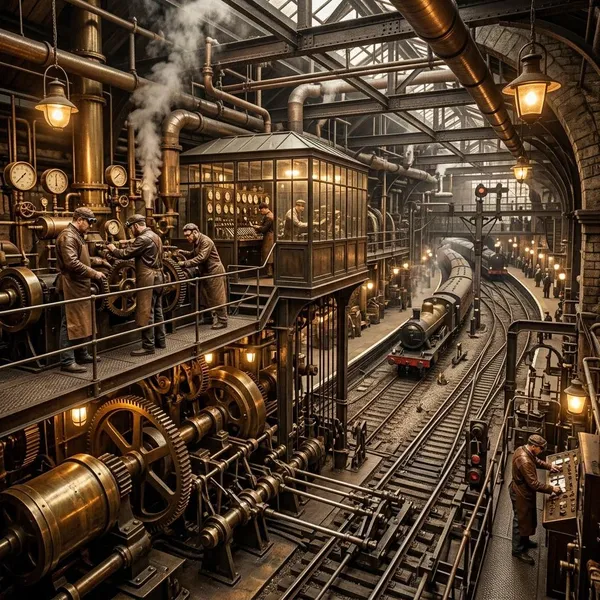
The machinery should feel like a connected system, not a set of separate props. Fuel heats boilers, boilers create pressure, pipes carry steam, valves control flow, and mechanical devices turn that pressure into movement, timing, lifting, signaling, or ventilation.
You do not need strict engineering realism for a fantasy build, but you do need visible cause and effect. The more clearly power moves through the station, the more believable the inventions become.
Boilers power the main systems
Boilers often work best as the station's industrial heart. They can power lifts, pumps, clock regulators, signal mechanisms, ventilation fans, and workshop tools.
Give the boiler area support details so it feels usable: coal or fuel access, water tanks, ash removal, gauges, valves, heat shielding, and a route for workers. Without those clues, a giant boiler can look impressive but oddly disconnected.
Pipes distribute steam around the station
Pipes show where power travels. Use thicker pipes as main lines and smaller branches for clocks, lifts, signals, platform devices, and workshop tools. Let them follow walls, beams, trenches, or overhead gantries so they look installed rather than scattered.
Mechanical signals control rail traffic
Mechanical signals tie the station to the railway itself. Semaphore arms, lever frames, pulleys, rods, route boards, and signal cabins all help explain how trains are controlled without modern electronics.
Place the signal room where it has a believable relationship to the tracks. An elevated cabin overlooking platforms or points makes more sense than a control desk buried in a decorative corner.
Cranes and lifts move heavy cargo
Cranes and lifts make the station feel commercially active. A freight-heavy depot might need a large crane, loading platform, and broad service yard, while a passenger-focused terminal may only need luggage lifts and a smaller goods bay.
Workshops keep engines and equipment running
Workshops make the station feel maintained rather than staged. Add workbenches, tool racks, spare valves, oil cans, inspection pits, replacement gears, and half-repaired equipment.
This is a good place to show mess, but keep it purposeful. A repair bay beside service tracks tells a clearer story than random clutter spread through the passenger hall.
How to build your own steampunk train station
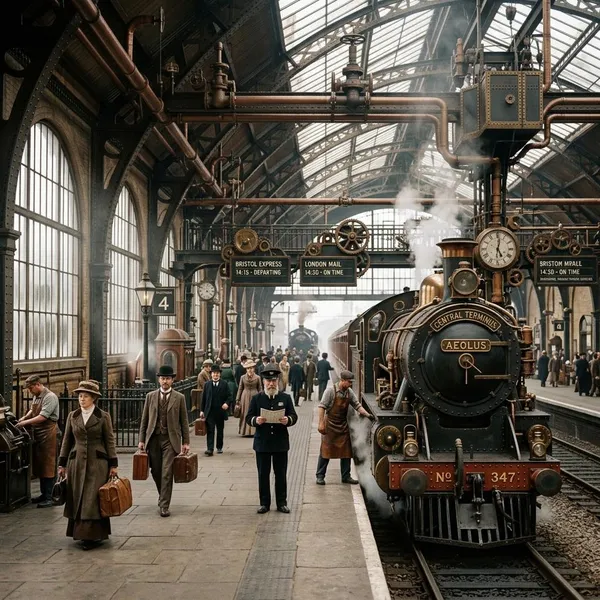
Build from function to detail. Decide what kind of station it is, block out the main structure, plan movement, then add tracks, machinery, materials, lighting, and weathering.
Choose the purpose and scale
Pick the station's role first. A luxury city terminal, mountain mining stop, military supply station, and small rural depot should not have the same layout or machinery.
- Small build: one platform, ticket room, small boiler, simple pipework, one clear focal point.
- Medium build: two or three platforms, freight area, signal cabin, service lift, workshop corner.
- Large build: multiple lines, overhead bridges, full boiler hall, cargo yard, workshops, tower, and layered routes.
Sketch the main station structure
Start with the big shapes: entrance hall, train shed, platforms, roofline, tower, service wing, and cargo side. At this stage, simple blocks are enough. You are checking proportion, silhouette, and whether the station reads as a station before the details arrive.
Leave room for expansion if the project may grow. Modular builders, digital artists, and Minecraft players all benefit from a structure that can accept another platform, side yard, or workshop later.
Plan movement and functional zones
Mark the zones before decorating them. Put waiting areas near platforms, freight storage near loading tracks, workshops near maintenance access, and signal controls where staff can plausibly oversee rail movement.
Add the railway and mechanical systems
Add tracks, switches, signals, boilers, pipes, lifts, cranes, and clocks once the layout works. Connect each major machine to a visible purpose: a pipe feeding a lift, a lever frame linked to signals, or a clock mechanism tied to a regulator.
- Set the story: decide who uses the station and what it transports.
- Block the layout: place entrances, platforms, cargo areas, staff access, and focal point.
- Add rail logic: include tracks, platform edges, signals, and service access.
- Layer the machinery: connect boilers, pipes, lifts, cranes, clocks, and controls.
- Finish with use: add signs, benches, lamps, luggage, soot, repairs, and worn surfaces.
The safest design choice is consistency. A restrained, realistic station and a wild fantasy station can both work, but mixing both without a clear rule often makes the build feel accidental.
Conclusion
The strongest design is not the one with the most gears; it is the one where the routes, machines, materials, and atmosphere all seem to belong to the same working place. Start with purpose and movement, choose one memorable focal point, then add steam-powered details only where they make the station easier to understand or more interesting to explore.
FAQ
Are steam trains automatically steampunk?
No. A steam train can be purely historical. It becomes steampunk when the surrounding world adds retro-futurist machinery, exaggerated mechanical systems, or alternate industrial technology.
What should a steampunk station include?
Include a readable station layout first, then add platforms, signals, boiler or power areas, pipework, cargo handling, lighting, and weathered Victorian materials. Skip any feature that has no clear role.
How do you make the design feel authentic?
Make every major detail answer a practical question: where people go, how cargo moves, what powers the machines, and who maintains the station. Authenticity comes from visible logic more than from adding more decoration.
Are steam trains automatically steampunk?
No. A steam train can be purely historical. It becomes steampunk when the surrounding world adds retro-futurist machinery, exaggerated mechanical systems, or alternate industrial technology.
What should a steampunk station include?
Include a readable station layout first, then add platforms, signals, boiler or power areas, pipework, cargo handling, lighting, and weathered Victorian materials. Skip any feature that has no clear role.
How do you make the design feel authentic?
Make every major detail answer a practical question: where people go, how cargo moves, what powers the machines, and who maintains the station. Authenticity comes from visible logic more than from adding more decoration.