
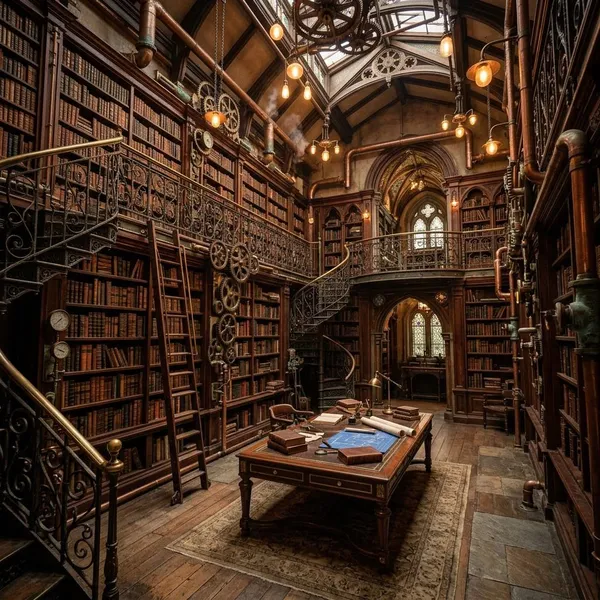
A steampunk library works best when it feels like a real reading space first and a themed room second. Start with dark wood, warm light, sturdy shelving, and a few purposeful metal details; then add Victorian shapes and mechanical objects only where they make the room richer, not busier.
What makes a library look steampunk
The fastest way to get the look right is to check three things before buying decor: does the room feel warm, does the furniture have weight, and do the industrial details look useful? If those basics are missing, small gears, novelty signs, or random vintage objects will not carry the style.
Victorian furniture and architecture
Victorian influence gives the room its library backbone. Look for carved wood, paneled walls, arched shelving, tufted seating, heavy desks, and framed artwork with some depth to it. Even in a plain modern room, adding picture-frame molding or a bookcase with a decorative crown can make the space feel more established.
Do not make every piece ornate. One strong Victorian element, such as a wingback chair or substantial writing desk, often works better than filling the room with fussy details.
Industrial metal and exposed hardware
Metal should look like it belongs to the structure of the room. Pipe shelves, black iron brackets, brass lamp arms, riveted corners, visible hinges, and sturdy drawer pulls all work because they suggest construction and function.
- Use black iron when the room needs stronger contrast.
- Use brass when the space feels too cold or modern.
- Use copper sparingly for warmth and workshop character.
Dark wood leather and aged finishes
Dark wood and leather make the space feel grounded. Walnut, mahogany, stained oak, worn leather, and matte finishes are easier to live with than glossy surfaces because small marks blend into the character of the room.
If the library will be used daily, choose finishes that can handle touch: a desk that can take a notebook, a chair that feels comfortable after an hour, and shelves that will not look ruined by small scratches. A display-only room may tolerate more delicate pieces, but a real reading space should not feel precious.
Mechanical details with a clear purpose
Mechanical accents work when they seem connected to reading, writing, travel, science, or storage. A large clock, adjustable lamp, telescope, globe, apothecary drawers, drafting tools, or rolling ladder has more value than a handful of tiny gears with no role.
A warm retro-futurist atmosphere
The room should feel imaginative, but not cold or theatrical. Warm bulbs, shaded lamps, dark shelves, old maps, globes, and scientific objects can suggest a retro-futurist world without turning the library into a stage set.
Keep modern needs quiet rather than pretending they do not exist. A laptop-friendly desk, hidden outlets, and closed cabinets for cables can sit comfortably inside the style if they are not the first things you notice.
Best colors and materials for the style
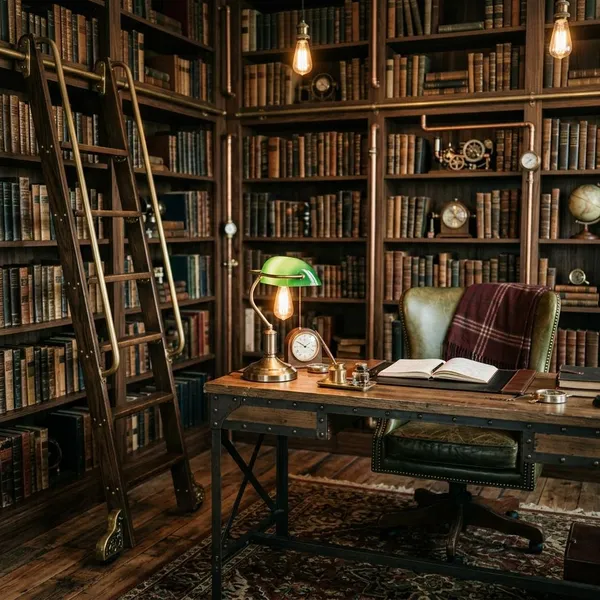
A steampunk palette should feel deep, warm, and slightly aged. Choose the main wood first, then choose one dominant metal, then add color through fabric, rugs, curtains, or a painted accent wall. That order keeps the room from looking like a mix of unrelated antiques.
Walnut mahogany and deep brown
Walnut, mahogany, and deep brown stains are the safest base for bookcases, desks, side tables, and picture frames. They give books a rich background and make even simple furniture feel more substantial.
For budget pieces, look less at whether the furniture is solid wood and more at whether the finish looks believable. A matte or satin surface with visible grain usually fits better than a shiny reddish veneer.
Brass copper and black iron
Brass brings the classic steampunk warmth, copper adds a workshop feel, and black iron gives the room weight. Pick one as the main finish and use the others only as accents.
| Metal finish | Best use in the room | When to be careful |
|---|---|---|
| Brass | Lamps, handles, frames, clocks | Too much polished brass can look new and decorative |
| Copper | Small accents, pipes, vessels, desk objects | Large amounts can pull the room toward kitchen or workshop decor |
| Black iron | Brackets, shelf supports, ladders, hardware | Too much can make the room feel more industrial than steampunk |
Burgundy navy and forest green
Burgundy, navy, and forest green work well because they feel rich without becoming bright. Use them where they can add depth: curtains, upholstery, cushions, rugs, lampshades, or one feature wall behind shelving.
Leather velvet and textured fabrics
Leather suits chairs, sofas, desk pads, boxes, and small accessories because it looks better with age. Velvet softens the darker materials and works especially well on curtains, cushions, or a single accent chair.
- Use woven rugs to reduce echo in rooms with hard floors.
- Add wool throws if the space feels visually heavy.
- Choose linen or fabric lampshades for softer light.
Patina soot and distressed finishes
A little age makes the style believable. Patinated brass, rubbed wood edges, softened leather, darkened metal, and slightly smoky tones all help the room feel collected over time.
Bookcases and furniture for a steampunk library
Furniture should solve the room before it decorates it. Decide where the books go, where you will sit, where task lighting belongs, and what needs to be hidden. Once those choices are clear, the style becomes much easier to build.
Floor-to-ceiling wooden bookcases
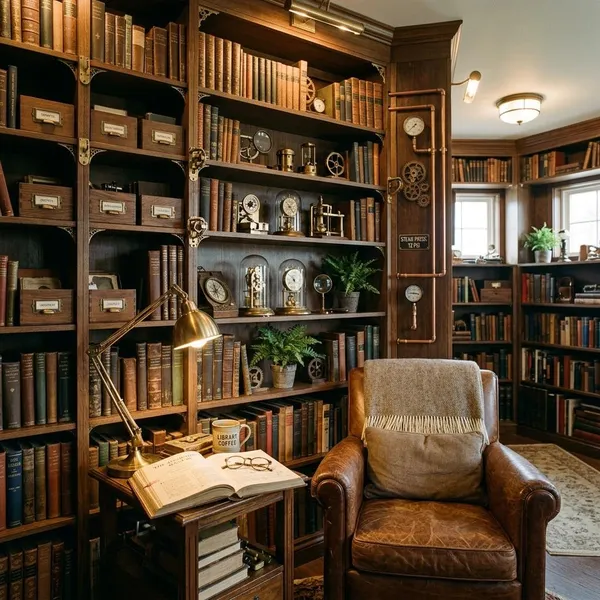
Floor-to-ceiling wooden bookcases create the strongest library effect because they make the room feel architectural. Built-ins are ideal, but freestanding units can work if they are grouped closely and finished in a consistent dark tone.
Closed lower cabinets are worth considering if the room also has office supplies, board games, devices, or paperwork. They keep the upper shelves focused on books and display pieces instead of everyday clutter.
Pipe shelves and metal brackets
Pipe shelves are best as a supporting feature, not the whole storage plan. They work above a desk, in a narrow corner, or on a small wall where a full bookcase would feel too bulky.
If the room starts to look like a loft or workshop, add more library cues: darker wood, leather seating, framed maps, warm lamps, and fewer exposed metal lines.
Leather reading chairs and sofas
A reading chair has to pass the comfort test before the style test. Sit in it the way you actually read: feet down, feet tucked, leaning back, or with a side table nearby. A beautiful chair that feels stiff after ten minutes will not help the room.
Leather club chairs, wingback chairs, tufted sofas, and deep velvet chairs can all suit the style. For occasional use, a dramatic accent chair may be fine; for nightly reading, choose supportive arms, a good seat depth, and space for a lamp within easy reach.
Writing desks with vintage hardware
A writing desk makes the library feel active rather than purely decorative. Brass pulls, label holders, turned legs, leather inlays, and darker wood all help, but the desk still needs enough depth for a laptop, notebook, lamp, and cup.
- Choose drawers if you need to hide chargers and papers.
- Place the desk near shelves if you want a working-library mood.
- Avoid oversized desks in small rooms; they can turn the library into an office.
Ladders cabinets and hidden storage
A ladder adds drama, but storage is often the more important choice. Cabinets, trunks, storage benches, and lower doors keep the room usable by hiding cables, remotes, spare notebooks, and less attractive paperbacks.
In a family home or shared room, hidden storage is what keeps the steampunk look from falling apart after a week. If the room is only a quiet reading corner, one trunk or closed basket may be enough.
How to style shelves and display pieces
Shelf styling should make the books look more interesting, not compete with them. Treat display objects as pauses between books: a clock here, a globe there, a framed map behind a stack. The shelves should still read as a library, not a souvenir shop.
Mix books with clocks and globes
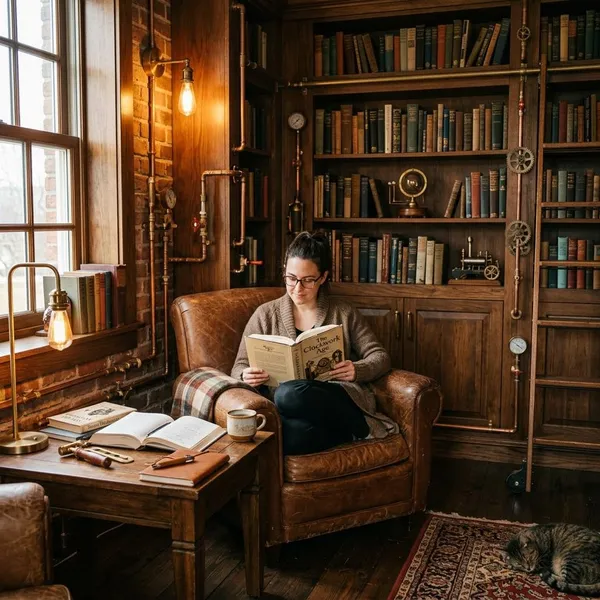
Clocks and globes work because they share the same world as books: time, travel, study, and discovery. Use them as visual breaks between vertical rows or on top of horizontal book stacks.
Keep scale in mind. A tiny clock can disappear on a tall shelf, while an oversized globe may crowd the books. One medium piece often looks stronger than several small ones.
Add maps instruments and mechanical objects
Maps, compasses, magnifiers, telescopes, drafting tools, and measuring instruments fit naturally because they feel connected to knowledge. They do not need to be antiques, but they should look made from materials that belong in the room.
A steampunk book nook can be worth making if you want a small focal point without changing the whole room. It works best when it uses the same wood, metal, and lighting tones as the surrounding shelves.
Repeat the same wood and metal finishes
Repetition is what makes a collected room look intentional. If the main furniture is dark walnut with brass details, echo that in frames, boxes, lamps, bookends, or small display pieces.
- Limit the shelves to one main wood tone when the room is small.
- Use one dominant metal so the display does not feel scattered.
- Let books add color instead of adding too many extra finishes.
Use one or two statement pieces
One strong object can carry more mood than a dozen small decorations. A large wall clock, telescope, old map, dramatic lamp, or antique-style cabinet gives the eye a clear place to land.
Leave enough open space between objects
Open space keeps the shelves readable. Leave some areas mostly books, some with a single object, and some with a small group of two or three pieces. If every gap is filled, the room stops feeling atmospheric and starts feeling dusty.
Conclusion
A convincing steampunk library is built from strong basics: useful shelving, comfortable seating, warm lighting, dark materials, and metal details that look like they serve a purpose. Start with the part of the room you will use most, whether that is one reading chair or a full wall of books, then add atmosphere slowly so the space feels collected rather than staged.
FAQ
What colors work best in a steampunk library?
Deep browns, burgundy, navy, forest green, brass, copper, and black iron work best. If the room is small, use the darkest shades on furniture and textiles before committing to dark walls.
What furniture suits a steampunk library?
Choose sturdy pieces with old-world shape and practical use: tall wooden bookcases, leather chairs, tufted sofas, writing desks, trunks, cabinets, and ladders. Comfort should win over appearance if you actually plan to read there.
Are steampunk book nooks worth making?
Yes, if you want a small project or a focal point for existing shelves. They are less worthwhile if they introduce colors and materials that clash with the rest of the room.
What colors work best in a steampunk library?
Deep browns, burgundy, navy, forest green, brass, copper, and black iron work best. If the room is small, use the darkest shades on furniture and textiles before committing to dark walls.
What furniture suits a steampunk library?
Choose sturdy pieces with old-world shape and practical use: tall wooden bookcases, leather chairs, tufted sofas, writing desks, trunks, cabinets, and ladders. Comfort should win over appearance if you actually plan to read there.
Are steampunk book nooks worth making?
Yes, if you want a small project or a focal point for existing shelves. They are less worthwhile if they introduce colors and materials that clash with the rest of the room.