
A steampunk city works best when it feels like a real place first and a stylish fantasy setting second. Start by deciding what keeps the city running: its fuel, transport, trade, class structure, and main source of conflict. The brass pipes, clock towers, airships, and smoky streets should then feel like consequences of that world, not decoration pasted onto it.
What makes a city steampunk
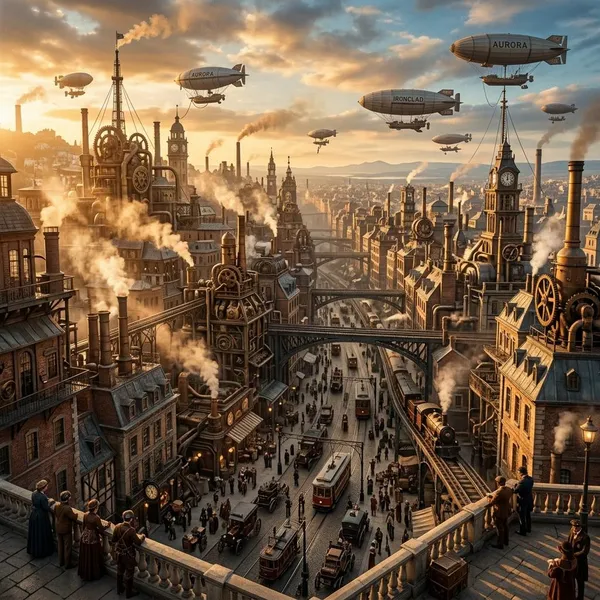
A city becomes steampunk when Victorian-inspired design, industrial machinery, visible infrastructure, and alternate-history logic all support each other. The quickest check is simple: if you remove the steam systems, exposed mechanics, and social pressure created by industry, does the city still function the same way? If yes, it may only be wearing a steampunk costume.
Victorian-inspired architecture
Victorian-inspired architecture gives the city its historical weight. Think brick terraces, arched windows, iron balconies, glass-roofed stations, carved stone civic buildings, and tall roofs broken by chimneys and towers.
Imagined steam-powered technology
Steam-powered technology should affect daily life, not just appear in the background. Boilers need fuel, engines need repair, pipes leak, pressure drops, and machines take time to warm up. Those limits make the world more believable.
For a story, game, or illustration, choose a few technologies that ordinary people actually use: tram engines, lift platforms, pneumatic message tubes, public boiler stations, mechanical ticket machines, or pressure-driven factory tools. A city feels stronger when its technology has routines, inconvenience, and maintenance costs.
Visible machinery and infrastructure
Steampunk cities usually show their systems openly. Pipes run along walls, gears turn above bridges, lift engines sit beside stair towers, and steam vents release pressure into alleys or station roofs.
If a district loses pressure, the effect should be obvious: trams stop, lifts stall, lamps dim, or workshops close early. That kind of cause and effect gives the city practical logic.
Industrial materials and aged finishes
Brick, iron, steel, brass, copper, dark wood, leather, glass, and rivets all fit naturally because they look durable and repairable. A steampunk city should feel touched by heat, labor, weather, and constant use.
Alternate history and social inequality
Most steampunk cities are not simple copies of the 1800s. They ask what might happen if steam, mechanics, air travel, or experimental industry developed in a different direction. That alternate path should change politics, trade, jobs, and public life.
Inequality is often where the setting becomes interesting. One neighborhood may enjoy private skybridges and clean pressure lines while another lives beside furnaces, coal yards, and unsafe lifts. If everyone benefits equally from invention, the city loses one of its strongest sources of tension.
What a steampunk city looks like
The look of a steampunk city should reveal how it works. A strong design has a readable skyline, busy transport layers, visible power systems, and signs of wear. It should be beautiful in places, but not weightless or spotless.
Clock towers and smokestacks
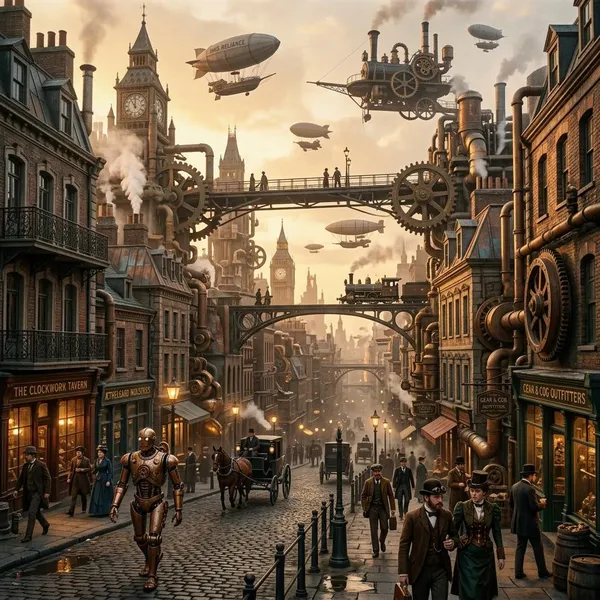
Clock towers suggest order, schedules, civic pride, and control. Smokestacks suggest production, fuel, labor, and pollution. Together, they tell the reader that time and industry shape the city's rhythm.
A clock tower can also be more than a landmark. It might regulate factory shifts, signal pressure rationing, mark curfews, or hide a central mechanism that keeps the city's transport system synchronized.
Brick buildings and iron bridges
Brick buildings make the city feel dense and permanent. Iron bridges show that people, trains, goods, or pipes must cross rivers, canals, rail yards, ravines, or stacked streets.
Use bridges as decision points, not just scenery. A public bridge might connect markets and worker housing, while a guarded iron viaduct serves only government trains or private cargo. That immediately shows who gets easy access and who has to take the long way around.
Copper pipes and mechanical facades
Copper pipes and mechanical facades make buildings feel connected to a larger network. A hospital might show sterilization pipes and pressure gauges. A newspaper office could display pneumatic tubes and visible presses. A workshop front might hiss, tick, and glow through its shutters.
Airship docks and elevated walkways
Airship docks add vertical scale and a sense of connection to distant regions. Elevated walkways show that the city has outgrown its streets or that certain groups avoid ground-level crowding, smoke, or danger.
This is especially useful for two different scenarios. In a wealthy capital, enclosed skywalks might let officials move between ministries, clubs, and private docks without touching the street. In an overbuilt industrial port, exposed catwalks may simply be the only way workers can cross above cranes, rail lines, and loading yards.
Fog, soot, warm light, and constant motion
Fog and soot give the city atmosphere, but they should come from believable conditions: river weather, coal smoke, factory output, steam leaks, or poor ventilation. Warm light from gas lamps, furnace windows, stations, and workshops keeps the setting from feeling only grim.
Transportation in a steampunk city
Transport is where a steampunk city proves whether it can actually function. Decide how people commute, how fuel arrives, how cargo reaches markets, and who gets the safest routes. If transport only looks dramatic but does not move anything important, the city will feel hollow.
Airships connect distant regions
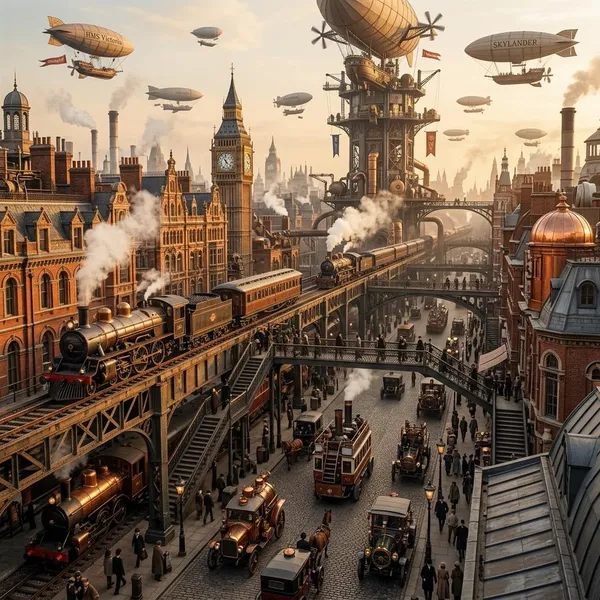
Airships work best for long-distance travel, diplomacy, military routes, exploration, or luxury cargo. They make the city feel connected to a wider world, especially if it has mooring towers, customs offices, repair sheds, weather stations, and hotels near the docks.
Give airships limits. Storms may ground them, fuel may be expensive, docking space may be controlled by elites, and repairs may take days. Those constraints stop air travel from solving every plot or design problem too easily.
Steam trains link major districts
Steam trains are ideal for heavy movement: workers, coal, ore, food, machinery, and manufactured goods. They can link mines to foundries, factories to ports, and outer housing districts to the city center.
A rail hub can also define power. If one company, guild, ministry, or noble family controls the switching yards, it controls the city's economic bloodstream.
Trams move through crowded streets
Trams make daily life visible. They pass shops, alleys, monuments, factory gates, and markets, so they help the reader understand the city from a human scale.
Mechanical lifts connect vertical levels
Mechanical lifts belong in cities with cliffs, terraces, deep canals, stacked districts, or tall industrial platforms. They can use counterweights, steam winches, hydraulic pistons, or gear-driven hoists.
They are also good conflict points. If a lift is the only safe route between the lower factory quarter and the upper administrative level, a breakdown, strike, or act of sabotage can divide the city instantly.
Cargo systems serve factories and markets
Cargo systems are less glamorous than airships, but they are often more important. A believable city needs routes for coal, water, food, spare parts, textiles, waste, mail, and finished goods.
- Start with the biggest material need: fuel, food, ore, or trade goods.
- Choose the entry point: port, rail yard, airship dock, canal, mountain road, or mine gate.
- Trace the route inward: storage yards, inspection points, factories, markets, and waste exits.
- Decide who is delayed: workers, merchants, officials, smugglers, or poorer districts.
How to design a believable steampunk city
Design the city from function outward. Start with geography, power, trade, districts, landmarks, and conflict; then add the visual style. This keeps the city from becoming a collection of attractive parts that do not quite belong together.
Choose the geography and climate
Geography should be the first decision because it controls almost everything else. A coastal city needs docks, salt-corroded metal, fog, warehouses, and naval defenses. A mountain city needs terraces, lifts, wind-sheltered airship docks, and strong bridges. A cold northern city needs heat pipes, enclosed walkways, and reliable boiler houses.
Climate also stops the design from feeling generic. Rain turns soot into grime. Dry heat makes boiler rooms more dangerous. Heavy fog can help smugglers, slow traffic, and make lamps essential even during the day.
Define the main power source
| Power choice | What it changes in the city |
|---|---|
| Coal | Mines, rail lines, smoke, labor disputes, storage yards |
| Geothermal heat | Unstable ground, sacred sites, deep engineering, political control of vents |
| Rare fictional fuel | Smuggling, monopolies, rationing, experimental machines |
Map transport and trade routes
Ask what the city exports, what it imports, and why routes meet there. A river city might ship engines downstream. A mountain hub may control the only reliable airship corridor. An inland capital might exist because every rail line passes through it.
Give every district a clear function
Each district should have a dominant purpose, even if real city life overlaps. Use functions such as government, manufacturing, repair, housing, entertainment, research, trade, transport, or religion.
This prevents every street from becoming the same mix of brass, brick, and steam. It also helps readers remember where things happen.
Create a recognizable landmark
A landmark gives the city a mental anchor. It might be a central clock tower, a bridge with rail and foot traffic, a parliament built over a river, a pressure cathedral, or a huge observatory with rotating brass domes.
The best landmark affects ordinary life. People may set their watches by it, pay taxes to maintain it, fear the machine inside it, protest beneath it, or use it to navigate the city. If the landmark only looks impressive, it is not doing enough work.
Build the central conflict into the city
The central conflict should appear in the city's layout. If class is the issue, put clean terraces above polluted labor districts. If fuel is scarce, show guarded boiler stations, ration queues, and illegal pressure taps. If empire drives the story, make airship docks, customs towers, and foreign quarters politically charged.
Conclusion
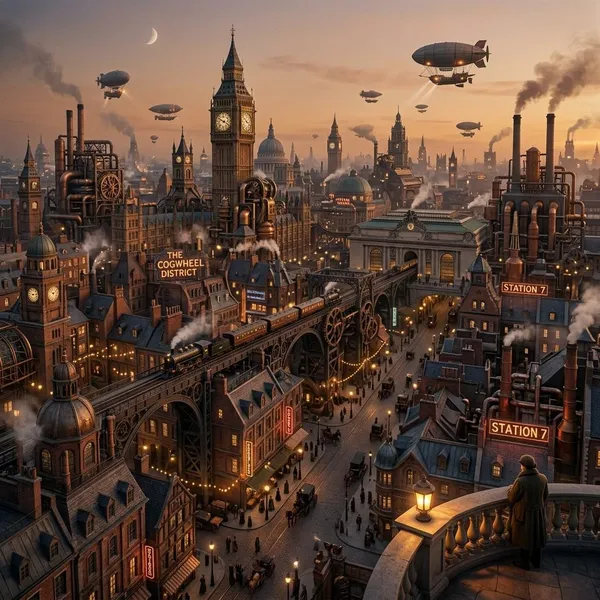
A memorable steampunk city is not built by adding more gears; it is built by making every visible detail answer a practical question. If the power source, transport routes, districts, landmark, and main conflict all connect, the city will feel solid enough for readers, players, or viewers to believe in. Once that foundation is clear, the clock towers, airship docks, warm lamps, and smoke become part of a working world rather than a decorative layer.
FAQ
Is there a real steampunk city?
No, not in the literal fictional sense. Real cities with Victorian architecture, rail heritage, old factories, iron bridges, canals, or preserved machinery can strongly inspire the look.
What powers a steampunk city?
Usually steam, often generated by coal or another heat source. Fictional settings can use stranger fuels, but the power should still have supply routes, maintenance needs, and visible consequences.
How is a steampunk city different from cyberpunk?
Steampunk is analog, mechanical, Victorian-inspired, and built around visible industry. Cyberpunk is digital, neon-lit, networked, and usually shaped by surveillance, corporations, and high-tech urban decay.
Is there a real steampunk city?
No, not in the literal fictional sense. Real cities with Victorian architecture, rail heritage, old factories, iron bridges, canals, or preserved machinery can strongly inspire the look.
What powers a steampunk city?
Usually steam, often generated by coal or another heat source. Fictional settings can use stranger fuels, but the power should still have supply routes, maintenance needs, and visible consequences.
How is a steampunk city different from cyberpunk?
Steampunk is analog, mechanical, Victorian-inspired, and built around visible industry. Cyberpunk is digital, neon-lit, networked, and usually shaped by surveillance, corporations, and high-tech urban decay.