
A steampunk village works best when the machines are not just decoration, but part of how the place survives. Start with one practical reason for the settlement to exist, then let the boilers, workshops, streets, jobs, and buildings grow from that purpose.
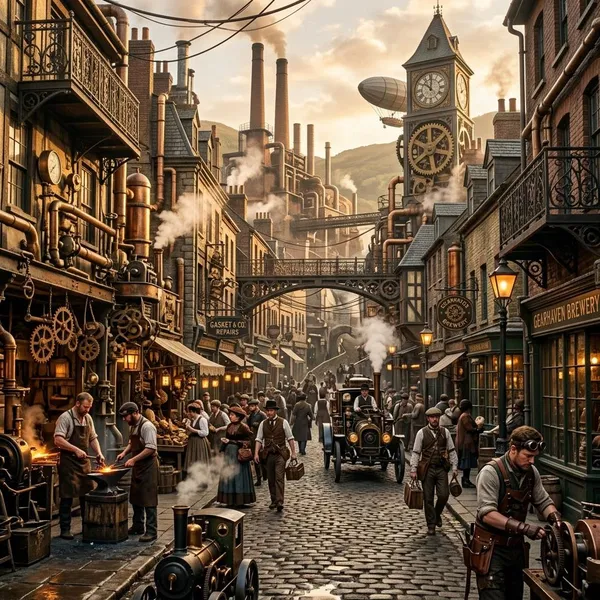
What makes a village steampunk
The fastest way to make a village feel steampunk is to connect the look to everyday function. Pipes, gears, brass plates, and smokestacks only feel convincing when they explain how people heat homes, move goods, repair tools, grow food, or travel beyond the settlement.
Small-scale steam-powered technology
Village-scale steam technology should feel compact, useful, and repairable. A shared boiler might heat several buildings, a pump tower could move water to gardens, and a belt-driven engine may run tools in a workshop. These smaller systems fit the scale better than huge factory machinery.
Victorian and frontier-inspired buildings
Victorian details give a steampunk village elegance, while frontier elements keep it practical. Brick storefronts, timber cottages, iron balconies, porches, tall windows, and narrow station buildings all work well when they match the village's location.
A remote mining village should probably look rougher than a wealthy airship stop. Use finer trim, glass, and brass where money or status gathers; use patched timber, sheet metal, and soot-darkened stone where labor happens.
Brass, copper, iron, and aged wood
Materials carry much of the mood. Brass suggests crafted instruments, copper warms up pipes and tanks, iron adds weight, and aged wood keeps the village from feeling too polished or modern.
Local trades built around machinery
A believable settlement needs jobs that explain the technology. Smiths, boilermen, machinists, haulers, parts sellers, railway clerks, pump keepers, miners, riggers, and mechanical farmers all give the village a reason to keep its machines running.
A close-knit community shaped by invention
The village scale is what makes the setting personal. In a city, a boiler failure is infrastructure; in a village, everyone knows whose workshop caused it and whose bakery lost heat because of it.
That creates useful story tension. A new machine may save harvest time, but if it is noisy, expensive, or unsafe, neighbors will have opinions. Invention should change relationships, not just scenery.
Essential buildings in a steampunk village
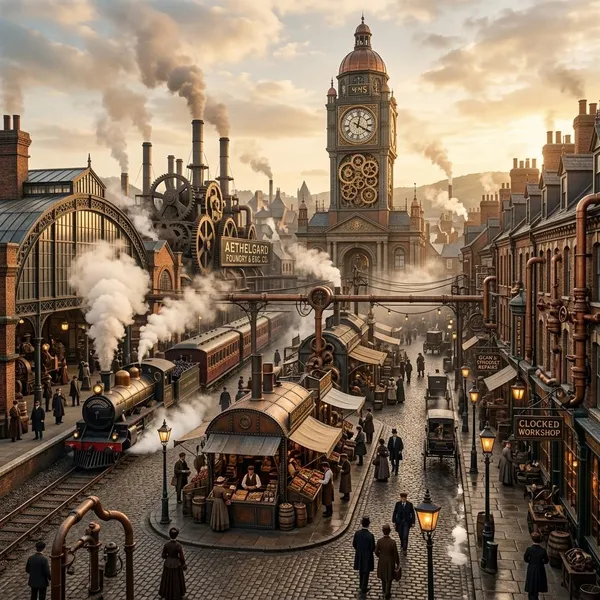
The essential buildings are the ones that keep the settlement running: invention, repair, trade, transport, local authority, food, and lodging. If those needs are covered, extra buildings like observatories, bathhouses, greenhouses, or pump stations will feel like natural additions rather than random set dressing.
Inventor's workshop
The inventor's workshop is the village's creative pressure point. It may hold drafting tables, prototype engines, gauges, salvage bins, test benches, and half-finished devices that either improve daily life or make everyone nervous.
Blacksmith and machine repair shop
This building is more important than it first appears because steampunk machinery should need regular care. A repair shop can combine a forge, anvil, lathes, drill presses, gear racks, leather belts, and pressure-testing tools.
- Place it near: workshops, farms, docks, rail yards, or mining lifts.
- Keep nearby: scrap storage, coal or coke, water, wide doors, and hauling access.
- Use it for: breakdowns, disputes over repair costs, apprenticeships, and local gossip.
Railway station or airship platform
A railway station or airship platform explains how the village connects to the wider world. It brings mail, travelers, rare parts, fuel, rumors, and pressure from outside interests.
Choose the transport type based on the setting. Rail suits valleys, plains, mining routes, and frontier trade. Airships fit cliffs, plateaus, coastal winds, or a more adventurous engineering culture.
Market hall and trading post
The market shows what the village has and what it lacks. Food, fuel, tools, cloth, spare parts, scrap metal, imported gauges, and small inventions can all pass through the same public space.
For a small rural settlement, the market may be weekly and practical: preserved food, oil, boots, nails, seed, and pump parts. For a busy dock or airship stop, it can feel more international, with strange instruments, polished fittings, and travelers arguing over cargo.
Town hall or guild headquarters
Local authority in a steampunk village should deal with practical problems: fuel storage, boiler inspections, docking fees, workshop noise, patents, trade disputes, and repair standards. That makes a town hall or guild headquarters more than a decorative civic building.
A guild headquarters works especially well when engineers or machinists hold social power. Blueprint cabinets, wall clocks, speaking tubes, permit ledgers, and inspection seals can show who controls progress and who gets left waiting.
Inn, tavern, or boarding house
An inn or tavern gives the village a human center. Rail crews need beds, merchants need meals, inventors need an audience, and tired workers need somewhere warm after the machines quiet down.
How daily life works in the village
Daily life should reveal the village's priorities. People need heat, water, food, transport, income, safety rules, and places to meet. Steam power can help with all of that, but it also creates chores: fueling, cleaning, inspecting, repairing, and deciding who gets power when supplies are tight.
Steam engines provide heat and power
Steam engines can heat homes, run pumps, turn workshop belts, lift cargo, or power small mills. In colder settings, a shared boiler house makes sense because warmth becomes a community service, not just a private convenience.
- Check first: where fuel arrives and where ash or waste goes.
- Plan for limits: some machines may only run during working hours.
- Add tension: winter shortages, pressure drops, leaks, and arguments over priority use.
Craftspeople build and repair machinery
Craftspeople are the practical backbone of the village. Machinists, smiths, carpenters, leatherworkers, and fitters keep the machines usable, and that gives them real status.
Merchants trade fuel, tools, and inventions
Merchants decide how dependent the village is on the outside world. A settlement with local coal and a strong repair trade feels sturdy; one that imports every pressure gauge or fuel drum feels vulnerable.
Farmers use mechanical equipment
Mechanical farming is a good option when you want the village to feel rural rather than grimy and industrial. Pump towers, steam threshers, heated glasshouses, seed drills, and hauling carts can all support food production without turning the place into a city.
Keep the machines heavy and imperfect. If every device works silently and effortlessly, the setting starts to feel modern. A better version has muddy wheels, patched hoses, seasonal repairs, and farmers who know exactly which part fails during harvest.
Residents gather around markets and workshops
Social life gathers where work and news meet: market halls, station yards, repair shops, taverns, and workshop doors. These places let the village react quickly when a shipment arrives, a machine breaks, or a new invention is tested in public.
Steampunk village ideas
The strongest concepts start with one main function. A village built around mining should not feel the same as one built around airship repair, and a farming village should not have the same street logic as a cliffside dock.
| Village concept | Best for | Design warning |
|---|---|---|
| Mountain mining village | Grit, danger, vertical layouts | Do not forget worker housing and ore transport. |
| Remote railway settlement | Isolation with regular arrivals | The timetable should shape daily life. |
| Airship repair community | Adventure and visual drama | Weather and storage need to matter. |
| Mechanical farming village | Rural comfort and seasonal stakes | Keep the equipment repairable and imperfect. |
| Coastal steam dock | Trade, fog, salt, and marine machinery | Rust, storms, and cargo flow should affect the design. |
| Hidden inventor village | Mystery and unusual prototypes | Do not let invention erase basic village needs. |
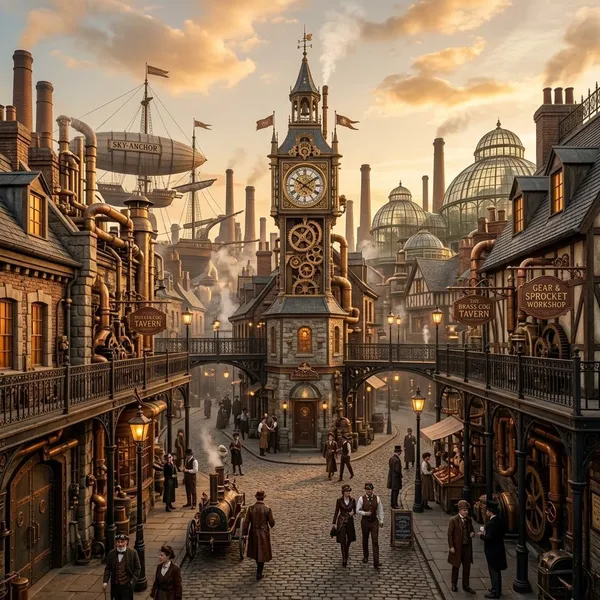
How to design a steampunk village
Designing the village is easier if you work from necessity to detail. Start with landscape, power, movement, buildings, and jobs. Add decoration only after those choices make sense.
Choose the landscape and climate
Pick the environment before choosing the buildings. Mountains push the village upward with lifts and bridges. Coasts need docks, drainage, fog signals, and weatherproof storage. Cold regions make heat and fuel central. Marshes or wet forests demand raised paths and rot-resistant construction.
Climate should affect daily behavior too. In a winter village, people may gather near boiler houses and enclosed markets. In a hot, dusty railway stop, shade, water storage, and engine cooling may matter more than heavy heating pipes.
Define the main source of power
Choose what actually powers the settlement: coal, wood, peat, geothermal heat, imported fuel, or a mixed system. Then decide who controls it and what happens when supply runs low.
- Fuel-rich village: more lifts, heated buildings, powered workshops, and public machinery.
- Fuel-poor village: steam reserved for pumps, transport, mills, or emergencies.
- Remote village: more repair culture, salvage, rationing, and local substitutes.
Plan the streets and public spaces
Streets should follow work. Heavy carts need access to markets, repair shops, depots, docks, or rail yards. Homes should be close enough to heat and water, but not pressed against dangerous machinery.
Public spaces need a job as well as a look. A station forecourt handles arrivals, a market lane handles trade, a workshop yard handles demonstrations and repairs, and a square gives people somewhere to gather when announcements or accidents happen.
Give each building a clear purpose
Every building should answer a practical need. A repair shop fixes machines. A guild hall manages rules. A boarding house shelters travelers. A pump station moves water. A warehouse protects fuel, food, tools, or cargo.
Create local jobs and social groups
Jobs turn the village from a map into a community. Boiler tenders, haulers, clerks, farmers, innkeepers, riggers, machinists, merchants, apprentices, and inventors all depend on one another in different ways.
- Choose the main purpose. Mining, farming, transport, repair, trade, or invention should lead the design.
- Place the power system. Add fuel storage, boiler rooms, pipes, pumps, or vents where they would actually be used.
- Map movement. Decide how people, carts, cargo, animals, rail lines, or airships move through the settlement.
- Add essential buildings. Cover invention, repair, trade, transport, authority, food, and lodging before adding extras.
- Give the village problems. Shortages, repairs, weather, unsafe experiments, and social disputes make the setting easier to believe.
Conclusion
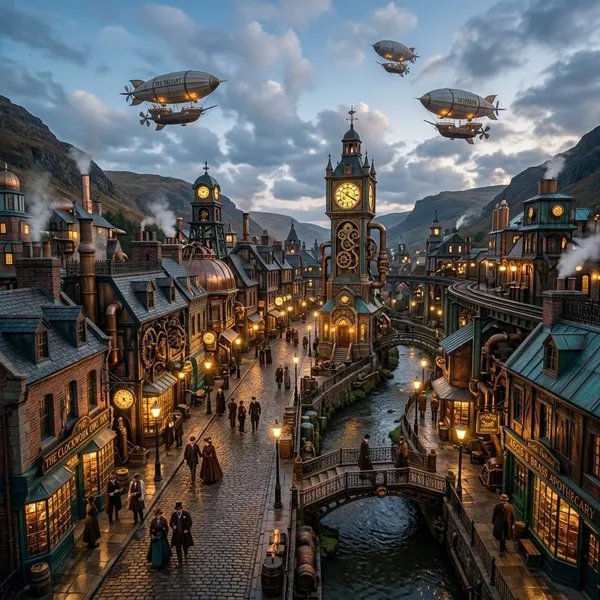
A convincing steampunk village is not built by adding gears to ordinary houses; it is built by deciding how people live with machinery every day. If the power source, jobs, buildings, and public spaces all support the same purpose, the setting will feel distinctive, practical, and much easier to use for stories, games, art, or worldbuilding.
FAQ
Does a steampunk village have to be Victorian?
No. Victorian design is common, but frontier, maritime, rural, or industrial influences can work just as well if the technology and materials stay consistent.
How do you make a village look steampunk?
Use aged wood, iron, brass, copper, visible pipes, vents, gauges, repair yards, and period-inspired buildings. The important part is making those features look useful, not pasted on.
What is the difference between a steampunk village and town?
A village is smaller, more close-knit, and usually built around one or two main trades or machines. A town has more districts, institutions, population, and commercial variety.
Does a steampunk village have to be Victorian?
No. Victorian design is common, but frontier, maritime, rural, or industrial influences can work just as well if the technology and materials stay consistent.
How do you make a village look steampunk?
Use aged wood, iron, brass, copper, visible pipes, vents, gauges, repair yards, and period-inspired buildings. The important part is making those features look useful, not pasted on.
What is the difference between a steampunk village and town?
A village is smaller, more close-knit, and usually built around one or two main trades or machines. A town has more districts, institutions, population, and commercial variety.