
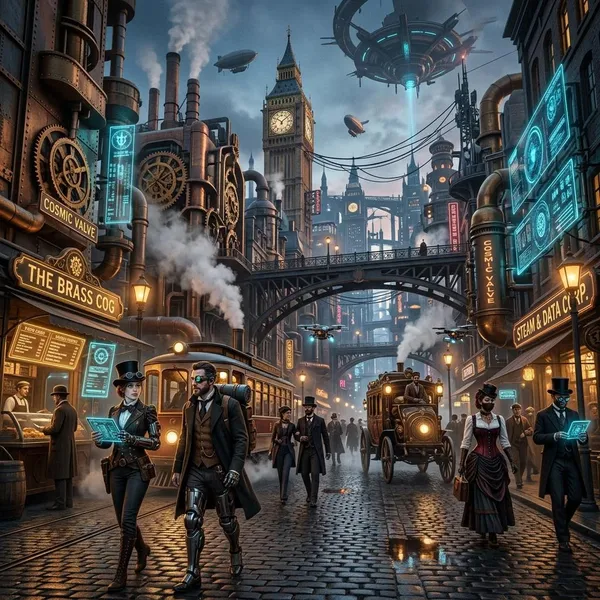
Steampunk futurism means imagining advanced futures through steam-age technology, industrial materials, and old-world social tensions. The style works best when brass machines, airships, clockwork, and smoky cities are not just decoration but signs of how people travel, work, rebel, and live.
What defines the steampunk futurism aesthetic?
The easiest way to recognize steampunk futurism is to look for three things working together: visible machinery, steam-era materials, and a society shaped by invention. A pair of goggles or a few loose gears is not enough on its own. The setting feels convincing when the technology has weight, heat, maintenance needs, and social consequences.
Brass, copper, iron, and dark wood
Material choice gives the aesthetic its first signal. Brass and copper bring warmth and shine, iron adds weight and grit, and dark wood makes labs, ship cabins, libraries, and workshops feel handcrafted rather than digital. Leather, glass, rivets, and worn fabric often support the same mood.
Gears, boilers, pipes, and clockwork
A strong steampunk machine looks as if it could move, hiss, overheat, jam, or need repair. Gears, boilers, valves, pressure gauges, belts, pistons, and clockwork parts make technology feel visible and understandable, even when the invention is fictional.
- Boilers imply fuel, heat, pressure, and risk.
- Pipes suggest networks running through buildings or cities.
- Clockwork adds precision, timing, and delicate control.
- Gauges and valves give characters something to check, adjust, or fear.
Airships, automata, and mechanical cities
Big inventions give steampunk futurism its sense of wonder. Airships turn travel into spectacle, automata raise questions about labor and personhood, and mechanical cities make the whole environment feel engineered.
How steampunk futurism fits retro-futurism
Steampunk futurism is a branch of retro-futurism because it imagines tomorrow from an older point of view. Instead of asking what the future looks like through software, satellites, and artificial intelligence, it asks what people might have imagined if steam power, mechanical engineering, and industrial expansion kept driving progress.
Both imagine futures from an earlier viewpoint
Retro-futurism looks at the future through yesterday's expectations. Steampunk does this through the 19th century and the broader steam age, so its futures are filled with railways, dirigibles, mechanical calculation, pressure systems, and industrial cities.
The viewpoint matters because it changes the fears as much as the inventions. A steam-age future often worries about factory labor, empire, class unrest, dangerous machinery, and urban crowding. Those concerns make the setting feel different from a cyberpunk world built around data, corporations, and digital surveillance.
Both combine nostalgia with invention
The nostalgic part of steampunk futurism usually comes from texture: tailored clothes, ornate interiors, brass instruments, gas lamps, old maps, and handcrafted machines. The futuristic part comes from pushing those references further than history allowed.
Steampunk uses steam-era ideas
Steam-era thinking is the boundary that keeps the style coherent. Power usually comes from boilers, pressure, combustion, gears, metallurgy, and mechanical timing. Even advanced devices should feel as if they grew from that logic.
That helps separate steampunk from nearby retro-futurist styles. Dieselpunk leans into early 20th-century engines and war machinery, atompunk draws from mid-century atomic optimism, and cyberpunk depends on networks, software, and digital control. Steampunk futurism stays closest to visible engineering and industrial-age imagination.
Common themes in steampunk futurism
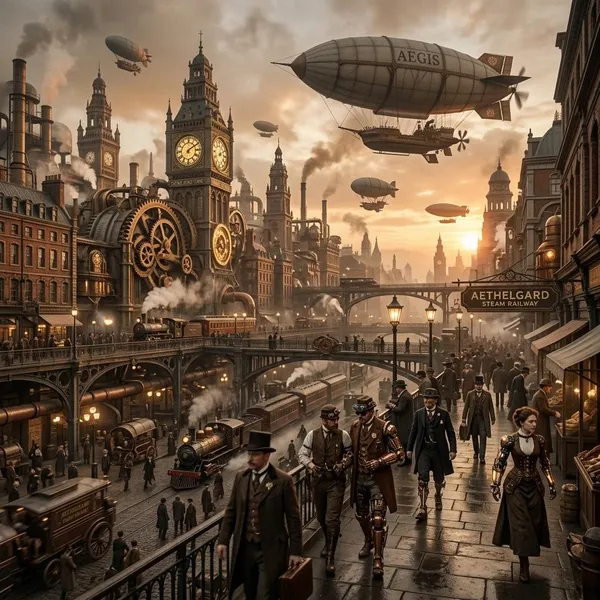
The style becomes more interesting when the machines create pressure, not just atmosphere. Many steampunk worlds ask the same practical question: if invention advances quickly, who controls it, who is left behind, and what risks become normal?
That is why the genre often works well for adventure, mystery, rebellion, political fiction, and alternate history. Its visual appeal draws people in, but its strongest stories usually have conflict built into the machinery.
Invention changing society
A new machine should change more than the plot. A steam elevator can reshape housing. Mechanical calculation can alter banking, navigation, or military planning. A cheap prosthetic technology can change medicine, work, clothing, and public access.
For writers, the best first check is simple: name one everyday routine that changes because of the invention. If nothing changes outside the inventor's workshop, the technology is probably still a prop.
Rebellion against powerful institutions
Steampunk settings often place the largest machines in the hands of empires, monopolies, academies, military states, or secret societies. Rebellion follows naturally because control over transport, energy, factories, and information becomes control over daily life.
The rebellion does not always need to be a grand uprising. A mechanic hiding a forbidden design, a pilot stealing an airship, or a worker sabotaging an unsafe engine can all carry the same theme at a more personal scale.
Class conflict in industrial cities
Industrial cities make inequality visible. The wealthy may live near clean sky docks, private laboratories, and polished transit halls, while workers live beside smoke, heat, crowded housing, and dangerous machinery.
This is one of the most useful settings for steampunk futurism because architecture, transport, and class can all speak at once. An elevated rail line might save the rich hours of travel while casting soot and noise over the streets below. That single detail does more than a long explanation of inequality.
Wonder mixed with technological risk
Steampunk invention should feel exciting, but rarely harmless. Airships can crash, boilers can rupture, automata can malfunction, and experimental engines can demand ethical compromises.
Empire viewed through alternate history
Because the steam age overlaps with colonial expansion and industrial empire, steampunk futurism often has to decide how it handles power. A weak version uses empire as decorative uniforms and maps. A stronger version asks who is being extracted from, who gets named as the inventor, and whose technology is ignored or stolen.
Where steampunk futurism appears today
Steampunk futurism appears in media and design because it is easy to recognize but flexible enough to adapt. Some works use the full worldbuilding package: alternate history, steam technology, class conflict, and industrial cities. Others borrow only selected elements, such as airships, clockwork limbs, or brass laboratory interiors.
Novels and short fiction
Books are often where steampunk futurism has the most room to breathe. Prose can explain how a city is powered, how a machine changes class relations, or why an inventor's breakthrough frightens the government.
Short fiction is especially good for focused ideas: one impossible engine, one airship route, one labor strike, one automaton with a legal problem. Novels can build a broader society around the same premise, which suits readers who want deeper worldbuilding rather than only visual style.
Films and animated worlds
Film and animation make the aesthetic instantly visible. Moving gears, steam vents, giant engines, layered skylines, and flying machines create atmosphere before a character says anything.
Animation can push the style even further because it is not limited by practical sets. Floating cities, walking fortresses, impossible laboratories, and oversized mechanical creatures can still feel coherent if their motion and design follow a shared logic.
Comics and graphic novels
Comics suit steampunk futurism because every panel can carry visual worldbuilding. A glove, a streetlamp, a skyline, or a workshop wall can show class, technology, and mood in one image.
Graphic novels also make contrasts easy to read. A polished upper city and a soot-stained factory district can appear side by side, letting the reader understand the social structure without a long explanation.
Video and tabletop games
Games make steampunk more practical because players have to move through the world. Fuel, repairs, routes, upgrades, factions, workshops, and risky machines can become systems instead of background details.
- Video games work well when exploration, crafting, combat, or transport depends on the machinery.
- Tabletop games are useful when players want to invent crews, guilds, rival engineers, airship routes, or black-market devices.
Fashion, art, and interior design
Fashion and interiors often use steampunk futurism in a more selective way. Goggles, waistcoats, corsets, boots, pocket watches, military coats, pipe lamps, reclaimed wood, leather furniture, and antique maps can all suggest the style without requiring a full fictional world.
How to use steampunk futurism in a story or design
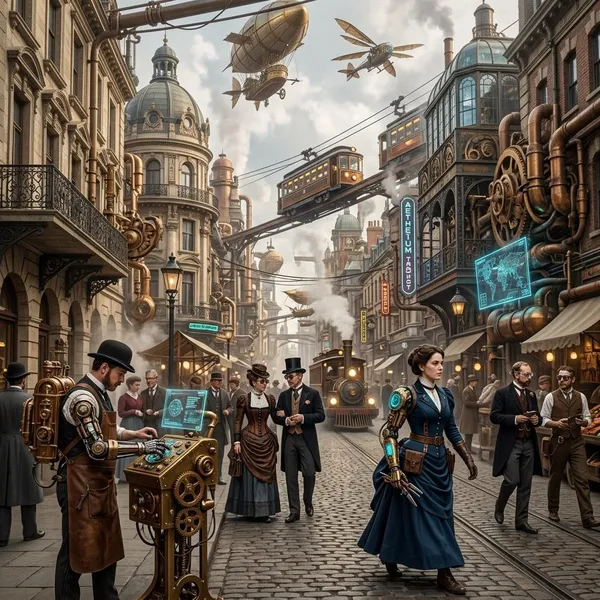
Start with function before ornament. The strongest steampunk futurism has a clear source of power, visible limits, daily-life effects, and social conflict. Once those pieces are in place, the brass, wood, gauges, and airships feel earned rather than pasted on.
Choose a clear technological foundation
Decide what powers the world first. It may be coal-fired steam, geothermal pressure, compressed air, alchemical fuel, or another invented source that still behaves like steam-era technology.
Set rules for machines and power
Rules make the inventions more believable. Ask what a machine can do, what it cannot do, how it fails, who can repair it, and what it costs to run.
- For travel: decide range, fuel needs, weather limits, and repair points.
- For prosthetics: decide strength, comfort, maintenance, and social access.
- For automata: decide whether they follow commands, learn, break down, or claim rights.
Connect inventions to daily life
Everyday details make a steampunk world feel lived in. Think beyond the spectacular machine and ask how people cook, heat rooms, send messages, commute, work, receive medical care, and deal with breakdowns.
Build a consistent visual language
Choose a visual pattern and repeat it with purpose. A refined imperial setting might use polished brass, cream canvas, engraved plates, and symmetrical clockwork. A worker-led city might favor black iron, patched leather, exposed pipes, modular parts, and easy repairs.
Consistency prevents clutter. Steampunk has a lot of detail, but not every object needs a gear. Repeated materials, shapes, colors, and signs make the world easier to read.
Add social consequences and conflict
Inventions should change who has power. Faster transport can expand trade or invasion. Mechanical servants can affect labor. Private airship docks can separate the wealthy from everyone else. State-controlled pressure networks can become tools of surveillance or punishment.
If you are unsure where the conflict is, follow the machine. Who owns it? Who maintains it? Who is harmed when it fails? Who is forbidden to use it? Those questions usually reveal the story.
Use details that serve the world
Small details work best when they carry function, mood, or character. A soot mark on a cuff can show where someone works. A cracked pressure gauge can create tension. A polished pocket watch can signal status, grief, or obligation.
- Start with use: decide what the object does before decorating it.
- Match the maker: academy tools, dockside repairs, and military gear should not look identical.
- Add wear carefully: dents, heat marks, and patched leather imply real use.
- Remove empty decoration: random gears weaken the design instead of strengthening it.
Conclusion
Steampunk futurism is strongest when its machines have a reason to exist and its beauty comes with consequences. If the power source, limits, daily routines, and social conflicts all point in the same direction, the result feels imaginative rather than decorative.
FAQ
Is steampunk futurism science fiction or fantasy?
It can be either. It leans science fiction when machines follow speculative engineering, and it leans fantasy when impossible fuels, occult systems, or magic drive the technology.
Can steampunk futurism use modern technology?
Yes, if it is reimagined through a steam-era lens. A communication network, prosthetic limb, or data system can fit if it feels mechanical, analog, and consistent with the world's power rules.
Does steampunk futurism have to be set in Europe?
No. Non-European and fully invented settings can work very well, especially when local history, materials, trade routes, and power structures shape the machines instead of copying a London-based template.
Is steampunk futurism science fiction or fantasy?
It can be either. It leans science fiction when machines follow speculative engineering, and it leans fantasy when impossible fuels, occult systems, or magic drive the technology.
Can steampunk futurism use modern technology?
Yes, if it is reimagined through a steam-era lens. A communication network, prosthetic limb, or data system can fit if it feels mechanical, analog, and consistent with the world's power rules.
Does steampunk futurism have to be set in Europe?
No. Non-European and fully invented settings can work very well, especially when local history, materials, trade routes, and power structures shape the machines instead of copying a London-based template.