
If you want a steampunk gears tattoo, start with the main idea before you start adding cogs everywhere. The best designs usually have one clear symbol, enough space for the mechanical detail to stay readable, and a placement that matches the shape of the artwork. Small gears can work, but dense clockwork needs room, contrast, and an artist who knows how to make machinery look connected rather than decorative.
Best steampunk gear tattoo ideas
Steampunk tattoo ideas work best when the gears seem to do something. A pocket watch can drive the clockwork, a heart can expose inner machinery, and a compass can feel like a navigation device rather than a random circle with cogs around it.
Mechanical heart with exposed gears
A mechanical heart is one of the strongest choices if you want the tattoo to feel emotional rather than purely decorative. It can suggest resilience, healing, guarded feelings, or the idea that someone keeps going even after being damaged.
This design needs enough room for the heart shape to stay clear. On the chest or upper arm, your artist can separate the valves, plates, gears, and shadows so the piece still reads from a normal distance. If you want it small, keep the heart bold and use only a few larger gears instead of many tiny parts.
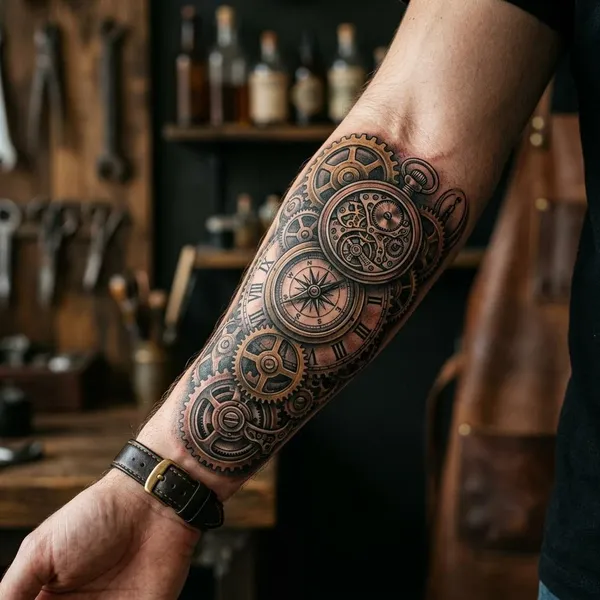
Clockwork forearm panel
A forearm panel suits people who want visible machinery with a long, engineered layout. Gears, screws, plates, watch hands, and narrow springs can follow the natural line of the arm, which makes the tattoo feel built into the body.
- Best for: medium detail, daily visibility, future sleeve expansion.
- Watch out for: too many tiny gears packed into the wrist end of the design.
- Good check: the main shapes should still be readable when you view the stencil from a few steps away.
Pocket watch and gears
A pocket watch adds a clear meaning to the mechanical style: time, memory, patience, mortality, or a specific turning point. If you want a personal detail, setting the hands to a meaningful time can work well, as long as the face stays simple enough to age cleanly.
This idea can be elegant or worn-down. A polished Victorian watch feels more refined, while cracked glass, exposed cogs, and a broken chain make the design feel rougher and more industrial.
Compass with moving parts
A compass with gears is a good fit if the tattoo is about direction, travel, curiosity, or rebuilding your path. The important part is keeping the compass rose strong; if the center becomes too busy, the whole design can lose its purpose.
Victorian key and machinery
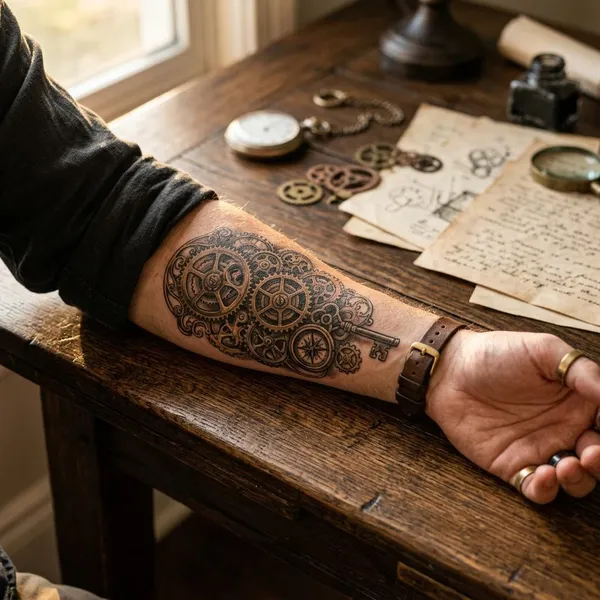
A Victorian key works well when you want the tattoo to feel symbolic but not too heavy. Keys can suggest trust, privacy, access, secrets, or unlocking a different part of your life.
Airship with clockwork details
An airship gives the tattoo more of a story. It suits people who like adventure, invention, fantasy, or old-world travel imagery, especially when the design includes propellers, rivets, gauges, and clockwork panels.
This is usually not the best choice for a tiny tattoo. The balloon, hull, and mechanical details all need space, so the upper arm, thigh, or back will usually give a cleaner result than the wrist or ankle.
Torn-skin mechanical illusion
A torn-skin illusion is the boldest option because it tries to make the body look partly mechanical. It can be dramatic on the arm, shoulder, or chest, but it depends heavily on shading, depth, and believable structure.
Look for healed examples before choosing an artist for this style. Fresh photos can look impressive, but healed work shows whether the torn edges, shadows, and inner machinery stay clear after the tattoo settles.
Best placements for steampunk gear tattoos
Placement decides how much detail you can safely include. A detailed gear tattoo needs space between parts, clear contrast, and a shape that works with the body area instead of fighting it.
Forearm for visible clockwork
The forearm is one of the safest placements for visible clockwork because it gives a long surface for panels, gears, watches, and mechanical strips. It is also easy to show, easy to look at yourself, and possible to expand into a half sleeve later.
If you work somewhere conservative, think about sleeve coverage before committing to the lower forearm. A design that stops higher on the arm may give you more control without losing the steampunk effect.
Upper arm for layered machinery
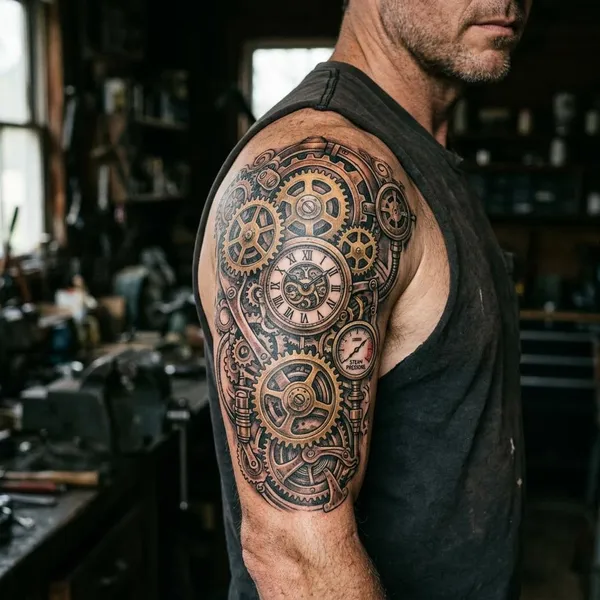
The upper arm gives more width than the forearm, which helps with layered machinery, larger gears, and central symbols like a key or pocket watch. It also gives your artist more room to leave negative space, which matters for long-term readability.
- Choose it for: medium to large designs with several mechanical layers.
- Skip heavy detail near: areas where the design will bend or compress too much.
- Plan ahead: leave room if you may want a sleeve later.
Shoulder for rounded compositions
The shoulder naturally suits circular designs. Gear clusters, compasses, watch faces, and rotating mechanical shapes can follow the curve of the muscle and look more integrated.
This placement is especially useful if you want a piece that can stay compact now but expand later toward the chest, upper arm, or back. Keep the central circle bold; small surrounding details should support the shape, not bury it.
Chest for mechanical heart designs
The chest is the most direct placement for a mechanical heart because the symbolism is immediate. It works well for designs connected to love, grief, recovery, survival, or emotional endurance.
This area can feel more personal than a forearm tattoo because it is usually not on display all day. If the design carries a private meaning, that can be a better fit than choosing a highly visible placement just because it shows more detail.
Back or thigh for large scenes
Back and thigh placements are best when the idea needs space: airships, mechanical cities, torn-skin scenes, large watches, or several connected objects. These areas let the artist separate the main focal point from the background so the tattoo does not turn into a dense patch of grey.
Choose the back for wide scenes with atmosphere and multiple elements. Choose the thigh for a strong vertical composition, such as a long key, descending airship, or pocket watch with hanging chains and exposed gears.
Wrist or ankle for simple gears
The wrist or ankle can work if you keep the design simple. A few clean gears, a small key, or a minimal watch detail will age better than a tiny version of a full mechanical scene.
This is the right placement for someone who wants a subtle symbol, not technical realism. If your artist suggests enlarging the design or removing small inner gears, that is usually practical advice rather than a lack of ambition.
Conclusion
A strong steampunk gear tattoo is not about adding as many cogs as possible; it is about making the machinery feel intentional. Pick one main symbol, give the details enough room to breathe, and choose a placement that fits both the design and your everyday life. If the tattoo still looks clear as a simple stencil, it has a much better chance of looking good once all the shading and texture are added.
FAQ
Can a steampunk gear tattoo be small?
Yes, but it should be simplified. Small designs work best with a few bold gears or one clean symbol rather than tiny mechanical parts that may blur over time.
Where should you place a detailed gear tattoo?
Choose a placement with enough surface area, such as the forearm, upper arm, shoulder, chest, thigh, or back. If the design includes realism, torn skin, or many layers, avoid very small areas.
Do steampunk tattoos look better in black and grey?
Black and grey is often the safest choice for detail and contrast. Muted bronze, copper, burgundy, or teal accents can work, but bright multicolor palettes can make the mechanical parts harder to read.
Can a steampunk gear tattoo be small?
Yes, but it should be simplified. Small designs work best with a few bold gears or one clean symbol rather than tiny mechanical parts that may blur over time.
Where should you place a detailed gear tattoo?
Choose a placement with enough surface area, such as the forearm, upper arm, shoulder, chest, thigh, or back. If the design includes realism, torn skin, or many layers, avoid very small areas.
Do steampunk tattoos look better in black and grey?
Black and grey is often the safest choice for detail and contrast. Muted bronze, copper, burgundy, or teal accents can work, but bright multicolor palettes can make the mechanical parts harder to read.