
A steampunk cabinet works best when it is treated as both storage and a statement piece. Choose the size and layout first, then judge the decorative details, because a cabinet with great brass hardware is still a bad buy if the doors cannot open properly or the shelves do not suit what you need to store.
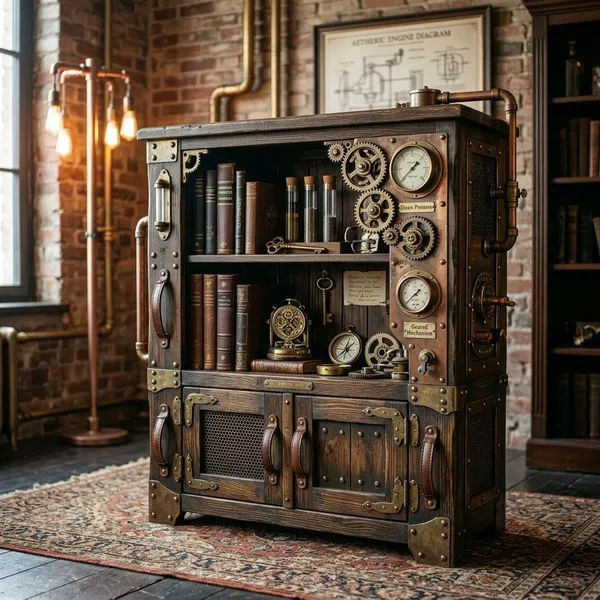
What makes a cabinet steampunk?
A cabinet starts to feel steampunk when it mixes old-world furniture shapes with industrial details. The best pieces do not rely on one gimmick, such as a few gears stuck on the front. They combine wood, metal, aged finishes, visible hardware, and a slightly mechanical mood in a way that still feels usable at home.
Victorian-inspired shapes
Victorian influence usually shows up in the silhouette: arched panels, turned legs, carved trim, raised doors, or a slightly formal shape. These details keep the cabinet from looking like plain workshop storage.
Wood and metal construction
Wood gives the cabinet warmth, while metal gives it the harder industrial edge. For everyday use, look for a body that feels stable, shelves that do not flex easily, and metal accents that are properly fixed rather than thin pieces added only for appearance.
- For books or dinnerware: prioritize strong shelves and a solid frame.
- For display pieces: lighter construction may be fine if the cabinet is not carrying much weight.
- For daily opening and closing: hinges and drawer runners matter as much as the outer finish.
Brass and copper finishes
Brass and copper are useful because they add warmth without making the cabinet look shiny and modern. Antique brass handles, copper-toned panels, or small metal label holders can make a simple cabinet feel more period-inspired.
Rivets, pipes, and exposed hardware
Rivets, pipe-style supports, visible hinges, latches, and bolts create the mechanical side of the look. A few well-placed details usually feel more convincing than a surface covered with decorative metal.
Aged and mechanical details
Distressed edges, darkened metal, old label plates, clock-like accents, and worn-looking finishes help the cabinet feel as if it has a history. A lightly aged finish is also practical in a busy home because small marks are less obvious than they would be on a glossy black or polished surface.
Popular steampunk cabinet styles
The right style depends less on the label and more on how you will use the cabinet. A display cabinet suits someone who enjoys arranging objects, while a closed storage cabinet is better for a living room that needs to hide cables, games, blankets, or paperwork.
Glass display cabinets
Glass display cabinets are best when the items inside are part of the look. They work well for old books, decanters, cameras, small sculptures, globes, or neatly arranged collections.
Living room storage cabinets
A living room cabinet should make the room calmer, not just more dramatic. Closed doors are useful for everyday clutter, while one open or glass section can keep the piece from looking too heavy.
- Small apartment: choose a slimmer cabinet with legs or glass to reduce visual weight.
- Family living room: choose solid doors for games, throws, remotes, and media items.
- Reading corner: shelves and drawers can hold books, notebooks, and smaller accessories.
Steampunk bar cabinets
A steampunk bar cabinet fits the style naturally because bottles, glassware, brass rails, and dark wood already suit a vintage lounge mood. Check the inside before choosing one: bottle height, glass storage, drawer space, and a usable serving surface matter more than decorative wheels or oversized handles.
Sideboards and accent cabinets
Sideboards are a good choice when you want the look without adding a tall, dominant piece. They work especially well in dining rooms because they provide hidden storage and leave a top surface for a lamp, tray, or framed art.
Accent cabinets are more flexible. A narrow one can work in an entryway for keys and gloves, while a wider one can anchor a hallway or home office. The key is to leave enough blank space around it so the detailing does not fight with other furniture.
Apothecary drawer cabinets
Apothecary drawer cabinets are the most distinctive option if you like a collected, workshop-like feel. The many small drawers are useful for stationery, craft supplies, jewelry, cables, tools, or entryway items, but they are not ideal for bulky storage.
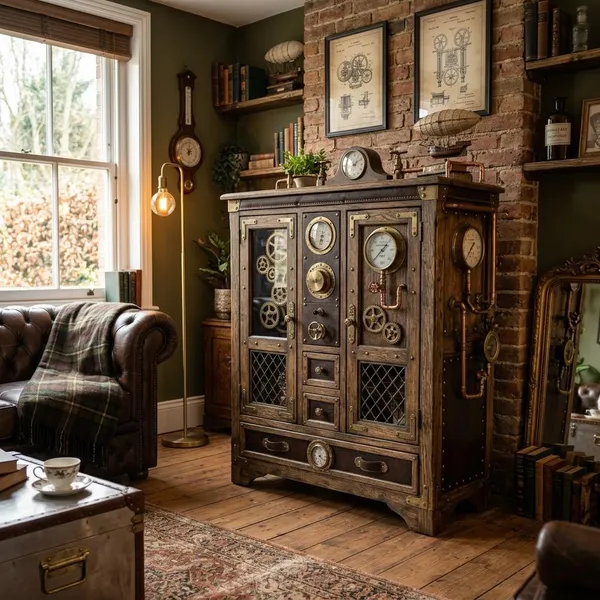
How to choose a steampunk cabinet
Start with the practical checks in this order: fit, storage layout, build quality, hardware, then finish. That order prevents the most common mistake, which is choosing the most dramatic piece first and only later discovering that it blocks a walkway or cannot hold what you bought it for.
Measure the available space
Measure the wall width, ceiling height, cabinet depth, and door clearance. Then check the walking path in front of it. A cabinet can fit on paper and still feel wrong if you have to step around it every time you cross the room.
Depth is often the hidden problem. In a hallway or compact living room, a shallower cabinet may be more useful than a wider one because it keeps the space comfortable.
Choose the right storage layout
Match the layout to what you actually own before thinking about styling. Shelves suit books, bottles, dishes, and baskets. Drawers suit small items. Glass doors suit display. Solid doors suit anything you do not want to see every day.
| If you need to store... | Look for... |
| Books, dishes, or bottles | Adjustable or strong fixed shelves |
| Keys, tools, craft items, or cables | Drawers or apothecary-style compartments |
| Decorative collections | Glass doors and simple interior shelving |
| Mixed household clutter | A combination of shelves, drawers, and closed doors |
Check the materials and build quality
For a cabinet you plan to use daily, build quality should outrank decorative detail. Look for a stable frame, smooth joins, shelves that feel strong enough for the intended load, and doors that line up evenly.
If you are buying online, zoom in on corners, hinges, drawer runners, and shelf thickness. Product photos often highlight the finish, but the less glamorous details usually tell you whether the cabinet will still feel good after months of use.
Inspect the doors and hardware
Open and close everything if you can. Hinges should move smoothly, handles should feel firm, drawers should not scrape, and latches should close without needing force.
Match the finish to your room
Choose a finish that supports the room you already have. Dark wood, blackened metal, and antique brass create a stronger, moodier effect. Lighter distressed wood with copper or aged brass feels easier in a modern or smaller space.
- Already have dark furniture? Add contrast with lighter walls, glass, or warm lighting.
- Mostly modern room? Let the cabinet be the one detailed piece and keep nearby furniture simple.
- Traditional room? Choose Victorian shapes and warmer metals instead of heavy pipe details.
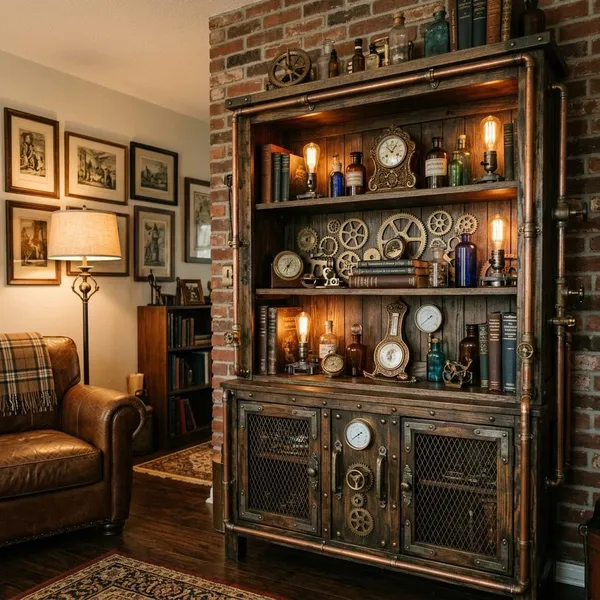
How to style a steampunk cabinet
Styling should make the cabinet look intentional, not overloaded. Because steampunk details are already strong, the safest approach is a calm backdrop, warm lighting, and a small number of objects that look chosen rather than collected by accident.
Use a simple neutral backdrop
Warm white, taupe, soft gray, charcoal, and muted beige all give the cabinet room to stand out. Busy wallpaper or bright wall colors can work, but they make styling harder because the cabinet already has texture, metal, and shadow.
Pair it with leather and dark wood
Leather and dark wood help the cabinet feel settled in the room. A leather chair, a dark side table, or a wood-framed mirror can repeat the mood without making the space look like a theme set.
Add warm industrial lighting
Warm lighting is one of the easiest upgrades. A metal floor lamp, wall sconce, banker's lamp, or soft bulb near the cabinet brings out brass, copper, and aged wood better than cool white light.
If the cabinet sits in a dim corner, lighting is not optional. Dark furniture can look bulky without it, especially in the evening.
Display a few vintage objects
Choose a small number of objects with different heights and textures: old books, a globe, a brass box, a clock, a magnifier, or dark glass bottles. Leave empty space between them so the cabinet itself remains visible.
- Good display rule: one tall item, one flat stack, and one small object often looks balanced.
- What to avoid: filling every shelf with small pieces of the same size.
- For glass doors: keep the inside neater than you would with closed storage.
Keep nearby decor minimal
A steampunk cabinet usually needs breathing room. If the wall around it is crowded with art, plants, patterned textiles, and extra furniture, the details stop feeling special and start feeling noisy.
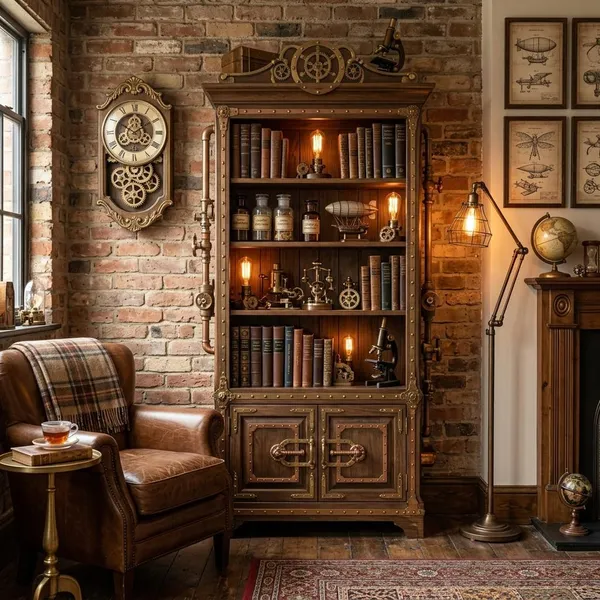
Conclusion
The best steampunk cabinet is not necessarily the one with the most pipes, rivets, or gears. It is the one that fits your room, stores the right things, feels solid in daily use, and has enough vintage-industrial detail to look deliberate without taking over the whole space.
FAQ
Which materials work best for a steampunk cabinet?
Wood and metal are the strongest combination. Solid wood or good-quality veneer gives warmth, while iron, steel, brass, or copper adds the industrial character.
Can a steampunk cabinet suit a modern home?
Yes, but it works best as a single statement piece. Keep the surrounding furniture cleaner and simpler so the contrast feels intentional instead of mismatched.
Where should you place a steampunk cabinet?
Place it where it has both visibility and clearance. Living rooms, dining rooms, studies, entryways, and dens all work, as long as the cabinet does not block movement or door swing.
Which materials work best for a steampunk cabinet?
Wood and metal are the strongest combination. Solid wood or good-quality veneer gives warmth, while iron, steel, brass, or copper adds the industrial character.
Can a steampunk cabinet suit a modern home?
Yes, but it works best as a single statement piece. Keep the surrounding furniture cleaner and simpler so the contrast feels intentional instead of mismatched.
Where should you place a steampunk cabinet?
Place it where it has both visibility and clearance. Living rooms, dining rooms, studies, entryways, and dens all work, as long as the cabinet does not block movement or door swing.